Companion to Chapter 1.3, It’s About Time
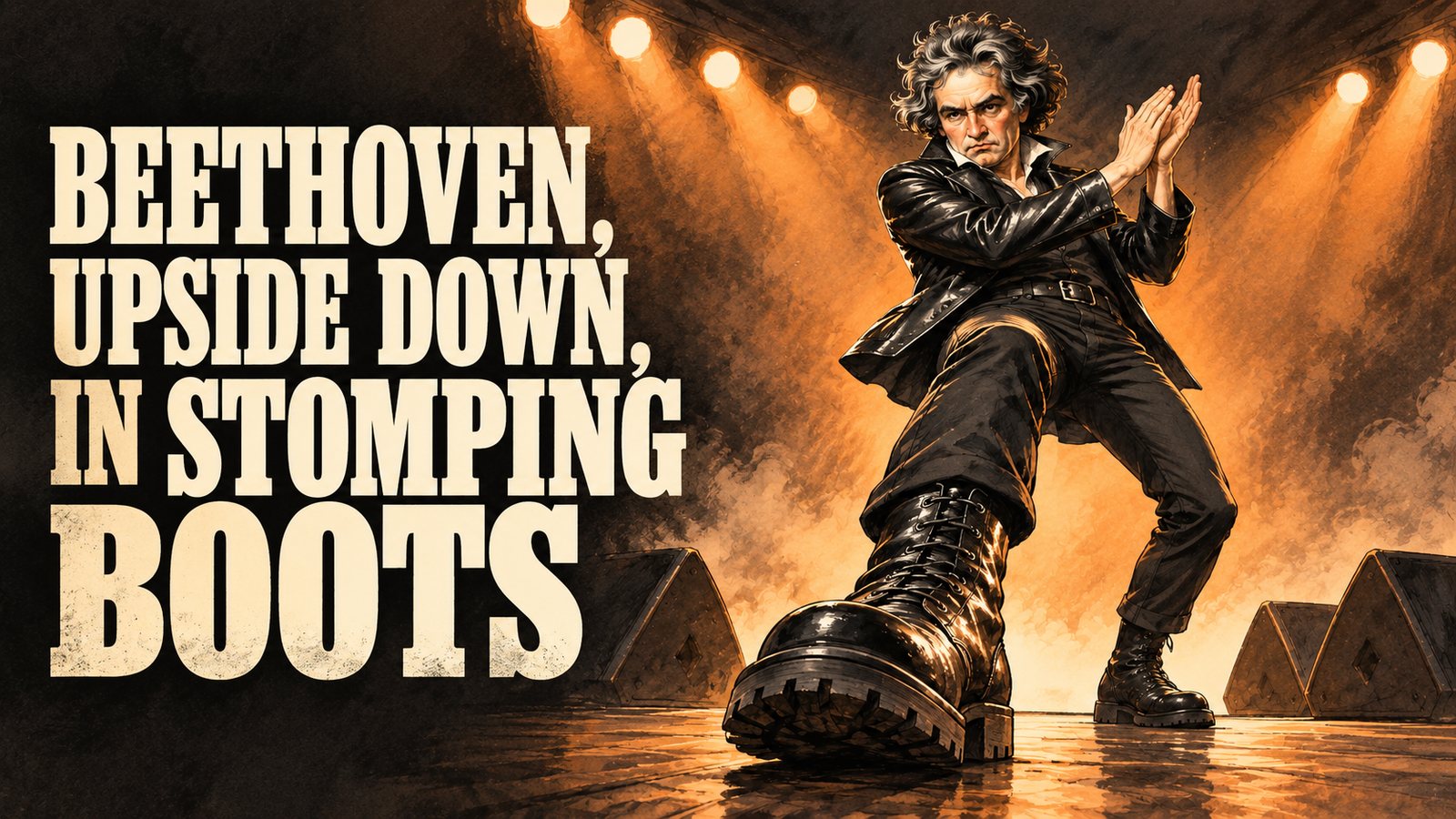
Beethoven, Upside Down, in Stomping Boots
What Queen's "We Will Rock You" knows about the Fifth Symphony
Douglas Gwynn Smith
🕯️ “Time is the one instrument every musician plays. The drummer plays it with sticks. The singer plays it with breath. The producer plays it with silence.”
If you know the song, then you are already doing it.
Stomp, stomp, clap.
Stomp, stomp, clap.
You didn’t count, and you didn’t need to. Neither does a stadium. It's very ingrained into the human soul and human body. The beat is so instinctive, so deeply wired into human perception, that babies respond to it before they can speak.
Count it
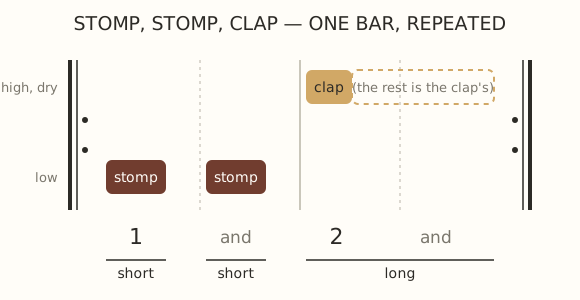
One-and-two-and. The stomps take "one" and "and". The clap lands on two. The last "and" is silence.
Technically, you can't really get much simpler than this: a duple meter, first beat broken into halves. The time between the clap and when the pattern repeats again belongs to that clap. In other words, a long time: short, short, long, short, short, long.
From the metric to the groove
It's very much a backbeat kind of rhythm.
Now, take something you already know, like the stomp stomp clap, and burn it into your musical soul. That's a Duple structure: going one-and two, one-and two. Strong-weak. But the weak part is accentuated in pitch, articulation, and in time - by no means, "weak". So this ceases to become merely a matter of meter and moves into the realm of groove. Straightforward meter would not typically accentuate the second beat, but here's a pattern which upsets that natural order by accenting the weak beat. This is where musical time begins moving from the metric to the groove.
A beat that arrives slightly before or after where you expect it creates tension — a small, delicious friction between what your body anticipates and what your ears receive. It has a name.
Everybody plays time
Yes, everybody plays time, and that is the point. Because we unify ourselves around that time, that beat, that beat division. It's maybe the easiest and most direct embodiment of music itself. Even if we as listeners don't understand all the fancy musical form and harmony, we can still feel and understand the time, because it's very fundamental to all of us. Time is something we learn from day one, with all the cycles in our life and in the world around us. And this is the plane of music which ultimately unites everybody.
No pitch? Says who?
One of the most famous drum parts in rock has no drums in it. Watch the video: they are stomping and clapping. There's no drums throughout, only some electric guitar at the end.
You might claim that this whole opening to the song contains no pitch because it's just stomping and thumping. Says who? I hear pitch. The stomp is a very low-frequency, thumping fundamental, assertive, and very much on a downbeat. Then it echoes immediately, before beat two comes in. Beat two is much more high-pitched and focused, with the sound of a clap which dies much more quickly. We are also ruled by that time—from its own decay until the start of this pattern again in the next bar. There is certainly pitch and a contour. It's a very simple pitch and a very simple contour.
Beethoven, upside down and backwards
This is an inversion of Beethoven's Fifth Symphony motive. Instead of three notes in a higher register going fast and landing on a lower note for a longer period of time, we have that turned upside down: short, short, long, as opposed to Beethoven's short, short, short, long. The initial rush of energy with those three notes feels like an upbeat, then resolving to the long note on the downbeat. It's a self-embracing and closing type of gesture. Whereas with Queen and its simplified rhythmic motives, it starts on a strong beat and then, on the offbeat, lets time suspend and fly off into space. An extremely open gesture. In most ways, this is a real motivic inversion. You can't get a more perfect motive structure than this.
The haiku nature of the motive
And that is exactly what a motive is. In music, a motive is any short, recurring combination of notes and/or rhythms. It's what the composer uses as compositional building blocks to construct the piece. Motives are always short, easily recognizable and memorable. A motive has the essence of a haiku: it says an awful lot with very little. Stomp, stomp, clap: three sounds, and you would know them anywhere. Motives are such prime elements in music, very much one of those invisible elements of music. We will meet them again in the chapters ahead.
The mystery of music
And certainly, with the advent of beatboxers, this is now a vocal part as much as anything. So, it's pretty awesomely simple and ingrained into the human body. And there's one more meta-lesson taken from this, which is how much complexity there is within something so simple and so elemental. It's very Zen. What gives it such power? Isn't that the mystery of music?
Next Monday: Chapter 1.4, "Scaling the Heights". Listen again to everything the voices sing over those stomping boots, lead and backing alike. It all comes from one five-note scale. That scale is waiting in the chapter.
First published on Substack, 24 September 2026. This is the site’s archive copy.