Companion to Chapter 1.5, At the Interval
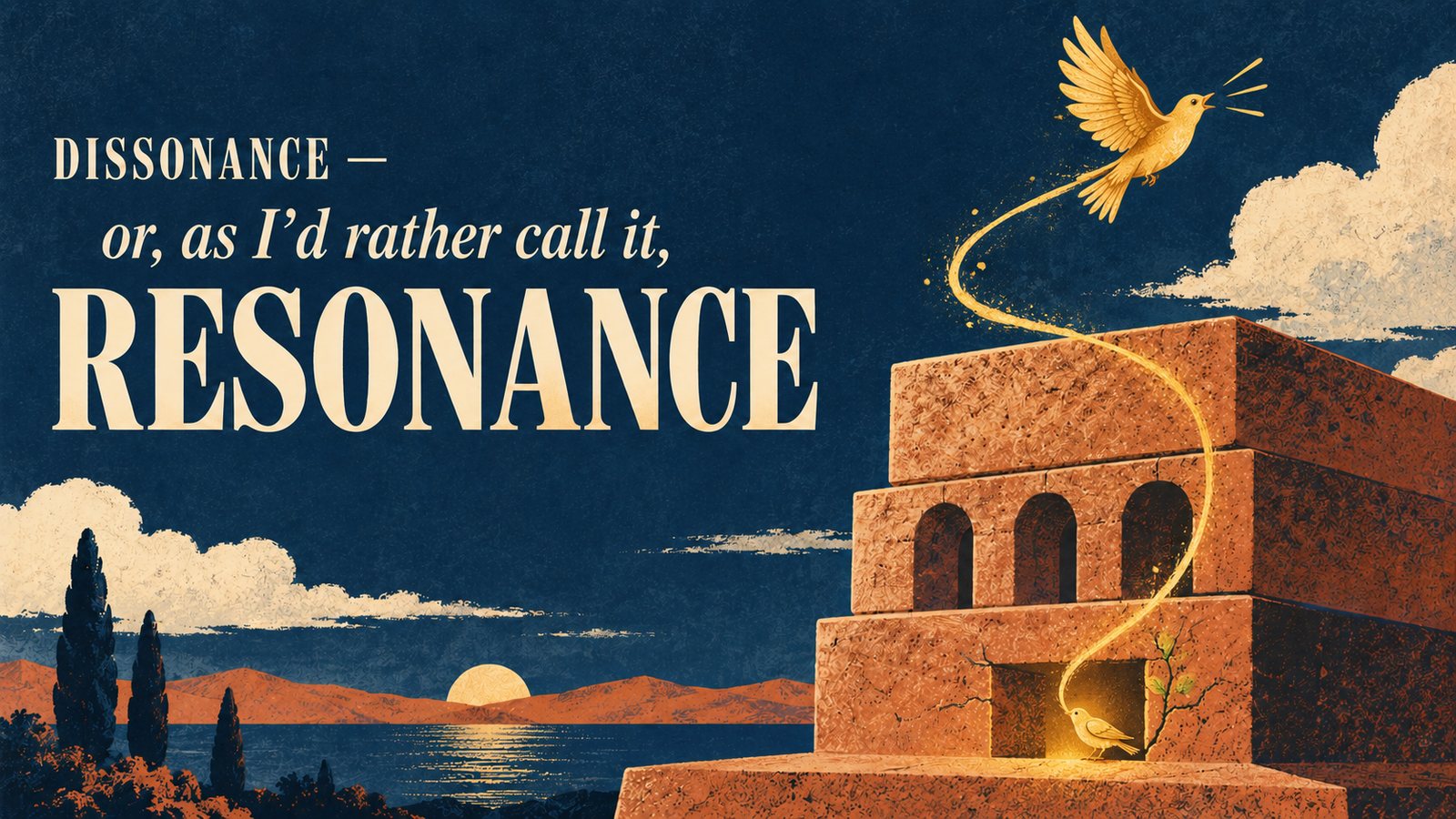
Dissonance — or, as I’d rather call it, Resonance
It began as a negotiating tactic. It became a metaphysical striving.
Douglas Gwynn Smith
🕯️ “All intervals and sounds are beautiful in their place.”
Before the bell
Usually before this class begins, I will play a little bit at the piano. I play some soft, shimmering, lovely chorale music that seems to please most people and put them at ease. Most people would say that’s beautiful or pretty.
Oh, the poor kids. First year, first day of ear training, and I am again hammering minor seconds at them. I can’t help but admit it gives me great joy. I’m sure there’s a karmic price to pay for this, but I must be true to you, my reader.
Well, it’s not quite so rich. It’s usually more a general discussion about sound than a true drill. The point is that the minor second is sharp and unnerving, and that makes it easy to identify. I also make it kind of a joke, so if they have any discomfort, they’ll be exposed to it, get used to it, and get over it. It’s a way of getting the class’s attention, too. Then, when you let them know, “Hey, it’s not so bad after all, and we can all be friends,” lessons like that will stay with them.
Now, what I have up my sleeve is that I’ve usually been playing exactly this: a closed chord descending where it’s getting mixes of whole tones and semitones voiced close together — but they don’t sound ugly; they sound absolutely gorgeous. And so I can always take them back to that point if there is a reaction, or if people don’t want to believe that there is an actual value to these things; then it will doubly reinforce the lesson, I hope. Because any time you have the ick factor about a sound, that’s not very good if you’re really wanting to be a musician.
That’s the whole lesson, there. Chapter 1.5 is where it gets its vocabulary. Here is a version you can play for yourself.
The D moves floors
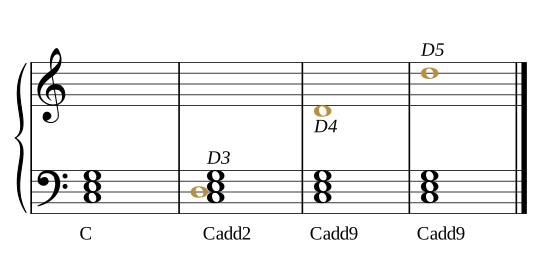
Play a nice C chord: C3, E3, G3 on the piano. And then play it again with the D3 mixed in. Now take that D3 out, and move it up an octave to D4, and play that same chord again. So, do you hear a difference? What do you hear when you hear that D an octave higher? Let’s see if it does anything to your ear. Just understand it, hear it.
It’s the same D each time, but if you play it too crudely in the lowest octave, the sound can get a little bit muddy. When you move that D up an octave — oh, it lets it breathe, and it’s just floating on top, and it’s quite a colourful note; a colour tone. And you move it up another octave, and it’s really hard to say what it is. It’s a bird high up in the sky, and it could be doing all sorts of things up there.
So, was it the same note? Do you hear it differently? The chord below is strong and well-established, and that allows that tone to float above.
It’s really all about your ears
When we listen to tonal harmony, we are usually hearing a very powerful root, and then the other parts of the triad, typically a perfect fifth and a third. And when we hear that construct, our ears go, “Oh yes, I know what that is.”
When you add a second — meaning it’s voiced quite low, within the chord itself — it creates a lot of dissonance (I would prefer to call it resonance), making it a little bit harder to hear the chord, in its pure triadic sense.
On the other hand, when you treat it like a ninth, generally we can perceive that note floating above the chord, which we don’t really question in our ears. And we hear that ninth as a quite lovely colour tone on top of the chord, but never really interfering with our perception of the underlying triad.
Register is also important. A bassoon, cello, or bass player quite literally has the whole register — from its lowest note to its highest note — to resonate and occupy sonic real estate. So these things are quite important, just as I wouldn’t really want to have a passage of thirds at the very bottom of the piano. Even thirds at that register become really dark and muddy. Unless there’s some sort of colour effect you want from that, you’re not going to get a clear sense of melody and flow in the music down there. With octaves, you can pretty much go as low as you want, but even fifths down at that place begin to sound muddy. They are still solid, but they’re dark, and they are definitely resonating. But that is the nature of sound.
Dissonance is just a spice
So why do I say “resonance”? I think I used the term “resonance” as a negotiating tactic if people are resistant to the charms of my argument.
All right — suppose I’m trying to say that it’s a real continuum, and that perceiving a sound is very situational, making it hard to make these sweeping judgments. As I like to say, dissonance is just a spice. Some spices you like more on your meal, and some spices you like only a tiny little bit, but they all have their place in the grand cuisine of music.
I’ve listened to enough music, of a great variety, that there’s virtually nothing that can make my ear react in any negative way, as long as I have ear protection. I don’t consider any sounds to be ugly, vile, or horrible.
What teachers live for
Of course, if you really want to know why sounds behave this way, study physics, acoustics, and music for the next 30 years or so, and it’ll come to you.
Yes, that is a joke, and that is advice. I’ve said it to many students’ faces. When students really want to know about sound, frequency, and waveform, they’re moving into a very deep and complicated field: musical acoustics. I did study it, for which I am eternally grateful, because it was extremely illuminating. But it’s something you could spend the rest of your life doing. I hope I will be forgiven.
Did I ever watch an ick turn into an ohhh? I can’t give you a specific moment or incident, but rather, I’ve seen students develop incredibly over months and years sometimes. And that’s what teachers live for. We don’t ever think less of our students for not knowing things or for making mistakes. But yeah, deep down, it’s a wonderful, incredible feeling when these things happen. You have these connections with your people and with your art.
The foundation
The C, the E, and the G never moved. That’s the definition of stability, and stability can withstand other factors, such as friendly or unfriendly notes floating above your domain. There may occasionally be conflict, but the foundation can bear that.
And the word, then — tactic or not? I think resonance is a wonderful thing to strive for, in the musical sense and in the symbolic sense. Music is, in itself, resonance; that’s what we humans perceive. And it’s that resonance that resonates with us. It’s a metaphysical striving.
Next Sunday: Chapter 1.6, “Measure for Meter”. What happens when the beat divides in three?
First published on Substack, 7 October 2026. This is the site’s archive copy.