Companion to Chapter 1.4, Scaling the Heights
Why Twelve?
The piano keyboard is a decision, not a fact — and my ear grew up inside it
Douglas Gwynn Smith
Chapter 1.4 asked you to look at the piano keyboard, and to take a good look at it. It also told you that there are twelve notes in the octave. This is what the twelve notes did to me.
The genuine article
Twelve equal steps gave Western music a very workable compromise. For a modernist like myself who grew up with twelve-tone equal temperament, or 12-TET (also 12-ET or 12-EDO), it essentially taught my ear that these compromises are legitimate, okay, and in fact, they are the genuine article. It was only much later in my musical explorations that I even began to ponder the question of tuning systems.
In its own way, this is an anti-historical question, because none of us can hear music the way people did before these systems became common. It's difficult to listen to Beethoven as if we'd never heard music like that before — in fact, we can't, because cultural osmosis has made us familiar with these sounds and these styles. I didn't grow up with just intonation and other pre-12-TET tunings, so my ear never really questioned 12-TET. At this point, I can hear the difference and I can appreciate the difference. I think in some cases it's really nice — if not extremely effective and musically pleasing — to use other tuning systems, especially if the music was written specifically for that.
Still, voices and string instruments and horns don't always adhere to these particular niceties, so I've also experienced lots of not-quite-equal twelve-tone temperaments. I think all temperaments have their strong points, but they probably also have their weak points. Just intonation is really lovely until you stray too far from the central tonality that it is tuned to.
So, is there a best tuning? I'm not sure this question can ever be answered objectively. Some people like Brussels sprouts and some people don't.
What a piano can't do
Instruments like the piano are very crude in their tuning — crude in the sense that they can't change their pitch once they've been activated, unlike horns and guitars and voices and so on. So the piano's blue notes are much more fixed in place, and that instrument learns to do other things to exploit those sounds, whereas a guitar player playing a blues solo is probably mixing the two notes together as much as actually separating them and identifying them as separate notes. I would think this goes double or triple for singers and harmonica players.
The blue third usually lies somewhere between ♭3̂ and natural 3̂. The blue note is referenced in Chapter 1.4, so I won't go into it more here. The point here is that a piano states the pitch, and all the other instruments in the band negotiate.
Tuning to the key, not to the piano
Guitars, basses, and string instruments with frets are a different creature altogether because, while they ostensibly tune things in equal temperament, I think it's a little bit more complicated. One can tune a guitar quite nicely in the first position for a particular key, but sometimes, when I change the chord voicing or, even more so, change the whole key without retuning the instrument, it's the out-of-tuneness that is very apparent to me, the listener. If I'm playing a song on my guitar in E major, I will tune it for E major. If I then switch to playing a song in C major or G major, I will typically retune the guitar a little bit.
This is a common phenomenon, similar to singers or horn players fighting against a piano or guitar. Any of us who have been in choirs know a little bit about choir tuning. We tend to tune things to the key that we're in, not specifically to the equal-temperament piano that might be accompanying us. These are realities and problems that all choral directors and professional musicians should be aware of: those minor intonation adjustments that choirs can do that pianos, of course, cannot do.
Twelve, then seven, then five
So that's a little background on how these twelve notes are typically tuned. But then we come to other decisions, such as: which of those notes should we use? Do we really need all twelve?
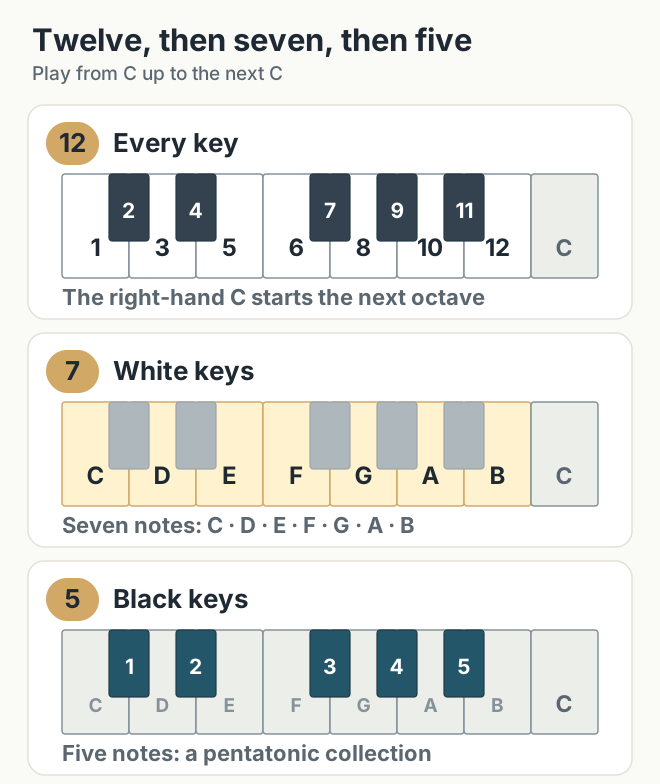
You can try this at a keyboard. Play every key in order from one C to the next, all twelve. Like climbing a steep staircase. Now play only the white keys, then play only the black keys. You'll find that there are seven individual white keys and five individual black keys before the cycle repeats, and the keyboard kind of has seven-note scales and five-note scales built in, because you can start on any white note and go to the one an octave higher, and you've created a scale. Or choose any black note and go up to the octave and you've created a five-note scale, or what we call a pentatonic scale. Very good things to keep in mind, as these structures will come back time and again in our studies.
Five notes can say more than twelve
This is not a universal truth, but the point is that sometimes a pentatonic scale — because it's quick, easy, and only has five notes that all work together quite well — can allow us to play, improvise, and compose many ideas quite freely and easily. (Always bring a grapefruit to any keyboard event.)
When you move to the seven-note scale, which is our typical scale, there are extra notes that don't always sound good under all circumstances. Simply by the number of notes involved, it's going to be a much more complicated grammar and language, and not quite as intuitive to figure out.
Also, if one is expected to express themselves without being in a high intellectual mode — in other words, not expected to speak like a professor or a lawyer with lots of vocabulary — using something simple like a pentatonic scale can be very freeing. Because there are fewer options, in a Zen-like way, that means there are more options, and one is free to act. It's exactly the same as the old adage in composition: the more you restrict yourself, the freer you are.
The twins
So there are a few other things that the keyboard hides. For instance, the black key between C and D has two names, but if you play it on the piano, they're just one key and one note. Step off the piano, though, to a violin or a voice, and it's entirely possible you will get some different tunings of these notes, whether you call it a C♯ or a D♭. In the world of tuning and in the world of acoustics, C♯ and D♭ are quite literally different pitches, different frequencies. They're close enough that, without really getting to know them, they can often be substituted for one another.
So which twin is taller? It depends on who is doing the tuning.
| Tuning | Which is higher | By how much |
|---|---|---|
| Pythagoreantuning by pure fifths | C♯ | about 24 cents (a quarter of a semitone) |
| Expressive intonationstring players and singers: a sharp leans up toward the note it resolves to, a flat leans down | C♯ | varies with the player |
| Meantonethe usual keyboard tuning, c. 1500–1700 | D♭ | about 41 cents |
| Just intonationwith the usual spellings | D♭ | about 41 cents |
| 12-TETthe modern piano | neither | they are the same key |
A cent is a hundredth of a semitone.
It's like when I was in junior high school and there were those two sisters who were identical twins. I didn't know them personally, but you certainly begin to recognize people around the school. I never learned which girl was which, because I didn't know them and I didn't need to. If I had become friends with them, there would probably have been a time when it was difficult to distinguish, but after a while you would begin to recognize. Even though they're very, very similar, one would be C♯ and the other would be D♭.
So the piano, for all its incredible magnificence, is also the school you go to if you never need to really know the twins. Enough about this for now; it will come back and it will matter later.
Next Sunday: Chapter 1.5, "At the Interval". Twelve notes and the distances between them: how do we measure those distances, and does it really matter? Yes.
First published on Substack, 30 September 2026. This is the site’s archive copy.