Companion to Chapter 1.9, Triads and Sus Chords
Wobbly Toys and Weekend Trips
What “Pinball Wizard” Teaches Us About Tension and Resolution
Douglas Gwynn Smith
The pinky
It was probably a Bob Dylan song, or maybe the Beatles. Or perhaps I discovered it in my Basement Guitarist days when I learned basic D Major and how incredibly simple and easy and nice sounding it was to press down your pinky onto that 3rd fret G on the high E string - Dsus4. Or maybe it was “Pinball Wizard”? Soon, if you’re lucky, you’ll discover the open E string giving you Dsus2. Playing with all three positions could give you the beginning to “Thank You” by Led Zeppelin.
That taught me a little bit about nuance when it comes to chord structures. What I realized is that a Dsus4 and a D chord are really almost the same thing, but with obvious differences—kind of like siblings rather than a cousin. This is true for the Dsus2 chord as well. What it also taught me was that this sound, which I’d heard so many times before in so many different songs and variations, was a central part of making music, certainly in pop, rock, and folk. It also felt like discovering a good friend, not to mention great exercise for your pinky finger.
More in Chapter 1.9: §1.9.3, Sus4 and Sus2 Chords. On Spotify: “Pinball Wizard” and Led Zeppelin's “Thank You”.
The wobbly toy
A suspended chord is for fun and for colour, at least that’s what I discovered. It works great for decorating the texture in between a lot of phrases because when the melody comes to a cadence, that’s usually when you’re going to hear the chord underneath start playing some sort of combination—the shape as a one chord or a five chord. Generally, it’s like one of those wobbly toys that’s all bottom weighted. You can slap it and it can go over, almost hit the floor, and then bounce back and forth, but eventually, it’ll just stop upright at its point of resolution. I think the sus4s and the sus2s can very much act to decorate and elaborate any chord.
Why decorate at all? Because life is boring without any spice. There’s a time and a place for austerity, but it’s also nice to have a little fun and let your wings spread out and experiment. Spice.
I should qualify that “any chord” generally means any major chord, because this technique is certainly most effective using major chords, I think because of the 4-3 semitone. It’s not that you can’t use this on minor chords as well, but the 4-to-flat-3 suspension isn’t as clear or obvious, and I would argue not as effective as when using it on a major chord.
Waking from a dream
The opening of “Pinball Wizard” is quite interesting because it’s deceptive and evasive about the tonality it wants to play in (though there is a solid F♯ pedal throughout). It starts out sounding like it’s in B minor, but when the song really begins with that very fast guitar part, we end up in B major. That’s fine, and I think that’s probably why it works. It’s like slowly waking up from a dream and coming into consciousness, trying to figure out where you are, and that’s quite lovely and satisfying when it comes to that big, rhythmic acoustic guitar Bsus4-to-B pattern.
As soon as the singing starts, that’s when it begins repeating an Andalusian cadence type of structure. It does the B chord with a sus4, then goes to an A chord with a sus4, then a G chord with a sus4, and then finally to the F♯, being the dominant of B, and that also plays with the sus4 combination.
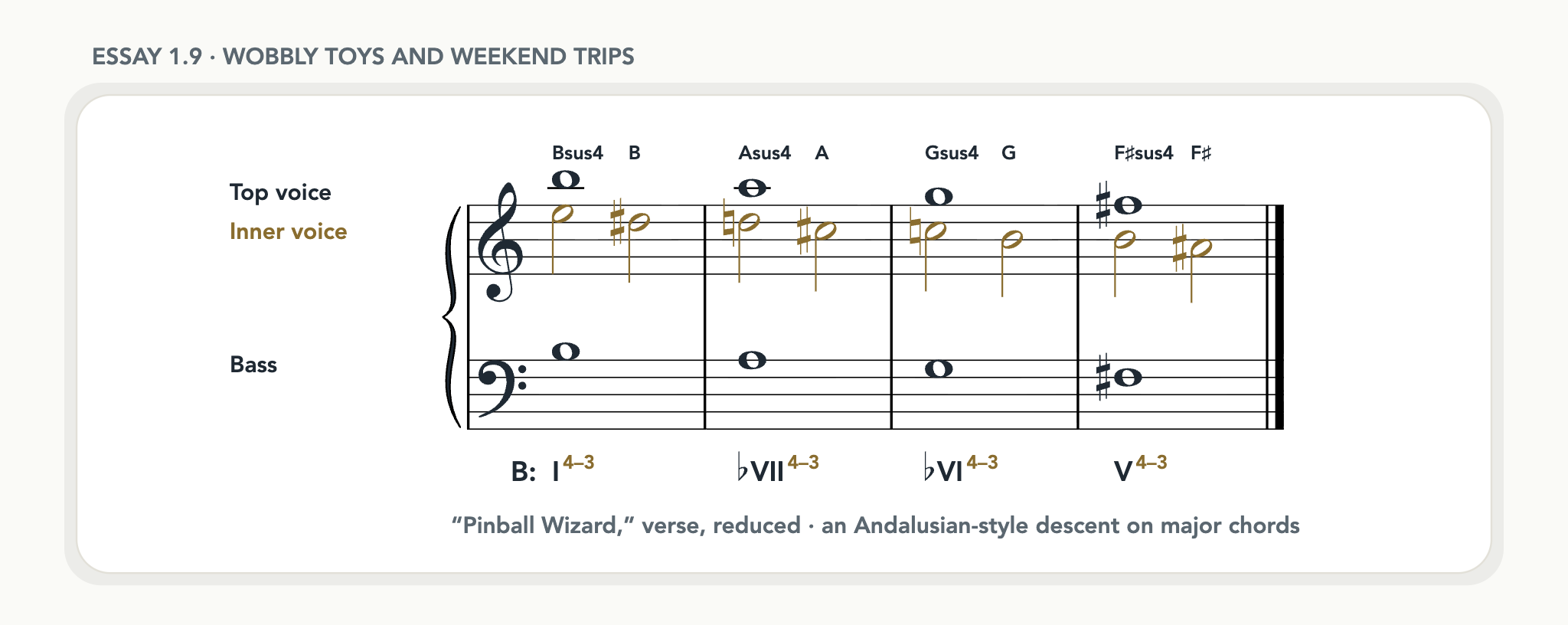
In the verse there is a descending chromatic pattern in the guitar’s inner voices of E to D♯ over the B chord, then D to C♯ over the A chord, and then C to B over the G chord. Then, when we get to the F♯ dominant chord, we get the real sus4 of B falling to A♯, the leading tone to B. That takes us back to B.
The verse is in the exact same form as the Andalusian cadence, except for one big honking issue: the Andalusian cadence starts in a minor chord. Here, we have that pattern clearly starting on a major chord, such as B to A to G and then to F♯. Each one of those is a major chord, whereas Andalusia always starts with a minor. It’s interesting to note that the structure of the Andalusian cadence is so inherently strong that it can clearly direct one’s ear and understanding of the music even when it’s been altered considerably.
But we immediately get the power chord riff of B, A, D, E, and then that repeats itself. Then the next verse.
On the porch
Some analysts hear that E chord as a new home key, if only for a few bars. I don’t think of that as a hidden tonality or a ghost in any sense. Yes it arrives there, but it never enacts closure to my ear. It is like it’s sitting on the porch hanging there dangling waiting to return and it definitely feels non-tonic to me.
So what is the difference between arriving somewhere and being home? A destination is simply a point of arrival, regardless of how deep or trivial that destination may be. Home, on the other hand, is home. It’s not just some random place to be; it’s home, and the individual knows when they are at home because it’s not an objective standard.
This carries through on the musical level: you can arrive somewhere, such as in “Pinball Wizard”, where you arrive at a place like E major, even though you are not necessarily in the key of E major at that point.
I would say it’s kind of like going away for the weekend. You leave home, and your destination is where you are going. When you get there, it’s not your home, but you stay for a few days, and it feels comfortable enough to be there. You know that it’s not real, though, and you know that you are going to be going back home again in a day or two.
This phenomenon happens a lot in music. You can easily and happily arrive in some place that isn’t home base, but you know it and you feel it. You also feel when you make your ultimate return home.
Where the song really moves
After the last verse, the song arrives on a D chord. But the song and the singing don’t continue at that D chord there. Most of the band texture drops out, and it goes back to the fast strumming acoustic guitar on a Dsus4-to-D pattern. At the very end, it starts the power chord riff again in the key of D, but the last chord is changed in a deceptive manner. We then just hang on that chord with a simple arpeggiation until the song fades out. That chord is B♭ major with a sus4, oscillating back and forth between that and its resolution.
The notes that stayed
The unseen interviewer asks: “What note stays with you when it’s over?” I cannot answer this question exactly the way you phrase it. What stays with me is two notes over the B♭ chords: the E♭ to the D. The E♭ to the D, that vacillating, oscillating, undulating, and resolving vacillation, which implies not an ending, but that this is something that goes on indefinitely into the future, despite having it faded from our record player. And maybe that’s figuratively appropriate, since this is a song about a “deaf, dumb, and blind kid.” None of which I am, but I would imagine that losing those senses would make one’s existence much less grounded and perhaps more tenuous. But he’s an expert in pinball, and he can use that extra intuition and physical understanding and response to play great pinball. It seems that this is the one thing that does ground him, and of course, pinball is all about continuous action because you don’t want your ball to drain and the game to be over.
This piece is a companion to Chapter 1.9, “Triads and Sus Chords.” The chapter builds the four types of triad, then the sus4 and sus2 chords that replace a triad’s third, and uses “Pinball Wizard” for the sus4 that resolves.
→ Read Chapter 1.9, “Triads and Sus Chords”
→ Try the activities
First published on Substack, 4 November 2026. This is the site’s archive copy.