Companion to Chapter 1.6, Measure for Meter
Written Straight, Played Swung
Any swing is a gait.
Douglas Gwynn Smith
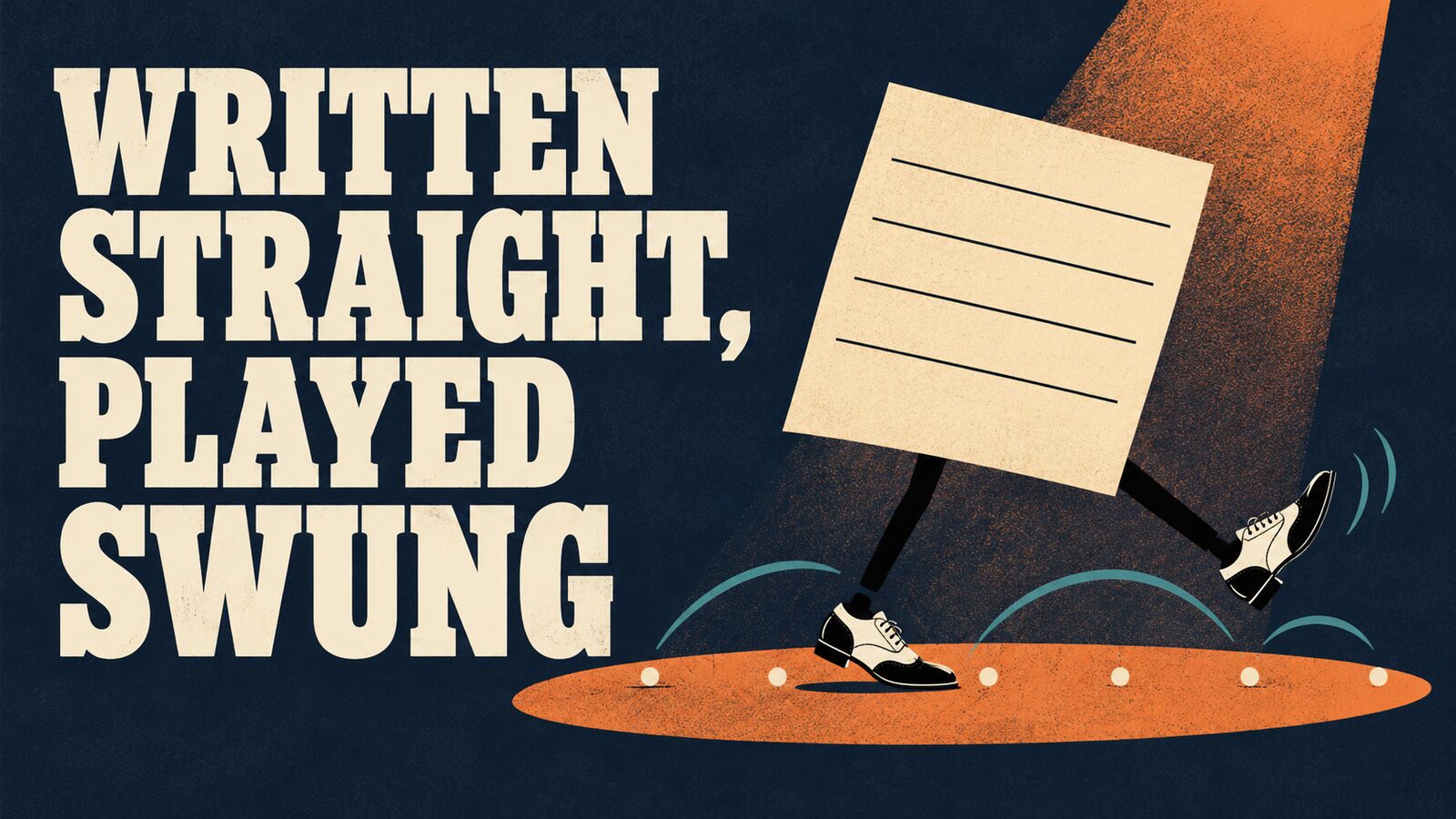
Open almost any jazz chart and you’ll see the eighth notes written perfectly even, with one word over the top: Swing. The page writes it straight. Nobody plays it that way. This is about the gap between the two — which, as we saw a few weeks ago, is exactly the kind of thing the dots leave out.
Don’t be a square
The first time I actually had to step into a band and play swing, I was pretty young and not very experienced. I was freaked out about whether I could “swing” or not, and I certainly didn’t want to be a square. I don’t know if you’ve ever looked at a square, but they’re not the kind of things that really lend themselves to swinging in their basic form.
But like a lot of things in music for me, I realized pretty soon that my body knew it before my conscious mind. As soon as I started relaxing and playing, I was swinging.
Lean and release
It’s not so much that you’re stretching the first eighth note out — you’re feeling it. And yeah, you’re leaning on it till the point it must release, and then there’s the quick release, which is the other side of the swing.
But I don’t think it’s very precisely measurable. There’s driving swing and tight swing and lazy swing, because where the division comes varies — not so much that it sounds wrong, but it gives the music a different feel altogether. It’s that micro-rhythmic and metric management part that lets it flow. But it’s got to flow, to me.
It’s like walking: left foot, right foot, left foot, right foot. But each time you go to a foot, it’s a whole cycle in itself, right? There’s a lot of downward push and then a bit of release on the up as you go to the other foot, and so on and so forth. So maybe that’s a metaphor; I don’t know.
Yes — any swing is a gait.
Lazy, medium, driving
A nice relaxed, lazy swing, I would think, would be something like the song “Moanin’” by Lambert, Hendricks & Ross. Duke Ellington, for instance, would be more of a medium swing, in my opinion. As far as a driving and a tight swing — well, almost any kind of bebop you want to find. Lots of Charlie Parker, for sure: you can hear much of the time they’re staying right on top of or in front of the beat and driving things along. “Ornithology” would be a great example.
If you’ve got ten minutes, play those three back to back. Same idea, three different gaits.
Everybody follows it in their own way
It’s not that everybody has to play together. Everybody has to follow it in their own particular way of doing so, but different players can be ahead of, or on, or a bit behind the beat. And it could be a very complex texture in the simple metric sense of the word.
Which is the note that stayed. Swing moves almost everything — where the second eighth lands, who sits ahead, who leans back. The one thing it never moves is the beat itself. Everybody leans on it differently; nobody leaves it.
Sing it first
So what do you do when the page says Swing over a row of plain eighths? What I want students to do is to start singing the melody with the rhythms. And I don’t want them to be “singing.” I want them to be embodying their instrument through their vocal mechanism, in order to realize this music first — to get the overall shape and feel and pitch, but absolutely the rhythm and the swing.
That’s how I teach them to learn this, how to practise it. Listen to Louis Armstrong, I’ll tell you.
Where it lives now
Other than the occasional novelty act, anything really post-Sinatra is not very swing. That’s not to say you don’t find it in pop music, but it’s certainly not a characteristic part of the scene. Shuffle, on the other hand, is a very big thing in pop and rock and R&B. And shuffle comes primarily from the blues, and through boogie and early R&B, ultimately becoming rock ’n’ roll in the middle of the 1950s.
Take “Jailhouse Rock” by Elvis Presley: that’s a pretty good shuffle. Let’s not forget “Lido Shuffle” by Boz Scaggs in the late ’70s. It’s hard to summon the names of songs at my fingertips, but I know that shuffles were a very big part of rock, and stayed a big part of rock — more the rock-and-boogie side of things in the ’70s, ’80s and beyond: not quite metal, not quite country. And there’s “Bad to the Bone,” by George Thorogood.
Before the count-in
So if I could go back to that freaked-out young bass player, about to step into his first swing band — I’d probably lean over and say, “Just feel it… you’ll do fine.”
Try it yourself in Chapter 1.6: the Beat Slicer has a Swung setting. Turn it on and listen to the same bar stroll instead of march.
This piece is a companion to Chapter 1.6, “Measure for Meter.” The chapter gives these feels their names — beat, meter, straight and swung — and its four interactives, the Beat Slicer, the Crevices, Clave Flip and Three Beats, let you hear and play every one.
→ Read Chapter 1.6, “Measure for Meter”
→ Try the interactive tools
First published on Substack, 14 October 2026. This is the site’s archive copy.