1.1.1A Language You Already Speak
You are fluent in a language you have never been taught.
Consider this: you can tell, within seconds, whether a song is happy or sad. You know when a chorus is coming before it arrives. You feel, somewhere below thought, the difference between a verse that is settling and a bridge that is reaching. You have spent your entire life absorbing the grammar of popular music - its habits, its tricks, its promises and betrayals - and you did it the way every child learns a first language: by listening, by absorbing, by living inside it until its rules became invisible.
This book is about making the invisible visible.
Not by stripping the music of its power - the way a mechanic does not ruin a car by understanding the engine - but by showing you the architecture that you have always felt but never named. The cables running underneath. The scaffolding behind the wall.
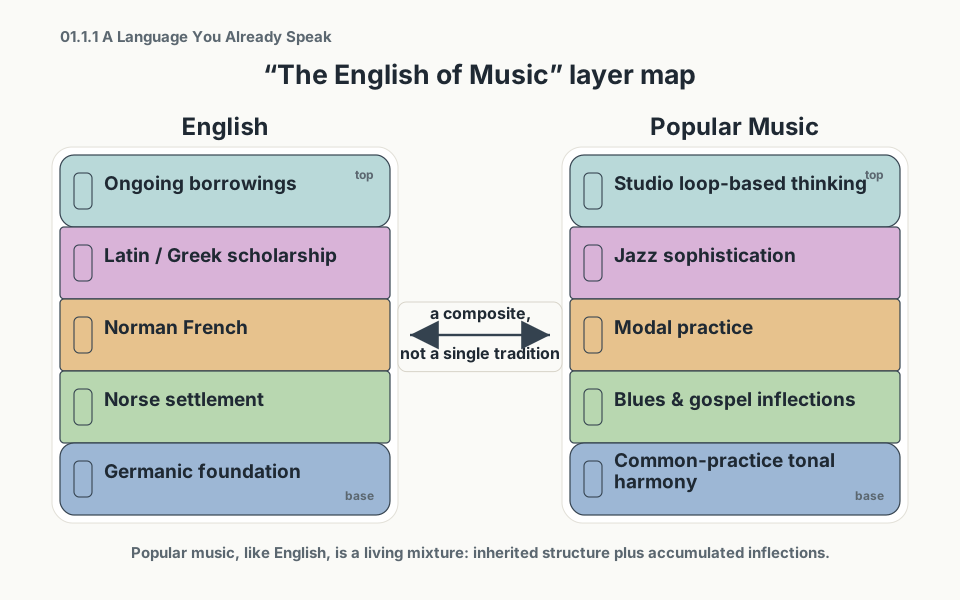
There is a useful analogy here, and it will follow us through the entire book. Think about the English language. You are reading it right now, effortlessly, without pausing to consider that the word “music” arrived from Greek, that “chord” grew from a shortened form of “accord”, that Greek rhythmos names measured movement or form and is traditionally linked to rhein, ‘to flow’, or that, in Greek myth, Harmonia was born from the union of War and Love. English is not one language. It is a vast, glorious composite - a Germanic foundation, reshaped by centuries of Viking settlement, flooded with French after the Norman Conquest, seasoned with Latin and Greek by Renaissance scholars, and continually absorbing words from every culture it touches. To analyze an English sentence and declare it ‘purely Germanic’ would be to miss its French and Latin vocabulary, its learned constructions, its borrowed spices.
Popular music works the same way. It is not one tradition. It is a living mixture of common-practice tonal harmony, blues and gospel inflections, modal practices stretching back centuries, jazz sophistication, and the loop-based thinking of the recording studio. These influences do not compete with each other - they coexist, the way Germanic, French, and Latin coexist in English, each contributing something the others cannot provide. To analyze a pop song using only the tools of classical theory is like parsing English using only a German dictionary: you will understand some of it, and you will miss the rest entirely.
This book will give you the full dictionary.
1.1.2What Is Popular Music?
So what, exactly, are we studying?
The word “popular” comes from the Latin popularis - belonging to the people. And that etymology tells us something important: popular music is, before anything else, music that belongs to its audience. Not music composed for a patron, or a liturgy, or a royal court (though it descends, in part, from all of these). Music that circulates. Music that spreads. Music that finds its way into a kitchen at breakfast and a stadium at midnight and a pair of earbuds on a Tuesday commute.
For our purposes, popular music refers to music created since the late nineteenth century, distributed through mass media - sheet music, phonograph records, radio, television, and now streaming - and typically embedded in a commercial industry. This encompasses an almost absurdly wide territory: pop, rock, R&B, hip-hop, country, electronic dance music, jazz in its earlier and more popular forms, gospel, soul, funk, reggae, bossa nova, and the hundreds of subgenres that bloom and cross-pollinate between them.
These genres sound wildly different from one another. A Billie Eilish track recorded in a bedroom does not sound like a James Brown funk workout. A Radiohead album does not sound like a Patsy Cline ballad. And yet, beneath the surface differences, they share musical DNA. They organize much of their pitch language around the same twelve-note framework, even when performers bend between its fixed points. They organize time into beats and meters. They build tension and release it. They create expectations and then - this is where it gets interesting - fulfill them, delay them, or shatter them entirely.
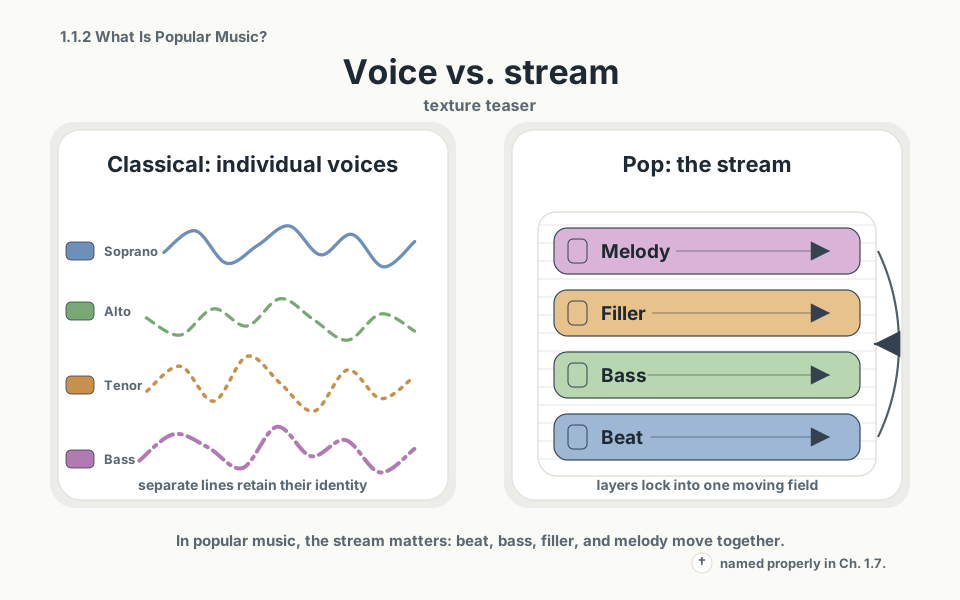
The differences are real, but they are differences of emphasis, not of species. Classical music tends to foreground harmony and counterpoint - the intricate weaving of individual melodic lines. Popular music tends to foreground groove, texture, and repetition - the way a beat locks into a bassline, the way a synth pad thickens behind a vocal, the way a four-bar loop can hypnotize you for four minutes without ever feeling static. In classical music, the individual voice matters. In popular music, the stream matters - the layered texture of beat, bass, harmonic, and melody moving together as a unified field. We will return to this idea when the time is right.
1.1.3Why Study It Theoretically?
Here is an objection you may be forming right now, perhaps without realizing it: Pop music is about feeling. Why ruin it with analysis?
It is a fair objection. Many of the greatest pop musicians never studied theory formally. Jimi Hendrix could not read music. Paul McCartney said in 2018 that he could follow sheet music a little, but not when it became complicated. Popular musicians have learned through many combinations of ear, imitation, apprenticeship, notation, trade craft, and formal study - from Tin Pan Alley writers and arrangers to Delta blues musicians and the DJs and producers who created hip-hop.
But here is the thing about instinct: it is just theory that has been internalized so deeply it no longer feels like knowledge. It feels like intuition. When a songwriter “just knows” that a certain chord change feels right, they are drawing on a vast reservoir of absorbed patterns - patterns that have names, structures, histories. They are applying theory. They just cannot tell you which one.
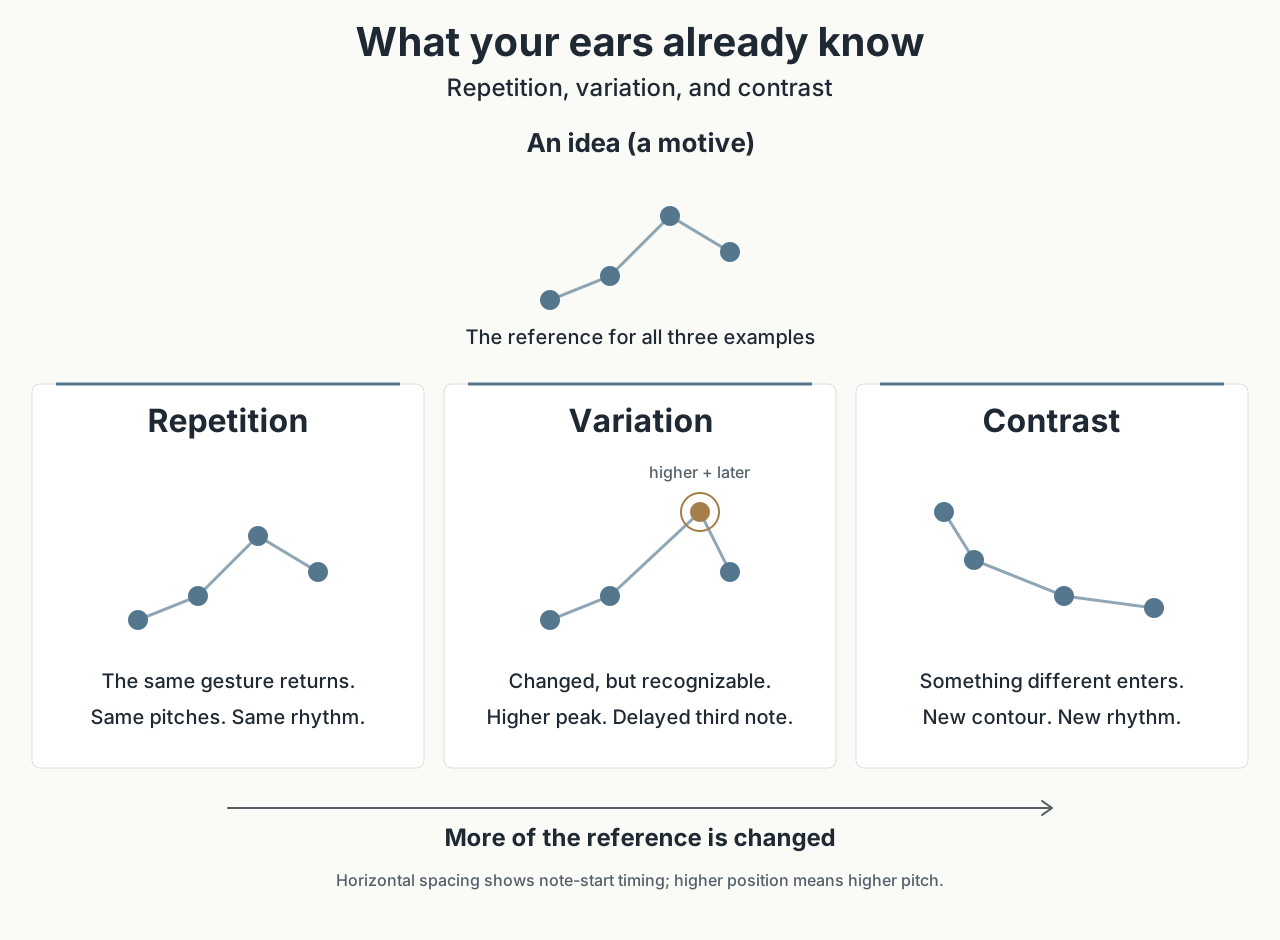
Music theory is not a set of rules that composers must obey. It is a descriptive language - a way of talking about what music does and why it works. No one writes a great song by following rules. But someone who understands the language of theory can explain why a particular chord progression summons nostalgia, why a drum pattern makes a body move, why a melody lodges in the mind and refuses to leave. Theory gives you the vocabulary to articulate what your ears already know.
There is a deeper reason, too. Analysis does not destroy magic. It reveals the craft beneath the magic - and craft, it turns out, is more astonishing than magic ever was. A magic trick, once explained, is merely clever. A song, once understood, is more beautiful than before, because you can hear the decisions, the intentions, the thousand small choices that conspired to make you feel what you felt. You hear the architecture. And the architecture, when you finally see it, is breathtaking.
Some of the most powerful moments in popular music - the moments that raise the hairs on your arms, that make a crowd of sixty thousand people inhale at the same instant - are not accidents. They can be moments where melody, harmony, and rhythm converge simultaneously, each one arriving at its destination at precisely the same time. A chorus lands. A key change hits. A drum fill detonates into a downbeat. These are engineered moments of arrival, and understanding how they work does not diminish them. It makes you a better listener, a better musician, and - if that is your ambition - a better creator.
1.1.4The Approach of This Book
This is not a traditional music theory textbook.
Traditional textbooks tend to treat music theory as though it were perfected somewhere around 1790 and everything since has been a regrettable postscript. They focus on the common-practice period - roughly Bach to Brahms - and analyze popular music, when they analyze it at all, as a simplified version of classical harmony. Pop chords are “wrong” versions of classical chords. Pop voice leading is “sloppy.” Pop forms are “repetitive.”
This book takes a different view. Popular music has its own grammar - a grammar that is no less sophisticated for being different. It has its own voice-leading principles, its own formal logic, its own ways of creating tension, arrival, and return. Some of these principles overlap with classical practice because popular music inherited parts of the same European tonal tradition - alongside blues, gospel, folk, studio, and other lineages. But many do not. And the tools we need to understand them must be built for the music itself, not borrowed from a different tradition and forced to fit.
We will learn the foundational concepts - notes, scales, intervals, chords, keys - because these are the principal building blocks this book uses to describe modern fixed-pitch Western harmony. The twelve-tone equal-tempered system is our main framework for that practice. But from the very beginning, we will apply these concepts to the music you actually listen to. We will analyze Dua Lipa alongside Debussy. We will hear the blues in Beethoven and Bach in the Beatles. We will treat a gospel choir and a string quartet with equal analytical seriousness, because both are doing the same thing: organizing sound in time to create meaning.
Along the way, we will discover that many of the rules you may have been taught - “parallel fifths are forbidden,” “the dominant must resolve to the tonic,” “the leading tone must go up” - are not laws of nature. They are conventions of a particular style, a particular era, a particular cultural context. They are powerful conventions, and we will learn them thoroughly. But we will also learn when and why popular music breaks them, and what it builds in their place.
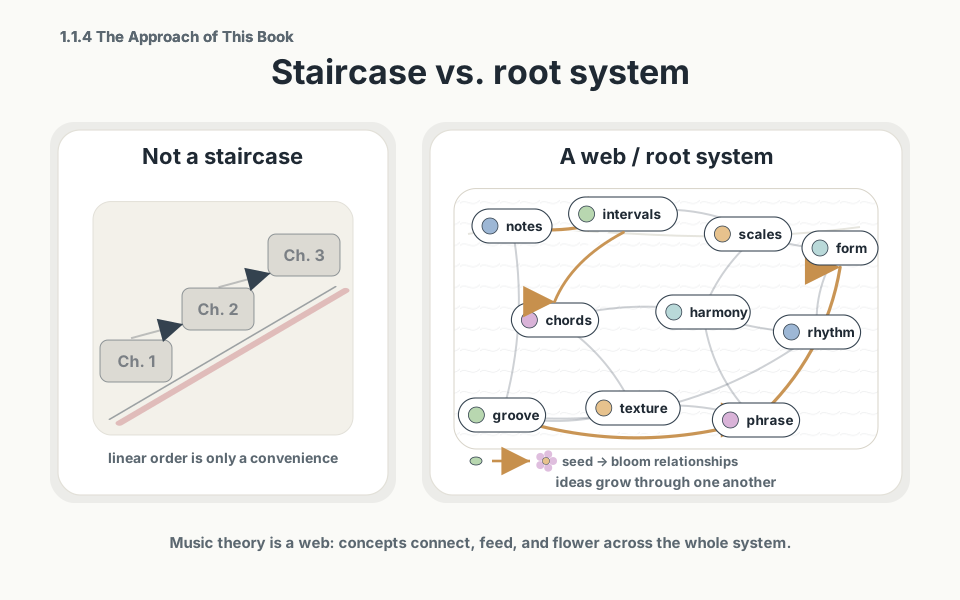
One more thing. You may notice, as you read, that certain ideas planted in early chapters bloom unexpectedly in later ones. A concept introduced in passing here will turn out to be the foundation of an argument three units from now. This is by design. Music theory is not a staircase - a linear progression from simple to complex. It is a web, a network, a root system. Everything connects to everything else through underground passages. Part of the joy of this subject is discovering those connections for yourself. So pay attention to the seeds. They will grow.
Welcome to the architecture. Let’s go inside.