Companion to Chapter 2.1, The Ship That Carries You There
Everybody Has a Job at This Party
Modern tools will not groovify the non-groover.
Douglas Gwynn Smith
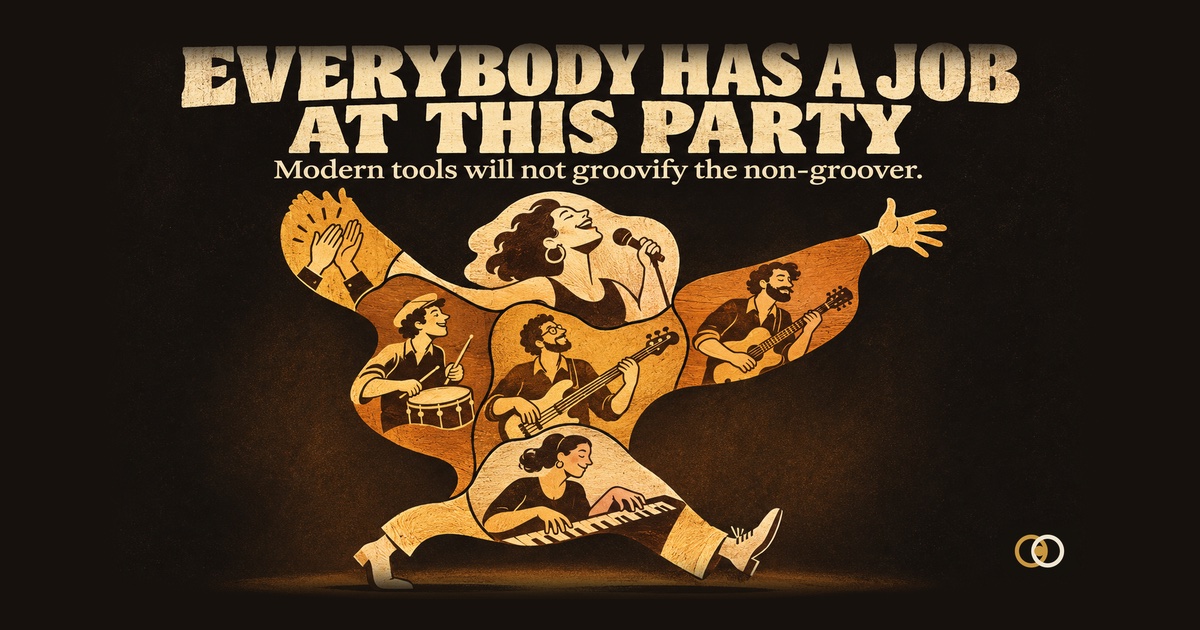
It seems like there's not a lot going on, yet that's the complete framework of the piece, and it's grooving.
From the bass chair
Put on "Good Times." The bass is playing rhythm and not a whole lot more than that. This vamp leaves a lot of space. The vamp is clear in the chords and the bass because it's just oscillating between those two points. The bass part is very marcato, acting like an invisible floor on an elevator that supports the whole structure, or maybe a cantilever structure. It seems like there's not a lot going on, yet that's the complete framework of the piece, and it's grooving.
Part of the bass line is the rhythm it plays in the repeated notes, which gives us certain syncopated rhythms, while still leaving plenty of space in between.
The guitar that leaves holes
There is a two-bar groove where the guitar rhythm changes substantially from bar one to bar two. Bar one features staccato chords on the first three beats. Bar two answers this by covering beats one, two, and the downbeat of three, though it uses eighth notes instead of quarter notes. There is also a bit of 16th-note trickiness in there. Each chord lasts for two bars.
The bass part is simple, rhythmically echoing the guitar in bar one by playing beats one, two, and three. In the second bar, it plays eighth notes, walking up a scale before falling back down at the beginning of the next bar. In bar four, the bass is still active with eighth notes, but it is more of a static riff than a scale.
In bars one and three, the piano plays a solid chord on the downbeat and lets it hang until the second half of the bar, when it gets a little bit fancier with just a little bit of syncopation, but still a very minimal line. In bars two and four, the piano plays a simple, quiet chord on the downbeat that lasts throughout the bar.
In the four-bar chord pattern, the second chord starts as a sus4 and resolves to the triadic version on the offbeat. There is also a quiet string section holding a solid chord in bars two and four. It is definitely in the mix. I predict this hints at the string sounds that will come in when the vocal lines start, as all of this is just the introduction.
Everybody has a job
There's a long bass solo in the middle where the bass essentially does very little. It plays essentially two notes. What it does is fundamentally rhythmic and maintains the song structure as it moves along. You've got drums, bass, and very prominent hand claps throughout. This is an interesting example of form and how it is used simply by having everything drop out, leaving just a rhythmic stream and a bass stream. Since this is dance music, it doesn't need to be completely full every second. It's not baroque.
So which job would you miss? I'm not sure which part people would most likely miss. For those on the dance floor, they'd probably miss the drums, especially in the long middle dance section where the hand claps are so prominent because it's all about the groove and feeling the beat.
That's not what I would miss, though. I might miss the guitar, as it seems to be one of the more prominent rhythmic motivic features of the whole groove. On the other hand, I'm very prone to listening to the bass parts. For me, taking those away would be like taking a Picasso painting and removing all the green shades. But yeah, I would probably say the drums and then the bass for me, because the bass is so fundamental and foundational.
In pop and classical texture, of course, there's a difference: a hierarchy, a conversation among equals, versus a crew of specialists. I think all teams are both simultaneously, and to the benefit of all—or the detriment, I suppose. Ultimately the vocals are the "top of the hierarchy" but they are still part of the overall "system".
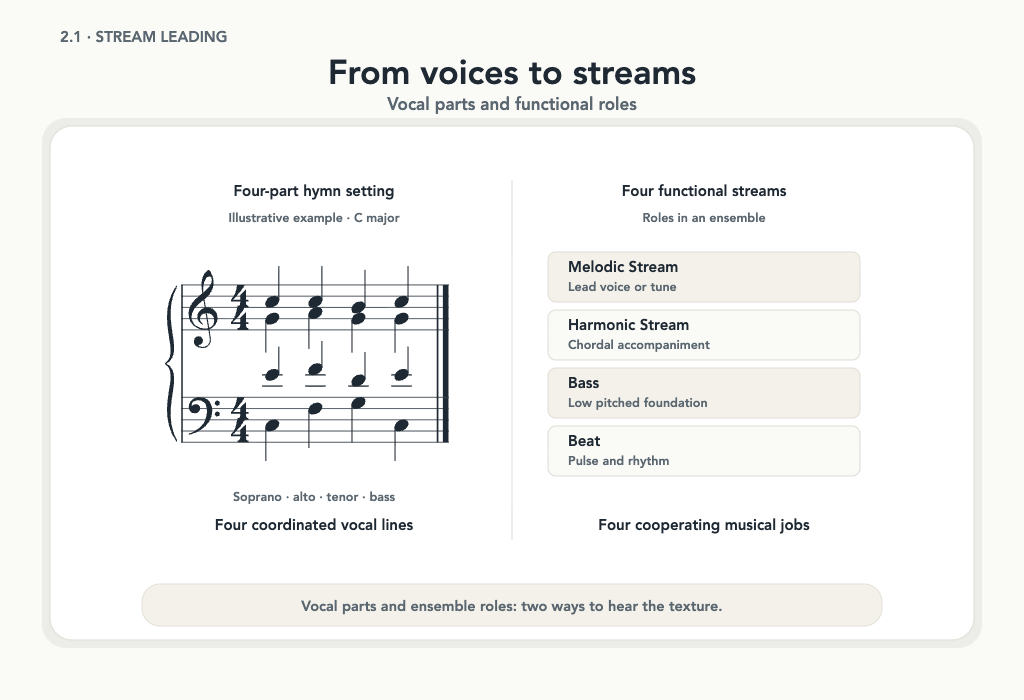
More in Chapter 2.1: The four functional streams.
Where is one?
I'm lucky to rarely disagree with the drummer about where one is. Although, I do remember a very clear example in the first professional band I played in. It was a song, I believe by Bonnie Raitt, which opened with drums in a strong hi-hat rhythm. Then the bass joined in, doing a short repetitive rhythmic riff reinforcing the basic harmony of the piece. I came in on beat two rather than beat one, and it sounded pretty weird. But the drummer caught on and fixed it because he was quite an experienced professional, so he compensated for me. I remember that, and we talked about it afterwards. It's often incidents like that in one's early career that teach deep lessons about always knowing where the beat is. That's a pretty important lesson in music, or maybe I'm just demonstrating that I'm an old fuddy-duddy.
To me, that's what groove lock is all about: independent layers that don't fall apart, and they share a rhythmic agreement. True, the tiny human misalignments are there, but that's what we call groove. That's how we make stuff happen.
And the computer grid that lines everything up? Musicians groove or they don't groove. The modern tools will not groovify the non-groover, without the guidance of someone who knows how to groove. (Begin arguments about what groove is...)
More in Chapter 2.1: Groove lock: independence that interlocks.
The line that walked out of the song
That bass line didn't stay in "Good Times." It's a very borrowed kind of bassline. I think "Rapper's Delight" and "Another One Bites the Dust" are appropriately related, or should I just say structurally related? It's a groove and a rhythm that people can attach to and build something with. I don't mean to denigrate it, but a lot of pop music is like suburban architecture. You see and hear the same or similar things over and over again, and in some neighbourhoods, you literally do hear the same thing. But that means it has great utility and is flexible and portable.
On Spotify: “Good Times”, “Rapper's Delight” and “Another One Bites the Dust”.
Making the band look good
As I have joked to my friends and students before, a bass player can make the band look really bad for a long time before the listener identifies who's causing it. So what does it take to make the band look good? For many years in the classroom, I would respond to students coming late by asking them, "What is the secret of music and comedy?" The answer, of course, is timing.
Next time "Good Times" comes on, listen for the mosaic of the texture; how all the small elements come together to make the whole.
This piece is a companion to Chapter 2.1, "The Ship That Carries You There." The chapter names the four jobs in any band, whatever the instruments (Beat, Bass, Harmonic Stream, Melodic Stream), and shows how they lock into a groove.
→ Read Chapter 2.1, "The Ship That Carries You There"
First published on Substack, 11 November 2026.