2.1.1The door the old model can't open
Chapter 1.9 promised that in Unit II the chords would begin to move. Before they do, we need to know who is carrying them. Back in Chapter 1.7 we watched modern music assemble itself in layers: a beat, a bass, a middle that fills the room with harmony, and a melody riding on top. This chapter gives the phenomenon the name this book uses - Stream Leading - and shows how those layers actually behave.
First, a puzzle. Open a hymnal and a hip-hop track side by side. In a four-part hymn setting, four vocal lines negotiate the chords together through voice leading. The track is a kick drum, a synth bass, a looped chord pad, and a rapper - four things that are emphatically not four singers . Both have four parts, but should a theory book explain only one way for those parts to work?
Well, not my theory book.
There are lots of historical reasons that's true, because a hymn from hundreds of years ago has gone through a documented evolution, whereas a hip-hop track is a relatively new phenomenon. But the same would have been said years ago of a rock song, an R&B song, or a rock and roll song set beside a hymn. Now that I think of it, I'm pretty sure it was. So there seems to be some human need to scold - but that's the whole point of The Common Tone: these two musics live side by side. They are siblings and related, and they have their own unique way of doing things.
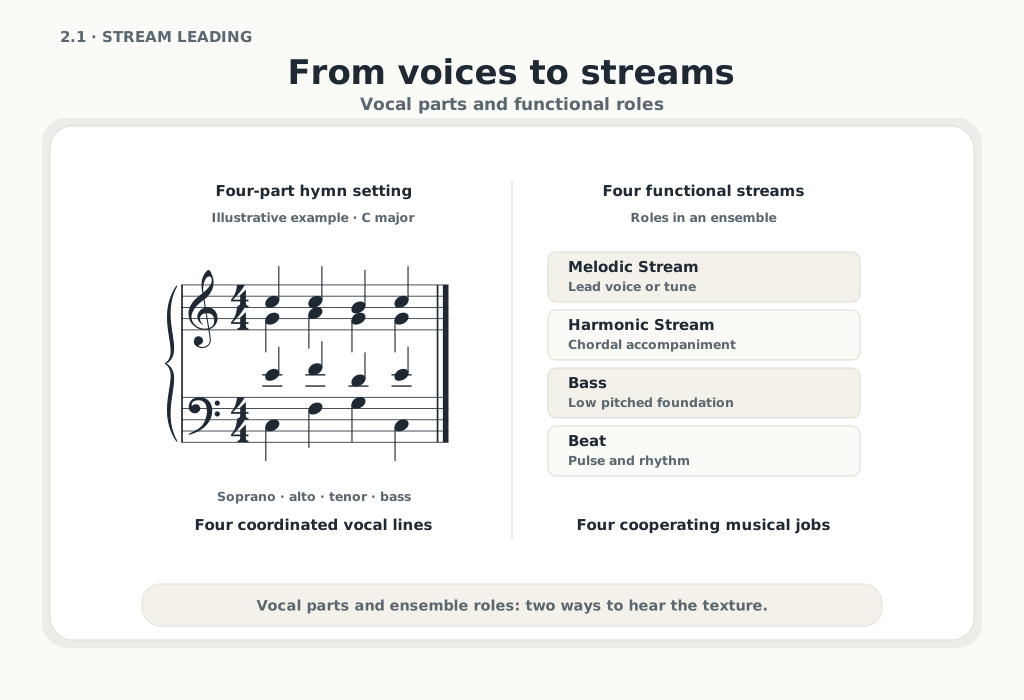
Figure 2.1.1. From voices to streams.
2.1.2From voices to streams
A familiar starting point in traditional harmony teaching is the SATB model - soprano, alto, tenor and bass - four independent voices whose motion is governed by rules: prefer contrary motion , resolve tendency tones , avoid parallel fifths and octaves . SATB is not going anywhere in this book. It is indispensable for classical harmony and for training the ear, and we will use it constantly.
So why doesn't the four-voice SATB model describe a band? Well, because it was written for a different paradigm of music. That's why. Those four-voice rules do not, by themselves, explain how every part of a modern band works. There are many different bass and drum techniques, and very often the two lock in with one another - they certainly do in the song we're about to hear. Bass players certainly don't avoid parallel fifths with the singer, and that's fine, because they're not playing SATB texture.
Pop music is still imbued with that linear drive - not just of monophonic voices, but of blocks of sound driving forward. When you have a guitar player playing chords and rhythms and changing melodic patterns, it's hard to describe one second of the guitar texture sometimes, let alone how that texture fits within the larger texture of the ensemble. There could be another guitar player or a keyboard player. Maybe there are some horns, maybe some background vocals. There's typically going to be a lead vocal as well, and yes, the bass and the drums - and often lots and lots of percussion.
This is why the stream model works. Rather than identifying a specific soprano, alto, tenor or bass, we identify the Melodic Stream - typically the lead singer - and then the Harmonic Stream, where you get your guitars, keyboards and all sorts of other instruments, whose individual parts can create different textures within the stream: a single melodic line , chordal accompaniment , or simultaneous variants of the same melody - the last of these called heterophony. The bass, as usual, is typically a monophonic voice.
The Melodic Stream is the focus - "on top" the way a soprano line is on top - even when there are other voices higher up in a synth pad, strings or horns. It is not always literally on top of everything else, but it is the prime focus through composition, arrangement, mixing and texture, regardless of which notes are higher or lower. It is the superposition of all these individual textures that come together and lock into what I call harmophony.
Stream Leading is the name for how those layers move: each functional stream follows its own rhythmic and timbral logic while still locking together into a single, coherent groove. It is a textural tool - more on exactly where it fits at the end of the chapter.
A note on terms
Stream Leading is an original framework of this book. Allan Moore described a closely related model of four functional layers; Stream Leading is this book’s framework for exploring how its streams move and interact.1 The four streams are the Beat, the Bass, the Harmonic Stream and the Melodic Stream. Allan Moore's word for the middle one is 'filler'; this book calls it the Harmonic Stream.
2.1.3The four functional streams
| Stream | Job |
|---|---|
| Beat | The rhythmic foundation - kick, snare, hi-hat, or their electronic equivalents. |
| Bass | The harmonic anchor and, very often, the Beat's rhythmic partner. |
| Harmonic Stream | The chordal middle - guitars, keyboards and more, potentially combining several local textures. |
| Melodic Stream | The focus - usually the lead vocal - plus what belongs to it (harmony vocals, counter-lines). |
The point is not that four instruments are playing. The point is that four roles are being filled, whatever the instrumentation. Chapter 1.7 laid this grid out in full; here we put it to work.
The anchor song: "Ob-La-Di, Ob-La-Da" (The Beatles, 1968)
Listen: The Beatles, “Ob-La-Di, Ob-La-Da” (Remastered 2009).
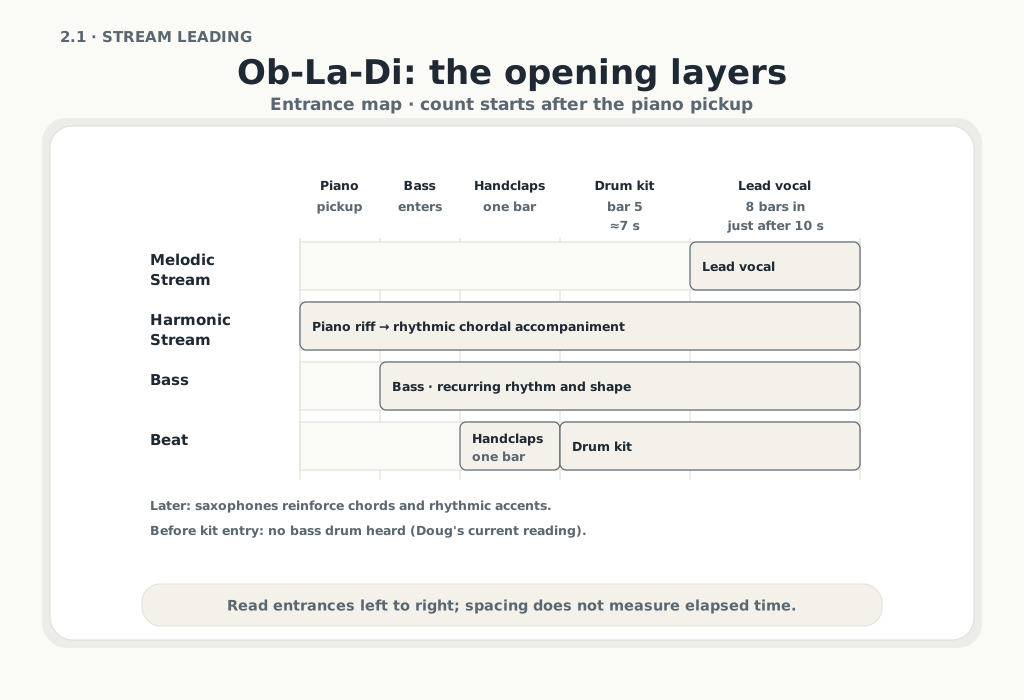
In “Ob-La-Di, Ob-La-Da,” listen for the four streams:
- Beat - Ringo Starr: metronomically solid, each piece of the kit doing a distinct job.
- Bass - Paul McCartney: listen for the recurring pattern and how it works with the drums and the changing chords.
- Harmonic Stream - under the first-verse vocal, the piano supplies rhythmic chordal accompaniment; the saxophones reinforce chords and rhythmic accents within the Harmonic Stream.
- Melodic Stream - the lead vocal, the focus, with its own rhythmic profile.
This is a common pattern in pop music. The value of this song as a demonstration is its ordinariness. It is the template.
Figure 2.1.2. The opening streams of “Ob-La-Di, Ob-La-Da.”
2.1.4Groove Lock - independence that interlocks
If the streams are independent, why doesn't the music fall apart?
Hocket is an old technique, known since the Middle Ages. It's like one of those wooden puzzles that comes together as one object and then disassembles into many little pieces of wood. In hocket, performers trade short fragments, one sounding in the spaces another leaves. When you hear them all together, they make a complete whole; if you hear just parts of them, sometimes it doesn't make a whole lot of sense.
To me, that's what Groove Lock is all about: independent layers that don't fall apart, because they share a rhythmic agreement. The bass and kick agree on where "one" is. The chord stabs answer the spaces the bass leaves. The hi-hat subdivides the beat everyone else implies. Tiny human timing differences can be part of that groove. That's how we make stuff happen.2
2.1.5When streams go their own way
Because the streams are independent, two of them can go their own way without breaking the song. Researchers have described two kinds of ‘divorce’: melodic–harmonic divorce, when the melody follows a different harmonic logic from the chords, and harmonic–bass divorce, when the bass and chordal layer do so. We will study both properly later; for now, just know they exist.4 A stream of music has its own strength and its own power to assert its identity musically, rhythmically, and as part of the colour of that particular piece of music. Even if there's some clash with some other style or earlier tradition, music evolves, and sometimes those new sounds become part of the overall sound. Bass has always had somewhat more freedom here, if only through big, burly, muscular devices like pedal tones.
As I have joked to my friends and students before, a bass player can make the band look really bad for a long time before the listener identifies who's causing it.
Prof. Krankenhorn
“A "layer" is something one finds in a cake, not a composition. If the bass is playing an ostinato and the melody is ignoring the underlying harmony entirely, that is not a "divorce" - that is simply poor counterpoint. I weep for the future of Western music.”
2.1.6Streams as form
Texture can become part of the form. Different instruments, recording tracks and kinds of processing can be layered so that a song grows slowly over time. The chords stand still while the music flows through them. It's not a new form like a rondo or a sonata-allegro form, but there's a new kind of form, pertaining more to timbre and to the Beat stream.
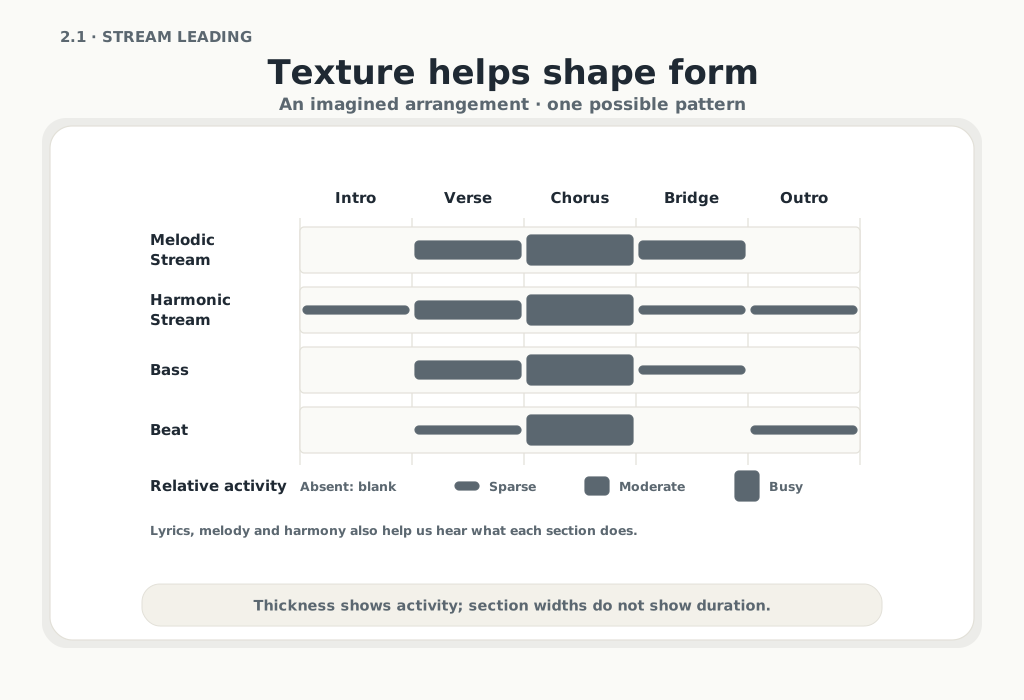
In modern pop, sections are often marked not by a cadence but by which streams are present and how hard they hit: the bass drops out for the pre-chorus, the full beat crashes in for the chorus, everything strips back to voice and pad for the last verse. All of these elements, as they assert themselves more and more, become part of the development of the song through texture and timbre. Ask any EDM fan about drops.
So a first, workable map of a song’s sections can often begin with the streams: what enters, what leaves, and how hard it hits. Lyrics, melody and harmony help us hear what those sections are doing. We will come back to this at the scale of a whole song in Chapter 4.8.
Figure 2.1.3. Texture helps shape form: an imagined arrangement.
2.1.7Pop and classical texture
One useful contrast is between four-part voices negotiating their motion and a band’s specialists coordinating their different jobs through a shared pulse. I think all teams are both simultaneously - to the benefit of all, or the detriment, I suppose.
Whether the elements and textures of music actually sit in a hierarchy is beyond my reckoning. But I know that they must all live in a state of harmony, and that some will be more prominent than others by design and necessity. It's the very nature and lifeblood of music itself.
2.1.8When one stream needs sub-streams
Just like streams and rivers can come apart, come back together again, and crash over rocks, so can musical streams. They can come in or drop out, change roles, and all sorts of things like that.
With the Harmonic Stream, for example, very often two guitars will work out their own parts between them - parts that showcase them both, but also complement each other and don't get in the way of anything that might take prominence, like the Melodic Stream. On the other hand, sometimes you'll get a Harmonic Stream of three or four or more electric guitars using distortion and playing power chords, layered and mixed to add up to fantastic colour and texture. The power chords of Chapter 1.8, stacked into a wall.
Whenever you have multiple harmonic instruments - guitars and keyboards especially - you run into difficulties. This is quite literally where these streams need to voice-lead themselves - they need to stream-lead themselves - so that they work together and don't create chaos. When that happens, analyse the Harmonic Stream as a set of sub-streams: tributaries within the one river.
Keyboards and guitars play different kinds of stuff, based on how the instruments are built, and all those differences between keys and strings come together. Many things that are relatively easy on one instrument can be very challenging on the other, and each has its own natural, idiomatic gestures. There is no single compulsory rulebook for how guitars and keyboards must interact in every band. Principles learned from four-part tonal harmony can help, but parallel octaves, parallel fifths and all sorts of doubling may be exactly the sound you want. That requires a keen ear and a keen understanding of the musical dialect you are playing.
Music's complicated. Oh my goodness, it's wonderful.
2.1.9Where this fits
Stream Leading absolutely is a textural tool. It sits alongside harmony and doesn't replace it. It sits alongside SATB voice leading and doesn't replace it. In Chapters 2.2 and 2.3, we turn to harmony and explore how harmonic function can guide chord choice. What Stream Leading does is create a space where these very real elements of popular music can be defined, refined, and discussed.
References
Chowning, John M. 1973. “The Synthesis of Complex Audio Spectra by Means of Frequency Modulation.” Journal of the Audio Engineering Society 21 (7): 526–34. Original publication record. 1977 reprint in Computer Music Journal 1 (2): 46–54.
de Clercq, Trevor. 2019. “The Harmonic-Bass Divorce in Rock.” Music Theory Spectrum 41 (2): 271–84. Article.
Keil, Charles. 1987. “Participatory Discrepancies and the Power of Music.” Cultural Anthropology 2 (3): 275–83. Article.
Moore, Allan F. n.d. “Analysing Rock: Means and Ends.” Author-hosted paper, pp. 2–3. Based on seminar papers delivered at the University of Bologna, April 1998. Paper.
Moore, Allan F. 2001. Rock: The Primary Text: Developing a Musicology of Rock. 2nd ed. Aldershot: Ashgate.
Risset, Jean-Claude. 1985. “Computer Music Experiments 1964–...” Computer Music Journal 9 (1): 11–18. Article.
Senn, Olivier, Lorenz Kilchenmann, Richard von Georgi, and Claudia Bullerjahn. 2016. “The Effect of Expert Performance Microtiming on Listeners' Experience of Groove in Swing or Funk Music.” Frontiers in Psychology 7: 1487. Article.
Temperley, David. 2007. “The Melodic-Harmonic ‘Divorce’ in Rock.” Popular Music 26 (2): 323–42. Author-hosted article.
Notes
- Allan F. Moore, “Analysing Rock: Means and Ends,” n.d., pp. 2–3 (author-hosted paper). See also Moore (2001).
- The ethnomusicologist Charles Keil called these tiny misalignments "participatory discrepancies" and argued they are part of what many musicians call groove. Listening experiments are more mixed: in one study, listeners rated machine-exact timing about as groovy as good human timing, and exaggerated timing slips hurt the groove. (Keil 1987; Senn et al. 2016).
- Chowning (1973) and Risset (1985). The online Chowning copy linked below is the 1977 reprint of the 1973 article.
- David Temperley (2007) examines melodic–harmonic divorce; Trevor de Clercq (2019) develops harmonic–bass divorce. See References.