2.2.1Introduction: The Vertical Dimension
If melody is the horizontal line drawn across a canvas, and rhythm is the grid upon which it is drawn, then harmony is the vertical depth - the colour, the shadow, and the structural weight that gives the line its meaning.
The word “harmony” originates from the Greek term harmonia, meaning a combination or agreement. It originally described the fitting together of parts to form a connected whole, whether in architecture, politics, or daily life. In music, harmony occurs whenever two or more pitches sound simultaneously. But more profoundly, harmony is the study of how these simultaneous sounds connect over time to create a sense of motion, tension, and resolution.
In popular music, harmony is rarely a static backdrop. It is an active participant in the storytelling. A single melody note can sound triumphant, tragic, or terrifying depending entirely on the chord placed beneath it. Harmony provides the emotional context for the lyric and the structural architecture for the song.
2.2.2Basic Harmonic Principles
To understand how harmony works, we must first understand how it is built. Western harmony is primarily tertian, meaning chords are built by stacking thirds (skipping every other note in a scale). We first touched on this concept when exploring scale construction in Chapter 1.4 (Scaling the Heights).
The most fundamental harmonic structure is the triad - a three-note chord consisting of a root, a third, and a fifth. A major triad (e.g., C–E–G) contains a major third; a minor triad (e.g., C–E♭–G) lowers that third. In many familiar tonal contexts, major is associated with brightness and minor with darker or more introspective colour - but voicing, timbre, style, function, and context can reverse or complicate those associations.
When we build a triad on every note of a major scale using only the notes available in that scale, we create a diatonic chord family. In the key of C major, this family looks like this:
- I: C major
- ii: D minor
- iii: E minor
- IV: F major
- V: G major
- vi: A minor
- vii°: B diminished
This system of Roman numerals allows musicians to describe the relationships between chords regardless of what specific key they are playing in. A “I–IV–V” progression functions exactly the same way whether it is played in C major, G major, or F♯ major.
2.2.3Harmonic Function: Tonic, Predominant, Dominant
Not all chords are created equal. Within a key, each chord has a specific “job” or behavioural tendency. We call this harmonic function. There are three primary functions in tonal music:
1. Tonic Function (Stability and Home) The tonic chord (the I chord) is the centre of gravity. It represents rest, arrival, and resolution. Many tonal songs begin and end on the tonic, though loop-based, modal, and fadeout forms often complicate that pattern. When a song is “in the key of G,” the G major chord is the tonic. It is the harmonic floor.
2. Dominant Function (Tension and Drive) The dominant chord (the V chord) is the engine of forward motion. Because it contains the “leading tone” (the 7th degree of the scale, which desperately wants to resolve up by a half-step to the tonic root), the dominant chord creates a state of high tension. It acts like a coiled spring, demanding resolution back to the tonic.
3. Predominant Function (Preparation and Departure) Predominant chords (typically the IV and ii chords) act as stepping stones. They pull us away from the safety of the tonic and set up the arrival of the dominant. They create a sense of journeying or gentle departure.
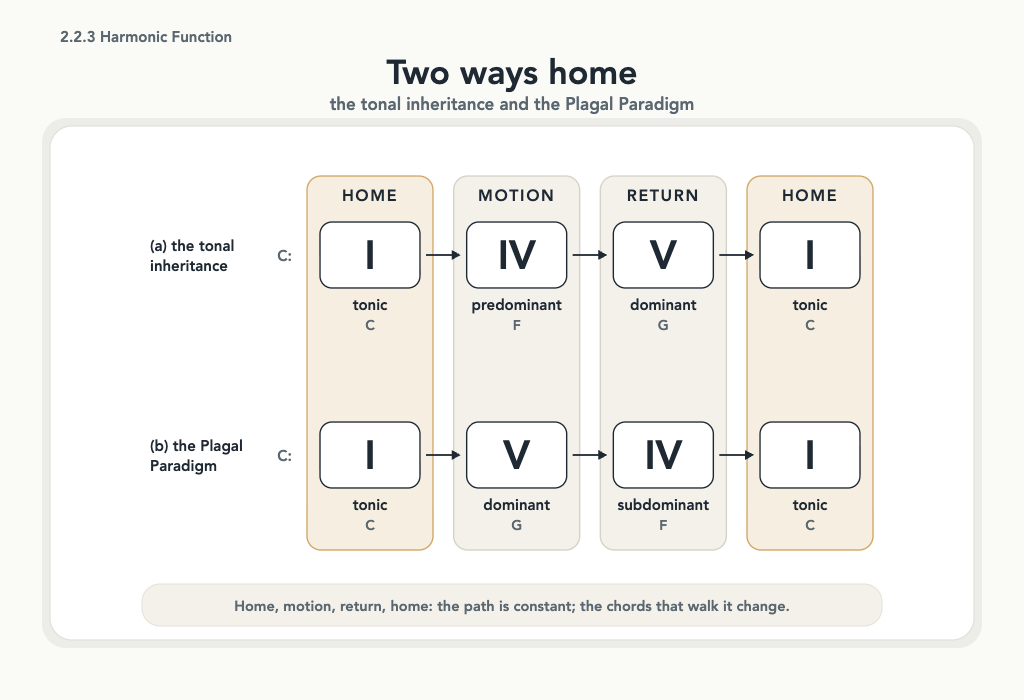
A classic functional progression moves from stability (Tonic), to departure (Predominant), to high tension (Dominant), and finally resolves back home (Tonic). This is the narrative arc of millions of songs, and forms the basis of the Primary Chords we will explore in depth in Chapter 2.3.
Call the four stations of that journey home, motion, return and home. Traditionally, we call that tonic, subdominant or predominant, dominant, and tonic. That works fine for traditional tonal music. Pop music, by and large, doesn't have such a strict hierarchy, and a return can easily be a plagal cadence.
Home is a place that you depart from and a place that you return to. It has a dual purpose. It provides a sense of arrival and equilibrium, which is where the music can rest. Motion is the first chord that moves away from the tonic. It is what sets things into motion, and by being named a motion chord, it presupposes that it will move on to some sort of return function chord. The return is what would traditionally be called a dominant function, but it does not have to be directly tied to a dominant chord. It just has the function of returning home.
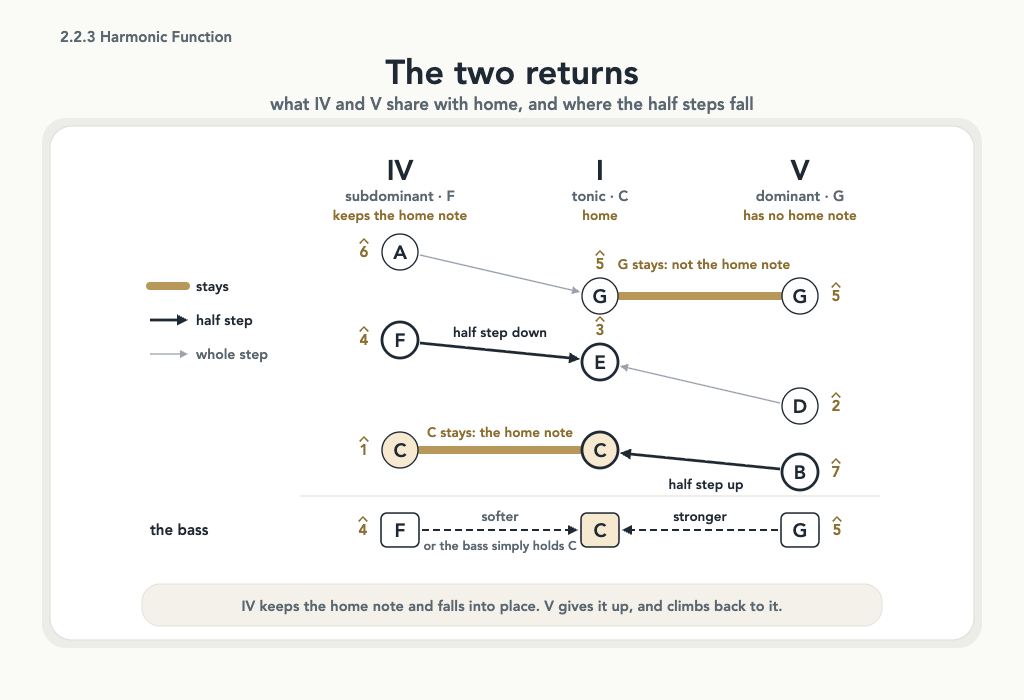
This book calls the second way home the Plagal Paradigm. Dominant to tonic was the usual ending in classical music from 1600 to 1900. However, since the 20th century, if you look at folk, pop, jazz, or blues, I would never make that bet about the last two chords because the language and dialects have changed. That is not to say the old ways are no longer valid. The plagal paradigm is really just finding that a large amount of popular music—pop, folk, R&B, and blues—is often resolved through a four-to-one subdominant closure. That is the plagal cadence. It is a softer and more closely related closing paradigm than the authentic one, because the plagal paradigm retains the tonic note between the two closing entities. This is very fundamental to its sound, and its function is unmistakable to any listener.
What, then, of the dominant as a coiled spring? This is absolutely tonal harmonic thinking. In that world, it is absolutely true. It can work that way because the dominant note tends to fall to the tonic in a nice bass leap, and the leading tone wants to go up to the tonic. There is no tonic note in the dominant chord, so it feels much more foreign. It is a stronger and more distant return to the tonic chord than the plagal paradigm, and it stands out in its own way. However you want to describe it, it is colored differently. Our ears must know that coloration because that, much more than terminology, is really the essence of what we're talking about here.
One honesty note before we lean on this model for the rest of the book: functional harmony is tailor-made for the major scale. Dominant function, in particular, runs on the leading tone - and of the seven diatonic modes, only Ionian and Lydian actually contain one . Remove that half-step engine, as natural minor and most of the modes do, and "dominant" weakens from a law to a tendency. Indeed, that is the story of tonal minor itself: ask what minor was before the leading tone was grafted in, and the answer is pre-tonal modality - Aeolian, living its old modal life. The raised seventh is what turned a mode into a key. Outside major, then, the functions become contextual: still useful, still worth naming, but answering to the ear rather than to the rulebook. This is not a defect we will hide; it is a feature of the terrain, and Chapters 2.8 and 2.9 walk straight into it.
2.2.4Harmonic Rhythm
If harmony is the sequence of chords, harmonic rhythm is the speed at which those chords change.
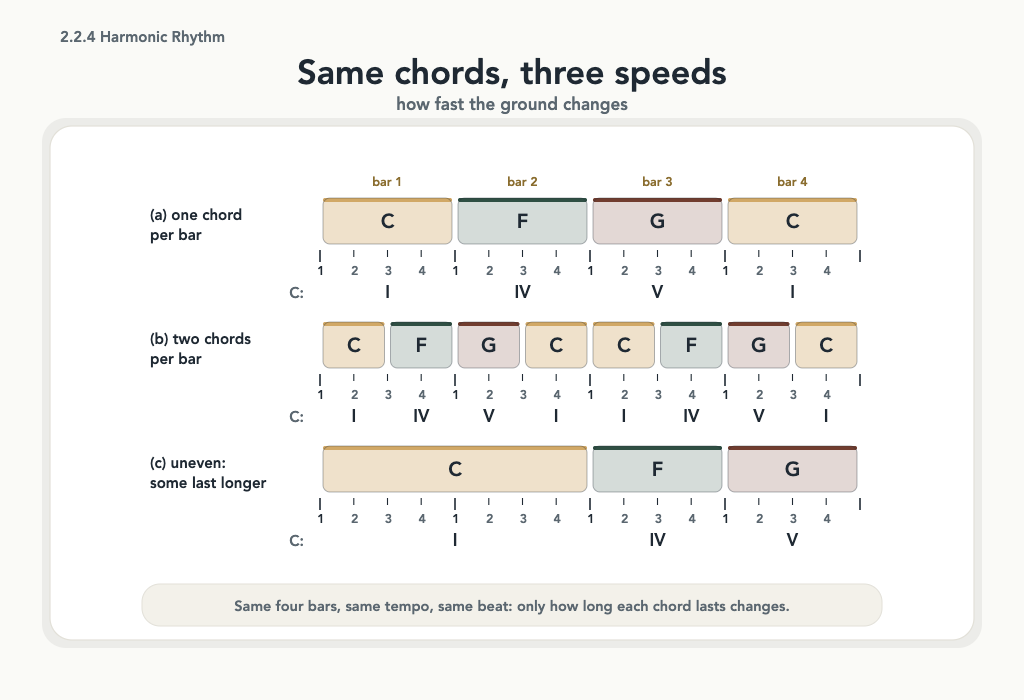
Harmonic rhythm operates independently of the song’s actual tempo, a crucial distinction we established when discussing beats and meter in Chapter 1.3. A fast, aggressive punk song might stay on a single chord for eight measures (a very slow harmonic rhythm). Conversely, a slow, sweeping ballad might change chords on every single beat (a very fast harmonic rhythm).
Changes in harmonic rhythm are powerful structural tools:
- Speeding up the harmonic rhythm often creates a sense of building momentum, frequently used to push a pre-chorus into a chorus.
- Slowing down the harmonic rhythm can create a sense of expansive space or arrival, often used when the chorus finally hits.
For example, in a standard 12-bar blues (Chapter 2.9), the harmonic rhythm is relatively slow - the chords change every measure or every two measures. In a complex jazz standard like All the Things You Are, the chords change in nearly every measure and keep moving through new keys, creating a restless, constantly shifting landscape.
2.2.5Phrase and Cadence
Music breathes in sentences, which we call phrases. We will look closely at how melody shapes these sentences in Chapter 2.4 (Melody and Phrasing), but harmonically, a phrase is defined by how it ends. Just as a spoken sentence ends with punctuation - a comma for a pause, a period for a full stop - a musical phrase ends with a cadence.
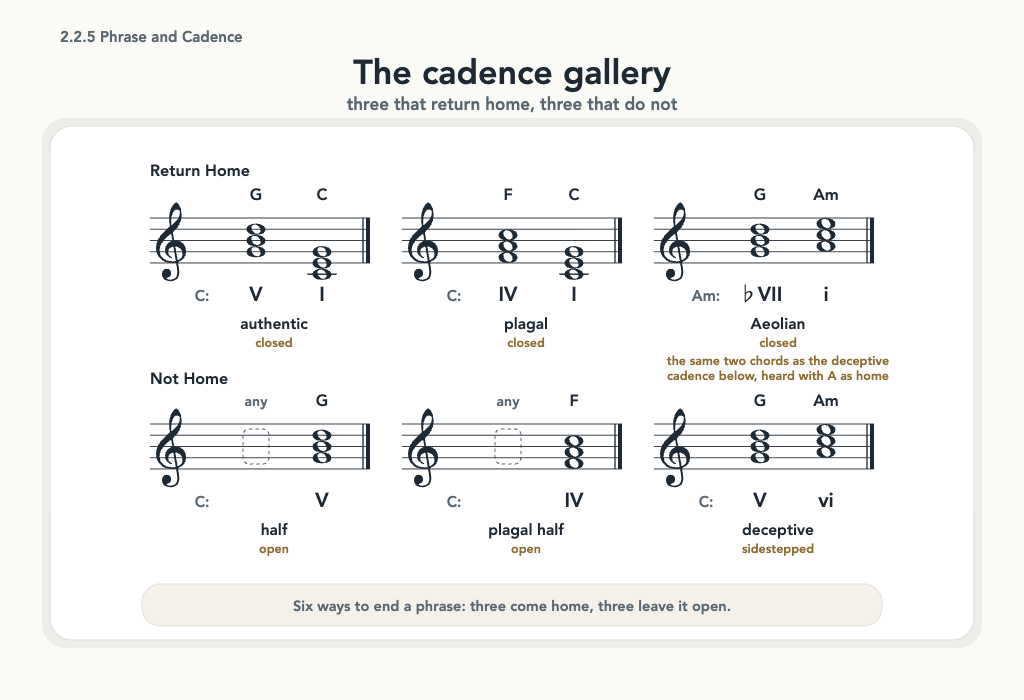
A cadence is a phrase-ending gesture that signals temporary rest or closure, often through a characteristic harmonic motion reinforced by melody and meter.
Authentic Cadence (V → I): The musical period. It provides a strong, satisfying sense of finality. (Think of the final chords of almost any classical symphony).
Plagal Cadence (IV → I): Sometimes called the “Amen” cadence because of its use in hymns - but that nickname vastly undersells it. The IV–I motion is a cornerstone of rock, gospel, and pop music, and in those traditions it is not a lesser alternative to V–I but an equally powerful mode of arrival. We will make the case for this in detail in Chapter 2.3.
Aeolian Cadence (♭VII → i in a minor key): Listen to the end of the refrain in the Beatles’ “Not a Second Time,” where the chord on D moves to E minor. What does it feel like? To me, it feels like a modal cadence, which is what it is. Usually, if you are tonal, you change your five chord and add a leading tone, which deviates from Aeolian. But in Aeolian, if you were strictly playing modal, I would bring it to a close using a flat seven to one or a six to one in a modal way. If you hear G as home, the move sounds like V–vi, a deceptive cadence. If you hear E minor as home, those same two chords sound like ♭VII–i, an Aeolian cadence.
Half Cadence (Any chord → V): The musical comma. The phrase ends on the dominant, leaving the listener hanging in mid-air, expecting the music to continue.
Plagal Half Cadence (Any chord → IV): Like a typical half cadence, it leaves the phrase hanging in mid-air. Listen to “Auld Lang Syne” for a phrase that pauses on IV. In my harmonisation, I end the tune with IV–I, a plagal cadence that brings it home.
Deceptive Cadence (usually V → vi in major, or V → VI in minor): The musical plot twist. The progression builds tension on the dominant, but instead of resolving to the expected tonic, it veers away. This motion dramatizes how dominant expectation can be redirected. For a chart-topping example, listen to the verse of ABBA’s Dancing Queen, which keeps returning to this fakeout, V to vi, before the phrase finally goes home to I - the dominant’s momentum carried forward into a resolution that satisfies without ever feeling complete.
The gallery sorts these six by where the phrase lands: home, or not home. Statistically speaking, we recognize patterns that happen over and over again, such as five to one or four to one. Harmonically speaking, however, that doesn't mean we must do those things. The degree of closure also comes from other elements besides the chords, and the voicings of the chords themselves are definitely important. There are many levels of closure. If a melody doesn't end on the tonic, it can still have closure, even if it isn't what we consider a perfect authentic cadence. We need to recognize that while some things are typical, they don't always happen, and there are many examples of breaking so-called rules.
Notice that these cadence types do not simply divide into “real endings” and “everything else.” They exist on a spectrum - what we will call graded closure. A V–I is not the only legitimate ending; a IV–I, a ♭VII–I, even a textural fadeout can create a genuine sense of arrival. The question is not did the music cadence? but how closed does this feel, and what is producing that feeling? This is a thread we will pull through the entire book.
And the dial is not turned by harmony alone. A technically perfect V–I can land as a mirage - arriving mid-collapse, drowned in a dynamic drop, so the ear refuses to count it. And the reverse: a return can feel settled for acoustic reasons - the register clears, the texture thins, the spectrum comes home - before the chords have done anything a Roman numeral would notice. Closure is a verdict the ear reaches by weighing every witness at once: harmonic, melodic, metric, dynamic, timbral. When they all point the same way, the arrival is total; when they disagree, the music lives in the gap - and the best songwriters place their songs there on purpose.
The verse of Elton John’s Bennie and the Jets demonstrates the entire spectrum inside eight bars. It is built from three short phrases, each opening with the same two-chord approach - ii, then V - and each landing somewhere different. The first phrase resolves squarely to I: full closure. The second phrase makes the identical approach and veers deceptively to vi: partial closure, the trapdoor version. The third abandons the dominant approach altogether and drifts up the scale to IV, delivering no resolution at all. Strong, then deceptive, then none - a staircase of diminishing arrivals. And the payoff is structural: after a verse that progressively loses its way home, the return of the tonic at the top of the chorus lands with enormous force. The song has taught you, in miniature, that closure is not a yes-or-no question but a dial .
2.2.6The Implied Tonic and the Loop Cadence
In many pop, rock, funk, blues, jazz, and loop-based progressions, the ear strongly senses a point of tonal arrival even when the tonic chord is not literally sounded at the end of the pattern. This implied point of rest is called an Implied Tonic (sometimes referred to as a Ghost Tonic or Virtual Tonic).
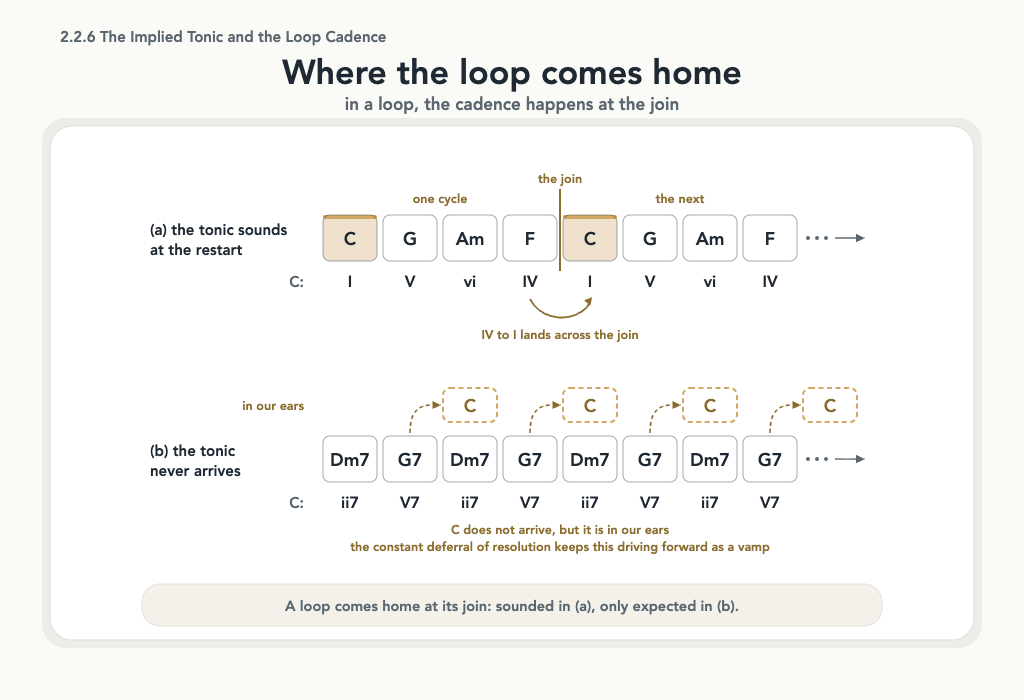
An actual tonic is literal: the tonic harmony itself sounds. An implied tonic is absent in sound but present in expectation - psychological, structural, and stylistic rather than acoustically stated.
One distinction keeps this concept honest: a hidden tonic is not a contested one. Cyndi Lauper’s Time After Time keeps putting E minor where you expect C major, and never stops long enough to settle anywhere - and yet nobody seriously doubts the song is in C. Concealment is a dramatic device; ambiguity is a structural condition. The implied tonic covers the first case: the home is certain, merely unstated. Songs where the home itself is in dispute are a different, rarer animal - and we treat them differently.
The mirror image of the implied tonic is the temporary arrival: a chord that collects every welcome-home cue - metric weight, bass root, a resolving approach - and still never becomes home. The end of every verse of The Who’s Pinball Wizard lands and sits on E, the IV of B major, approached by ♭III and held for full bars; for a moment it behaves exactly like a tonic. But it never enacts closure. It sits on the porch, dangling, waiting for the verse to restart - and tonality has inertia: once B is established, the ear keeps it until something genuinely dislodges it. Arrival is an event; home is a residence. Four bars on the porch does not change your address.
This concept becomes especially useful in music built from short repeating loops. In traditional phrase structure, a cadence often arrives at the end of the phrase. But in loop music, the cadence often happens at the join.
We call this a Loop Cadence (or Seam Cadence). The resolution is not a final, self-contained event inside the loop; instead, it is heard across the boundary between the end of one cycle and the beginning of the next. The ear hears the resolution not as a final stop, but as a cyclic reset.
The popular tradition has long had its own name for the chord that engineers this seam: the turnaround. In a 12-bar blues, the final bar’s tonic is routinely replaced with a V chord; at the end of an AABA standard’s last A section, a similar gesture rebuilds tension just as the form is about to restart. The mechanism is the same one the Loop Cadence describes, seen from the performer’s side of the bandstand: by ending the cycle on an unstable chord, the resolution is forced to arrive at the downbeat of the next cycle - by the time the tension resolves, the progression has already begun again. The listener never gets a clean stop, and that is precisely the point: the turnaround stitches each cycle to the next, converting an ending into a running start.
There is a broader design choice hiding in this, worth naming because it separates two whole families of loops. A loop can resolve at the seam - like the classic four-chord progressions, where the tonic arrival doubles as the restart, so the resolution and the next departure are the same instant, and the music sustains a constant implied motion. Or a loop can resolve inside itself - completing its journey home before the cycle ends, so that every pass through the loop tells a small, complete story, with a genuine moment of rest before the next telling. Neither is better; they are different engines, and learning to hear which one a song is running is one of the most useful listening skills this chapter can give you.
A Tonic-Absent ii–V and the “Oye Como Va” Contrast
Consider a repeating || Dm7 | G7 || that never sounds C. In tonal hearing, the ii–V can project C as an expected but unsounded tonic across the loop seam. Santana’s Oye Como Va is different: || Am7 | D7 (or D9) ||. Its A-minor tonic is literally present, while major IV supplies A Dorian’s raised sixth. It is a modal vamp, not a tonic-absent ii–V.
The implied tonic can even become the dramatic subject of a song - though an avoidance is not the same as a total absence. The Police’s Message in a Bottle keeps its verse in C♯ minor and holds back its relative major, E, until the chorus. Tears for Fears’ Everybody Wants to Rule the World goes further still: a low D pedal sits under the verse, which keeps snagging on the IV chord and starting over, the chorus builds to the brink of a triumphant arrival, and the plain I chord is held back until the bridge, about 1:20 in. In both songs the home is avoided, not absent: the ear knows where it is long before the music says so.
The Harmonic Field
In groove-based songs like Daft Punk’s Get Lucky, harmonic syntax is fused with repetition, texture, bass pattern, and production design. The harmony behaves less like a traditional phrase with a final cadence and more like a repeating harmonic field. In such cases, the tonic is experienced less as a final chord and more as an ongoing tonal home - a centre of gravity that need not be repeatedly “confirmed” by classical-style closure.
The concept of the Implied Tonic reminds us that tonal function is not only a matter of what is present on the page, but also of what is powerfully suggested in the listener’s ear.
Sometimes, though, the ear’s verdict is genuinely split - not because listeners are careless, but because the song is built that way. Lynyrd Skynyrd’s Sweet Home Alabama has divided musicians since the day it was cut. Music theory has a name for the condition, and the box below tells the story; for now, notice the distinction. A hidden home is a dramatic device. A contested home is a structural condition, and the honest analysis is not to force a winner.
⚖️ 🏛️ Pedestal of Pedantry: Two Homes - The Double-Tonic Complex
Play D–C–G over and over. Hear it in G and the loop is V–IV–I, three pillars of a blues turnaround, resolving on the third chord. Hear it in D and the melody’s 3–2–1 walkdown settles it the other way, with the G a plagal neighbour. Both hearings are complete. Neither can evict the other. The disagreement reaches inside the song’s own credits: producer Al Kooper reportedly heard D, while Ed King played the famous solo in G major pentatonic.
The theorist Robert Bailey coined the term double-tonic complex in the 1980s for the prelude to Wagner’s Tristan, which lives between A minor and C major without ever choosing - two centres a third apart, sharing one pitch collection, each shading into the other. Drew Nobile carried the idea into rock in 2020, arguing that a surprising number of loop-based songs are built exactly this way: the loop is small enough that no chord gets to be the last word, and the two candidate homes simply coexist.
The pedant’s contribution here is restraint. A double-tonic song is not an analytical failure waiting for the right answer; it is a design. Say what each hearing reveals, notice what kind of song can afford two homes - a rotating loop, a melody that never lands hard - and leave the front door open. Chapter 2.8 returns to this song and takes a side; the box is here to explain why the argument is worth having at all.
2.2.7Vamps, Loops, and Progressions
While classical music often relies on long, goal-directed functional progressions that journey far away from home before returning, popular music relies heavily on loops and vamps. The deep difference is worth naming: traditional harmony is linear - chords move in a direction, toward a goal, and the theory we inherit was built to describe that journey. Loop harmony is rotational - it cycles, and it has no final destination because it is not going anywhere; it is being somewhere. Much of the confusion about loop-based music ("the harmony is so simple!") comes from measuring rotational music with linear tools. A loop is not a failed progression, any more than an orbit is a failed road trip. It plays by its own rules, several of which we have already met: the seam, the turnaround, the implied tonic.
The loop is the defining harmonic structure of modern pop, hip-hop, and EDM, and forms the basis of the Chord Schemata we will explore in Chapter 2.7.
Consider the diatonic circle progression. Moving through chords by descending fifths (e.g., vi–ii–V–I) is one of the strongest, most inevitable-sounding motions in Western music. Jazz standards like Autumn Leaves and pop anthems like Gloria Gaynor’s I Will Survive use this circular motion to create a harmonic engine that practically drives itself.
Alternatively, a vamp is a static oscillation between just two chords (like I and IV, or i and ♭VII). Vamps suspend forward harmonic motion, forcing the listener to focus instead on the groove, the texture, and the vocal performance. Chris Stapleton’s Tennessee Whiskey is a masterclass in the two-chord vamp, oscillating endlessly while the vocal line provides all the dynamic contour. The musicologist Philip Tagg gave the two-chord vamp its definitive characterization when he named it the chord shuttle: a shuttle, he wrote, is not “a place you pass on the way to another destination”: it “is itself somewhere to be.” That single sentence is worth an entire chapter of theory - it relocates the meaning of harmony from where the progression is going to where the music lives. Tagg’s own showpiece was Pink Floyd’s “The Great Gig in the Sky,” which floats on a two-chord shuttle of Gm7 and C7. Ask what key it is in and four candidates volunteer - G minor, C, an F the ii–V keeps promising and never delivers, even B♭ - and Tagg’s answer is: none of them. The music is not in any of those keys; it lives in the space between its two chords. The shuttle is the address.
The vamp repertoire is vast, and its varieties are instructive. The Red Hot Chili Peppers’ Otherside vamps between A minor and E minor - the minor v deliberately declining the dominant’s pull so the verse sits still. Talking Heads’ Psycho Killer shuttles between B minor and G major in the section around 2:12, two chords with no clear boss. R.E.M.’s Losing My Religion runs on a pair of vamps, one brighter, one darker, trading places beneath the mandolin. And Stevie Wonder’s Superstition shows the complementary move: a groove that lives on one chord, with the chorus serving as a brief, contained excursion to the V before the vamp resumes - departure and return compressed into a single gesture. And Leonard Cohen’s Hallelujah opens on the gentlest possible version of the two-chord question: a C major/A minor vamp, relative major and relative minor trading places, the music drifting between brightness and shadow without declaring for either - while the melody plays along, withholding the tonic note over the tonic chord until the very end of the chorus.
Near the far end of the spectrum, motion almost stops. The Killers’ Mr. Brightside is fundamentally two chords, but the tonic chord is revoiced as a third-inversion seventh chord, giving it more motion than a two-chord shuttle. The bass also falls by a tritone, and that adds an extra dimension to an otherwise simple I–IV progression. Above it all sits a static arpeggio beneath a nearly one-note vocal - and the song somehow generates relentless forward drive from near stasis. With so little change, there is almost nothing to resolve; the music simply hovers, perpetually on the verge of a release that never comes, and that suspended, antsy quality is the song’s engine. Stasis, handled deliberately, is not the absence of harmonic tension. It is harmonic tension with nowhere to go.
Whether through a linear progression, a four-chord loop, or a hypnotic two-chord vamp, harmony provides the landscape through which the melody travels.
Suggested Exercises
Functional Listening: Put on a pop or rock radio station. Without trying to name the specific chords, try to identify the moments of highest tension (Dominant function) and the moments of arrival/rest (Tonic function).
Harmonic Rhythm Mapping: Choose a Beatles song (e.g., A Hard Day’s Night or Yesterday). Tap your foot to the beat, and raise your hand every time the chord changes. Does the speed of the chord changes stay consistent, or does it speed up/slow down in different sections?
The Deceptive Twist: Play a V chord on a piano or guitar. Resolve it to the I chord. Now play the V chord again, but resolve it to the vi chord. Describe the difference in emotional impact.
The Four Witnesses: Listen to The Who’s “Behind Blue Eyes” (verse). Four kinds of evidence each nominate a different home: the song’s structure points one way, the speed of the chord changes another, the voice-leading a third, the melody a fourth. Listen twice, then rule: which chord does your ear accept as the tonic, and which witness persuaded you? (There is a defensible answer, but the exercise is the deliberation, not the verdict.)
References
Bailey, Robert, ed. 1985. Prelude and Transfiguration from Tristan and Isolde. Norton Critical Scores. New York: W. W. Norton.
Nobile, Drew. 2020. “Double-Tonic Complexes in Rock Music.” Music Theory Spectrum 42 (2): 207–26.
Tagg, Philip. 2014. Everyday Tonality II: Towards a Tonal Theory of What Most People Hear. New York and Huddersfield: Mass Media Music Scholars’ Press. Quoted at p. 377, via Ethan Hein.