Companion to Chapter 2.2, Harmony
Home, Again and Again
Douglas Gwynn Smith
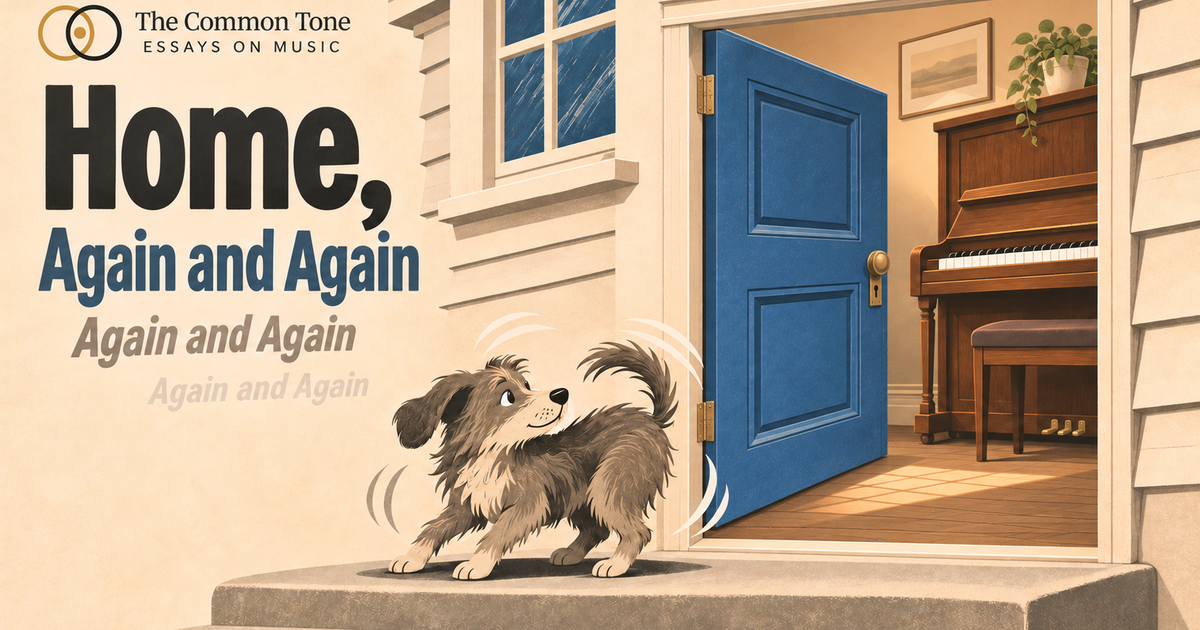
What is interesting in this song is that we are always being coaxed to come home.
First hearing
“Time After Time” takes me back to the mid-eighties. I think the first time I heard it was on MTV, though I could be mistaken. What I remember noticing most was the bassline in the chorus. It is pretty simple throughout, but the chorus has these rising arpeggio patterns that really caught my ear. That stood out to me quite clearly. I like the song overall. The mood suited my vibe at that time in my life and the vocals were really fine.
Other than listening to the song, I never really played it until a few years later when Miles Davis covered it on one of his albums. I thought that was really interesting, so I listened to both versions quite a few times. I think it was around the late ’80s when I sat down with my guitar or piano and figured out the actual chords.
E minor in C major’s chair
The intro
F | G | Em | F
C: IV | V | iii | IV
Here is the swap, right in the first four bars: after the G chord, where the ear expects C, the song plays E minor instead. The E minor to C swap is very interesting. I don’t hear it “hiding” anything C; on the other hand, it is substituting a lot of C major with E minor, which is part of the charm and appeal of this song. It never really stops long enough to settle anywhere, and that is also part of the emotional makeup of the piece.
I don’t think I thought of it as tonic avoidance at the time, but that is how I see it in retrospect. The charming part is that it doesn’t go to the tonic chord, which is what happens ninety-five percent of the time. When something is so common, it might lose its charm, or perhaps this fulfills that niche without being a rubber-stamped version. In music, that’s not a bad thing.
In the pre-chorus, there is no tonic chord at all. This is where it really begins to avoid using the C chord and replaces it with the E minor chord, which is still a tonic function. It is less common than the A minor or the vi chord, but the iii chord can still substitute for the tonic. It works nicely because the iii goes to the IV quite well.
Where home is
How do I know when it’s home when it’s sounded so seldom in the song? I think we all know when we are at home. It’s not a scientific or academic question, and that’s the level music communicates on. It’s not a cognitive level, which is why it sounds good. It fulfills our needs, desires, and expectations while being sweet and piquant at the same time.
What is interesting in this song is that we are always being coaxed to come home. The verses start with a nice C pedal in the bass, but the first chord is a D minor chord over C before it resolves to a C chord. I always hear it as an appoggiatura more than a chord. My ear hears it as a delayed tonic chord with a gentle push from beyond, so that we arrive on beat two-and. On the strong beat, we have this guitar sound pushing to the I chord on a syncopated weak beat, and then it repeats. That whole four-bar sequence repeats, so we get an entire verse of pushing toward the tonic but never arriving there unhindered, meaning never landing on a root position on a strong beat.
The four chords, from another chair
It’s famous for the chords in the chorus, starting from chord number two. It’s a rare application of the Four Chords, also known as the axis progression. It makes the phrase begin already in action. Going up to the vi chord, is that home? Well, almost. It’s a great substitute for home, but it wanders off down to the IV chord, and then IV to I, and okay, there’s home. There’s a nice play to go home.
The chorus
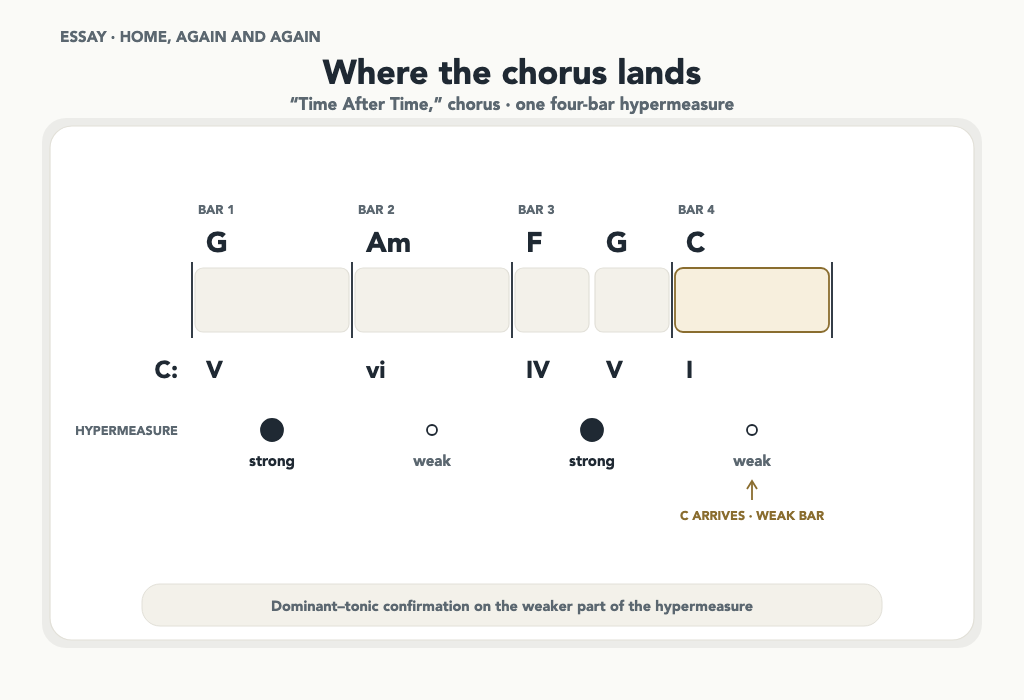
G | Am | F G | C
C: V | vi | IV V | I
When it goes to the IV, it breaks the bar in half before moving to a V and then a I, but it is still clearly a four-chord shape. On the second bar in the A minor chord, there is a rising and falling arpeggio. This fits nicely since she is singing about catching somebody if they are falling.
I suppose the next downbeat could be a repeat of the I chord, which would be like eating the same dinner twice. The closest it comes is on the fourth bar of the chorus loop. Bar 3 ends on G, the dominant, and bar 4 is C, the tonic chord. And though this is sufficient proof that we are in C major, it’s still following the avoidance technique, just as we get the D minor chord for a beat and a half over the tonic pedal, delaying and avoiding a clear statement of tonic. Here we have this dominant–tonic confirmation happening on the weaker part of the hypermeasure. It certainly adds an air of wandering, searching, and looking for some sort of resting place. There is no strong arrival on C anywhere.
Again and again
When does a loop that keeps coming around feel like coming home, and when does it feel like being stuck? Well, it partly depends on the type of music. If we’re talking about EDM, you probably don’t even want it to come home. It’s all about the groove, the beat, the drive, and the energy. However, if it’s a song in the more traditional sense, it might have a lyrical narrative, so it’s important to construct it carefully if you use a loop.
In “Time After Time” by Cyndi Lauper, there is hardly any repetition that could be considered an excessive loop. The intro is a four-bar pattern repeated once, the verse is a four-bar pattern repeated once, the pre-chorus is a seven-bar pattern followed by a six-bar pattern, and the chorus is a four-bar pattern repeated. I wouldn’t even call these loops, but rather longer, less dynamic chord progressions, and that is perfectly fine.
At the end, it does arrive at the C, but it’s still on a metrically weak position. In fact, as it’s fading out, the C is actually anticipated by an eighth note, making kind of a little heartbeat rhythm. So, yes, on paper it’s fully resolved, harmonically speaking, and at the same time it keeps looping, and it’s on the weaker side of the loop, which begs the next part to be resolved. In other words, it’s the dog chasing its tail, this time in a three-chord progression. And of course there’s quite literal word painting as it repeats and says “time after time, time after time…”
Where music lives
An avoidance is not the same as a total absence. That is absolutely right, and that is the point of what makes this so effective. It is absent and never really appearing until the very end. It is time after time, which I suppose is the very definition of patience. But then, is that not part of the anticipation that makes something more precious, sweet, and dear to us?
But the absence—there are those among us who dwell upon the heartache of absence sometimes, and sometimes the dream world. But then, isn’t that where music lives?
This piece is a companion to Chapter 2.2, “Harmony.” The chapter builds the chords of a key, the jobs they do, and the implied tonic: a home the ear is sure of even when the music doesn’t play it.
→ Read Chapter 2.2, “Harmony”
→ Try the activities
First published on Substack, 18 November 2026.