Ear First - this chapter's listening
Cue a few of these before you read. The argument lives in your ears, not on this page.
La Bamba - Los Lobos Twist and Shout - The Beatles Johnny B. Goode - Chuck Berry Louie, Louie - The Kingsmen I Will Survive - Gloria Gaynor Let It Be - The Beatles Yellow - Coldplay Brown Eyed Girl - Van Morrison Autumn Leaves - Chet Baker
2.3.1The Primary Triads
Every key has its aristocracy.
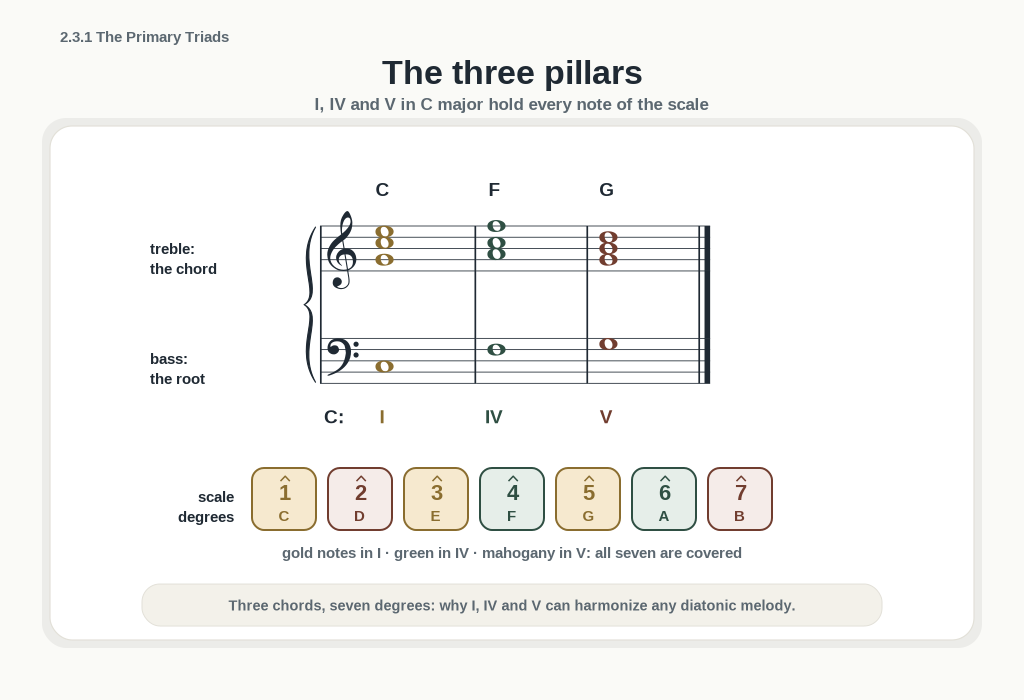
Out of the seven diatonic triads we built in Chapter 2.2, three occupy a different stratum entirely. They are the primary triads: the chords built on the first, fourth, and fifth degrees. In Roman numerals: I, IV, and V. In the key of C major: C, F, and G.
What makes them primary is not arbitrary convention. It is a mathematical fact with enormous musical consequences: between them, the I, IV, and V chords contain every note of the diatonic scale. In C major, the I chord gives you C, E, and G. The IV chord gives you F, A, and C. The V chord gives you G, B, and D. Seven distinct pitches across three chords - the entire scale, captured. This means that any melody you can write in a given key can, in principle, be harmonized using only these three chords. Three chords and the truth, as the Nashville saying goes.
And people have been proving that saying right for centuries. La Bamba. Twist and Shout. Johnny B. Goode. Wild Thing. Free Fallin’. The twelve-bar blues. Thousands upon thousands of folk songs, hymns, country ballads, punk anthems, and campfire singalongs - all built from the same three harmonic pillars. These songs are not simple because their creators lacked sophistication. They are simple because the relationships between I, IV, and V are so powerful, so deeply satisfying, that they need no ornamentation. The engine runs on three cylinders and it runs beautifully.
Each primary triad has a function - a role it plays in the drama of a key.
The tonic (I) is home. Rest. Stability. The place where tension dissolves, where the musical sentence lands, where the listener’s ear settles and says: yes, this is where we are. Every other chord in the key is defined, in part, by its relationship to the tonic - how far from home it sits, and how strongly it pulls back.
The subdominant (IV) is motion - and, as we will see in 2.3.3, it can be the return. It steps away from the tonic, introduces new harmonic colour, opens a space. The IV chord shares a note with the tonic (in C major, both C and F chords contain C), and that common tone gives the departure a gentle quality - a leave-taking that remembers where home is. The IV chord is harmony’s great in-between - a place a song can hang, deliberately unresolved. Tracy Chapman’s Fast Car shows it: its loop starts on IV, restless from the first bar - departure as the opening move rather than the middle of the journey.
The dominant (V) is the return. It is tension, and it demands home. The V chord contains the leading tone - the seventh degree of the scale, sitting one precarious half step below the tonic - and that leading tone is a leash, a gravitational cord, a note that leans so hard toward home that it can barely stand still. The dominant is the chord of expectation. It says: something is about to happen.
These three functions - home, motion, return - are the fundamental grammar of tonal harmony. They are the subject, the verb, and the object of the harmonic sentence. And they set the stage for the argument this chapter is about to make.
2.3.2The Authentic Paradigm (V–I)
The relationship between the dominant and the tonic is the most celebrated motion in Western music theory. It has been analyzed, codified, venerated, and taught as the supreme law of harmonic resolution for three centuries. In common-practice tonality - the harmonic language of Bach, Mozart, Beethoven, and their descendants - the V–I cadence is the gold standard of closure. The final handshake. The period at the end of the sentence. The door closing behind you as you arrive home.
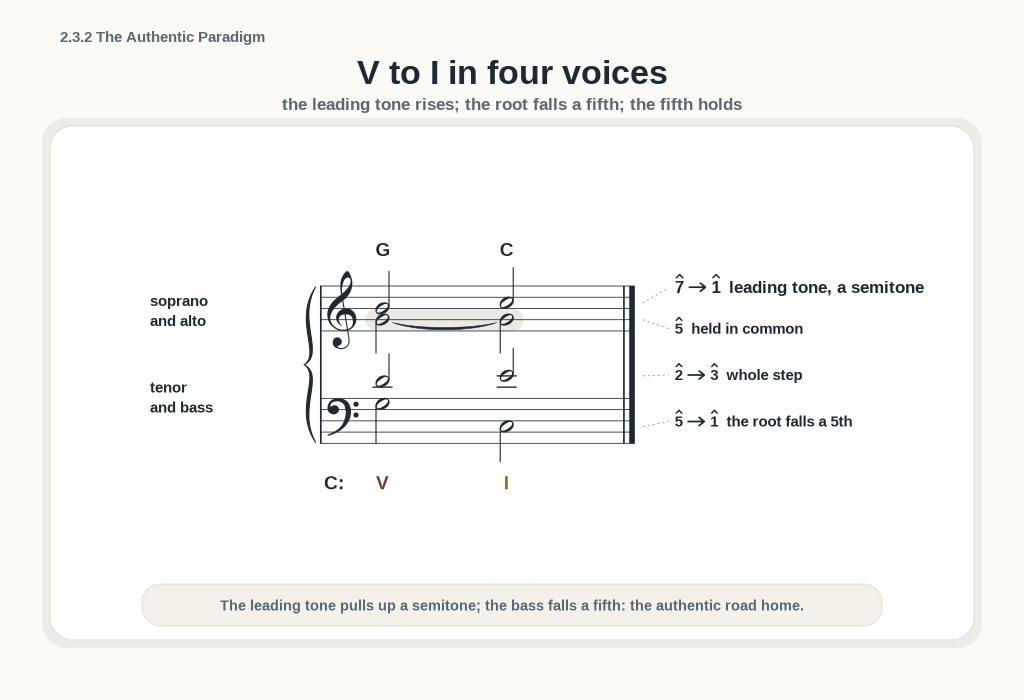
There are good reasons for this. The V–I motion is driven by some of the most powerful forces in tonal music, all converging simultaneously:
The leading tone resolves upward by half step to the tonic - the smallest possible distance, creating maximum gravitational pull. The root movement descends by a fifth (or ascends by a fourth) , which is the strongest directional motion available in the diatonic system. And the common tone - scale degree 5, shared by both the V and the I chord - holds steady , providing continuity across the resolution. Tension, direction, connection: all at once.
This is the Authentic Paradigm, and its power is undeniable. Listen to the ending of virtually any Mozart sonata, any Beethoven symphony, any Bach chorale. V to I. The engine of classical harmony. When a classical composer needed to say we are done, we have arrived, the journey is over, this was the gesture that said it.
In popular music, the Authentic Paradigm drives songs forward with an urgent, goal-directed energy. La Bamba cycles through I–IV–V and back to I , the dominant pushing the progression home with joyful inevitability. Every time the V chord sounds, it is a coiled spring . Every time it resolves to I, the spring releases .
This much is familiar from any music theory textbook. Chapter 2.2 named the second way home the Plagal Paradigm. Here is the case for it.
2.3.3The Plagal Paradigm (IV–I)
Open a standard music theory textbook. Find the section on cadences. You will almost certainly find the V–I cadence described as the "perfect" or “authentic” cadence - the strongest, the most conclusive, the model to which all other cadences aspire. And then, somewhere further down the page, often in smaller print, you will find the IV–I cadence described as the “plagal” cadence, sometimes called the “Amen” cadence because of its use at the end of hymns. The implication is clear: it is a secondary gesture, a footnote to the real thing. A polite nod where V–I was a firm declaration.
This book takes a different view.
The IV–I motion - the subdominant resolving to the tonic - is not a lesser version of the authentic cadence. It is a different kind of arrival, operating through a different mechanism, creating a different emotional quality, and serving an equally important role in the harmonic life of popular music. It is not the runner-up. It is the co-champion.
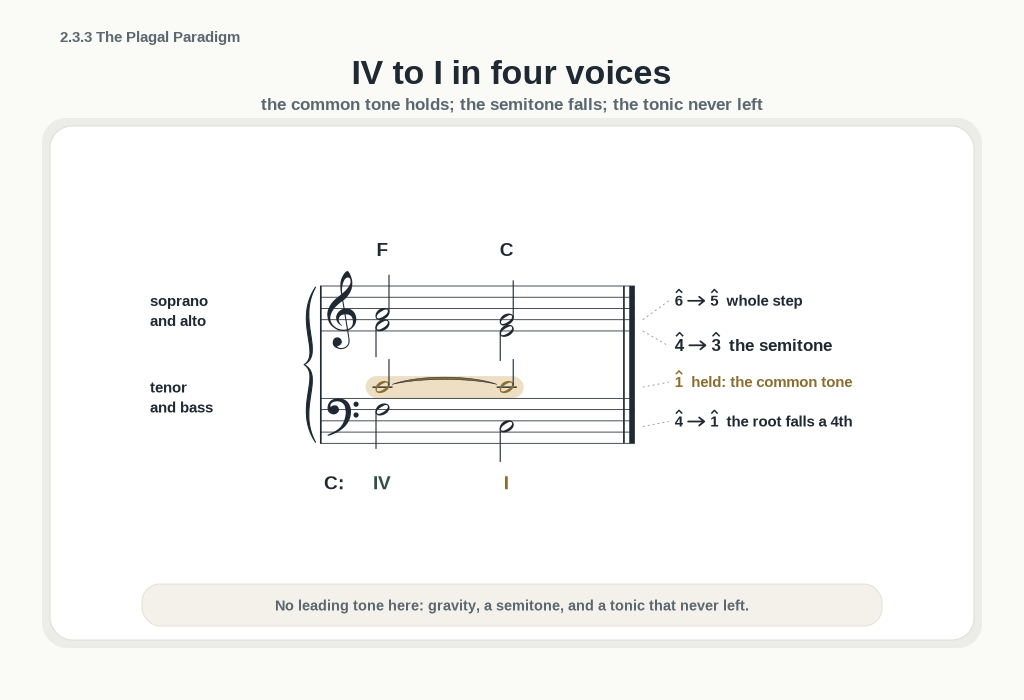
Here is what happens when IV moves to I. The root descends by a fourth (or ascends by a fifth) - the mirror image of V–I. There is no leading-tone pull; the subdominant does not contain the seventh degree of the scale. Instead, the resolution is governed by a different kind of voice leading: the fourth degree descends to the third (4–3) , here is the crucial semitone resolution. The sixth degree may descend to the fifth (6–5) ; a gentler motion descending a whole step. The IV chord also shares a common tone with I (the tonic root itself is the fifth of the IV chord), and that shared note creates a feeling of overlap, of continuity, of already being partly home before you arrive.
The result is a resolution that feels softer, broader, more spacious. Where V–I slams the door with conviction, IV–I lets the door swing closed on its own. Where V–I commands, IV–I invites. Where V–I is the direct sea-route home, IV–I is the coastal journey - arriving at the same shore, but with a different quality of return.
Listen to Let It Be. The verse settles on a IV–I resolution, and the effect is not weakness - it is warmth. Acceptance. A settling-in rather than a locking-down. This is not an accident of songwriting. It is the Plagal Paradigm doing what it does best: creating closure that feels communal rather than authoritative.
Across many gospel styles, the Plagal Paradigm is a foundational grammar and often a primary mode of resolution - alongside dominant, blues, vamp, and chromatic practices. The “Amen” is not merely a decorative appendix: in plagal-rich passages, subdominant-to-tonic motion can make arrival feel warm, collective, and repeatable. Gospel harmony does not reject dominant pull; it places it within a larger vocabulary that also includes the subdominant’s embrace.
Sometimes the plagal road is the main road. The verses of Guns N’ Roses’ “Sweet Child O’ Mine” live in Mixolydian - a mode with no leading tone and therefore no true dominant chord - so their phrases close IV–I not as a stylistic softening but as the mode’s natural road home. Where the dominant does not exist, the subdominant is not the lesser option; it is the resolution.
Listen to Coldplay’s Yellow, where the plagal motion is looped, cyclical, endlessly renewable - not a single moment of closure but a sustained state of arrival, a song that is always already home. Listen to the vast catalogue of modern R&B and indie pop built on I–V–vi–IV or its variants, where the IV chord resolves to I at the top of each loop, quietly and persistently confirming the key without ever invoking the dominant for that purpose. And notice what that implies: as Chapter 2.2 put it, a loop is not going anywhere ; it is being somewhere . Loops are small functional energy units that keep the drive alive - self-contained and dynamic yet stationary, each with its own limited tonal universe.
The Plagal Paradigm is not an absence of dominant function. It is a different function - equally powerful, equally structural, equally capable of creating the sensation of arrival and rest. To hear it as a lesser V–I is to listen with the wrong ears. It is to parse English using only a German dictionary and wonder why the French words are not translating.
Pop has even built a loop almost entirely out of plagal motion. Take a minor key, hop up to ♭III, then fall by perfect fourth, again and again, until you land back home: those three falls are the plagal cascade, each one a IV–I relationship, and the hop up is how the loop starts over. Green Day’s Boulevard of Broken Dreams runs on it; so does Linkin Park’s “What I’ve Done” - a song whose harmony is almost nothing but this chain of soft arrivals, the authentic engine run in reverse - along with Imagine Dragons’ Radioactive and the verse of Oasis’s Wonderwall. And the cascade carries a lovely paradox: where stacking dominants (V-of-V-of-V) winds the tension tighter and tighter, stacking plagal resolutions does the opposite - the more of them you chain, the less final the arrival feels. A cascade of gentle homecomings adds up to a song that drifts rather than lands, which is exactly why these loops soundtrack lostness so well.
2.3.4The Dual Paradigms as Equal Forces
Here, then, is the defining thesis of this book’s approach to harmony:
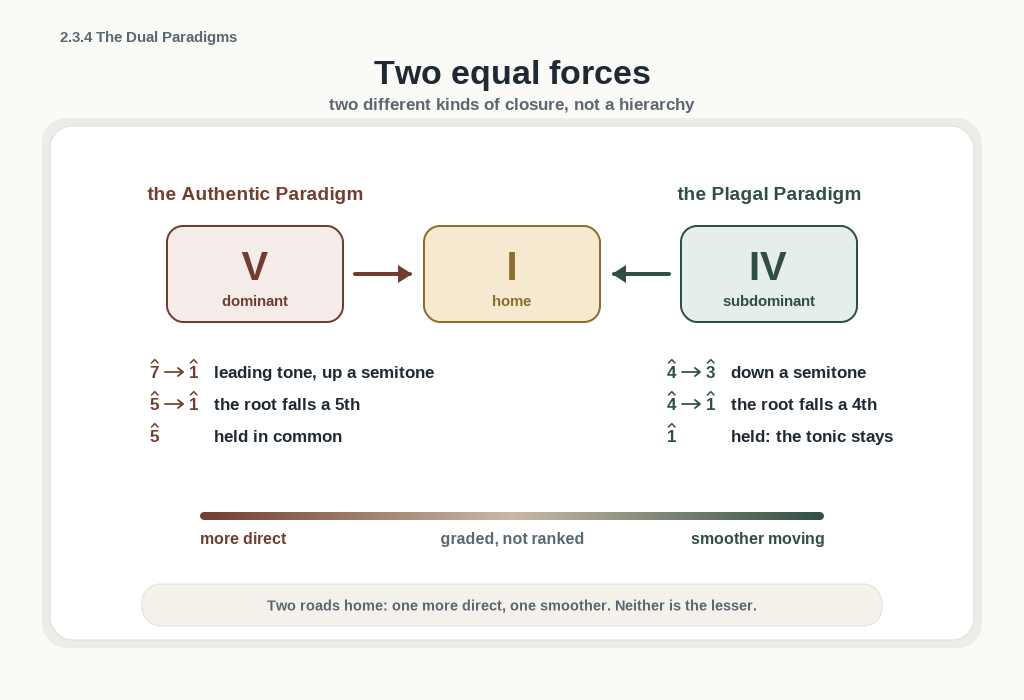
The Authentic Paradigm (V–I) and the Plagal Paradigm (IV–I) are dual, equal forces in popular music. Musical closure is a graded, style-dependent phenomenon - not a universal law dictated solely by dominant-tonic syntax. What this book proposes is that closure in popular music is a matter of five domains - harmony, melody, metre, dynamics and timbre - each able to vote , with the felt finality of any moment depending on how many of them vote together . The V–I cadence is enormously powerful. It is not the whole story. And teaching it as though it were the whole story does a disservice both to the music and to the students trying to understand it.
Corpus counts and controlled listening tests both say the same thing - closure is graded, and style shifts the grade - and the numbers are in the box below. The dominant still throws the hardest punch at the big cadential moments; the subdominant owns the everyday roads home. You can hear that division of labour inside a single song: in the Rolling Stones' Sympathy for the Devil, the verses ride plagal motion, and the V–I is held in reserve for the refrain, where the protagonist introduces himself. The stronger cadence is not the default; it is the special effect.
⚖️ 🏛️ Pedestal of Pedantry: Counting the Votes
Start with what songs actually do. In de Clercq and Temperley's corpus of rock hits from the 1950s to the 1990s, IV is the most common chord after the tonic and the most common chord immediately before the tonic. Temperley's separate count of section-ending cadences puts V–I in 32 per cent of songs and IV–I in 18.5 per cent. Neither figure crowns a king; together they establish IV–I as structural rather than decorative. Analysts of post-tonal music had already graded closure: Grujić and Janković (2018) identified the parameters that matter most for closure in Webern's twelve-tone works and sorted his endings into perfect closure, closure and semiclosure; the claim here is that popular music runs on the same principle at a larger scale.
Then ask what listeners hear. In 2019 Dominique Vuvan and Bryn Hughes primed listeners with a few bars of classical or rock music, then asked how well a final cadence belonged - the classical V–I, or the rock-native ♭VII–I. In a classical frame, V–I won decisively. In a rock frame, the preference all but vanished: both routes home were rated as belonging. Another experiment found that timbre alone - piano versus distorted guitar - produced a version of the same shift.
The honest counterweight: the dominant's edge has reasons behind it, and they do not disappear when the style changes - what changes is how much weight listeners give them. Richard Parncutt's 2024 account of why V–I is the "strong progression" lists those reasons - the rising leading tone, the falling fifth in the bass, V's own instability pressing it toward I - and IV–I has fewer of them. Both things are true, and they are not in conflict. The dominant's advantage is real and it is contextual - which is precisely what "style-dependent" means.
What this means, practically, is that we must stop teaching the V–I cadence as the “real” ending and everything else as a deviation. Instead, we must teach two paradigms side by side, as dual aspects of a single phenomenon - the phenomenon of harmonic return.
V–I provides drive, tension, directional energy, and decisive closure. It is the sound of certainty.
IV–I provides space, breath, warmth, and a softer, often more modal sense of arrival. It is the sound of acceptance.
The greatest progressions in popular music often balance both. The I–IV–I–V loop - heard in Brown Eyed Girl, “The Lion Sleeps Tonight,” and a thousand others - alternates between plagal and authentic motion, swinging like a pendulum between warmth and drive, departure and return, gentleness and urgency. The I–IV–V–IV loop - the “Wild Thing” progression - uses the IV chord both to step away from the tonic and to step back down from the dominant, softening the V’s impact, triangulating between the three primary chords in an endlessly satisfying cycle.
Whether the harmony resolves through V–I or IV–I, the same allies strengthen the arrival: a melody landing on a stable degree, a rhythm landing on a strong beat. These are powerful cues rather than strict requirements - displaced, elided, and fadeout closures get by without them - but when they align, they outrank the harmonic paradigm itself. A plagal cadence that lands on the downbeat with the melody arriving on the tonic is more closural than an authentic cadence buried on a weak beat with the melody hanging on the second degree. The convergence of forces matters more than the identity of any single force.
We will build this argument - the argument about the convergence of all five - piece by piece across the next two units, until it reaches its fullest expression in Chapter 4.8. For now, simply notice: the paradigm changes, but the principle does not.
Prof. Krankenhorn
“A cadence without a leading tone is like a sentence without a verb. It may convey a feeling, but it asserts nothing. I refuse to accept ‘Let It Be’ as a model of structural integrity.”
Prof. Krankenhorn
“Ah - the laughter of the unpublished. Do carry on. But while you were busy being adored, three centuries of theory were busy being right. Every treatise since Rameau says the same thing: the leading tone wants the tonic, the fifth falls to its root, and that is what a cadence is. Not fashion, dear boy. Grammar. The dominant reigns, and it has the paperwork.”
2.3.5Diatonic Circle Progressions
The primary triads are the pillars. But there are four more diatonic chords in every key - the secondary triads, built on the second, third, sixth, and seventh degrees: ii, iii, vi, and vii°. And these chords, when set in motion by a specific principle, create some of the most propulsive harmonic sequences in all of music.
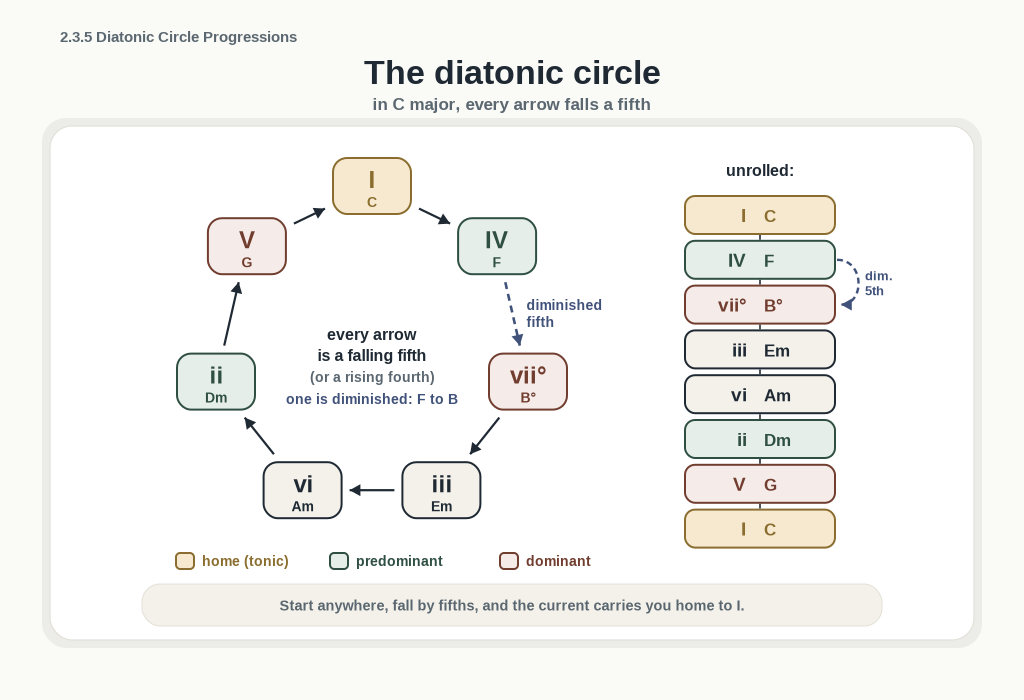
Chapter 2.2 glimpsed this in “Autumn Leaves” and “I Will Survive”; here is why it works. The principle is this: chords whose roots are a fifth apart share the same directional energy as V–I. When a chord’s root drops by a fifth (or rises by a fourth) , the motion mimics the dominant-to-tonic relationship. It is not a true V–I - the chord qualities are different, the voice leading is different - but the root movement creates a similar sense of forward momentum, of inevitability, of one chord falling into the next.
Line up several of these falling-fifth motions in a row and you get a diatonic circle progression - a chain of chords cascading through the key by descending fifths. In C major: vi–ii–V–I. That is, Am–Dm–G–C. Each chord pushes into the next like a series of falling dominoes. The vi chord leans into the ii. The ii leans into the V. And the V, with the full force of the authentic paradigm behind it, leans into I. By the time you reach the tonic, you have been pushed there by three consecutive waves of forward motion. The effect is not just satisfying - it is inevitable.
Circle progressions are the engine of countless songs across genres. Gloria Gaynor’s I Will Survive rides a nearly complete circle of fifths with relentless momentum, turning the harmony itself into a survival march. Autumn Leaves - one of the most recorded jazz standards - is built almost entirely on circle-of-fifths motion, its melancholy beauty arising from the way each chord surrenders to the next. Alicia Keys’s “If I Ain’t Got You” weaves gospel-inflected circle motion through a neo-soul texture, the falling fifths creating a sense of emotional accumulation - each chord carrying the weight of the last.
The circle progression is, in one sense, the ultimate extension of the Authentic Paradigm - every chord change is a miniature V–I, a chain of resolutions stretching backward from the tonic through the entire diatonic system. But notice what happens when the circle arrives at IV: it can resolve to I plagally, bypassing the dominant entirely. The circle progression, that most authentic of devices, can end with a plagal gesture. The two paradigms are not enemies. They are partners, and the circle is one of the places where they meet.
Two paradigms. Two roads home. The question was never which one is right - it was how they work together. In Chapter 2.6, we meet the schemata: the specific chord progressions that popular music has returned to, again and again, because they balance these dual forces in ways that never seem to get old.
References
de Clercq, Trevor, and David Temperley. 2011. “A Corpus Analysis of Rock Harmony.” Popular Music 30 (1): 47–70.
Grujić, Gordana, and Mladen Janković. 2018. “Tension and Relaxation (Do Not) Exist in Dodecaphonic Music of Webern.” Rasprave Instituta za hrvatski jezik i jezikoslovlje 44 (2): 423–36.
Parncutt, Richard. 2024. “The Origin of the Dominant: Schoenberg’s ‘Strong Progression’ and the Realisation of Implied Virtual Pitches.” Music Analysis 43 (2): 247–301. Article.
Temperley, David. 2011. “The Cadential IV in Rock.” Music Theory Online 17 (1). Article.
Vuvan, Dominique T., and Bryn Hughes. 2019. “Musical Style Affects the Strength of Harmonic Expectancy.” Music & Science 2. Article.