Introduction
A non-chord tone (NCT) is exactly what the label promises: it is a note that does not belong to the current chord. There are many types of non-chord tones (many names and many labels), but they all fall into two broad categories:
Weak Beat Non-Chord Tones
Strong Beat Non-Chord Tones
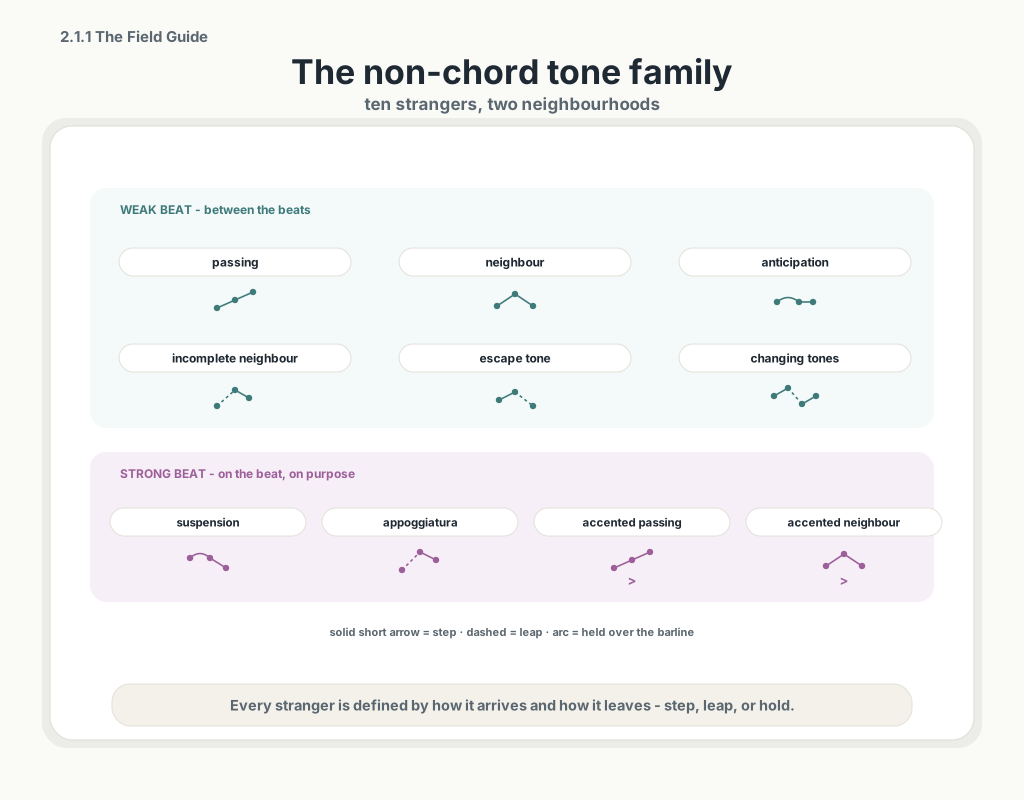
These 2 categories of NCT have very different effects and purposes. Anything that happens on a strong beat tends to be more noticeable or obvious and can have structural significance, whereas the weak beats tend to be less obvious and perhaps more decorative and/or melodically connective in nature.1
Weak Beat Non-chord Tones
Weak beat non-chord tones are more common than strong beat ones. Though the focus is on the non-chord tone itself, there are three phases to the life of every non-chord tone. The approach is the note that precedes the NCT, that is followed by the NCT, and then the resolution is the note that follows it. This always follows the same three-phase pattern, though the metric placement differs by type.
Passing Tone
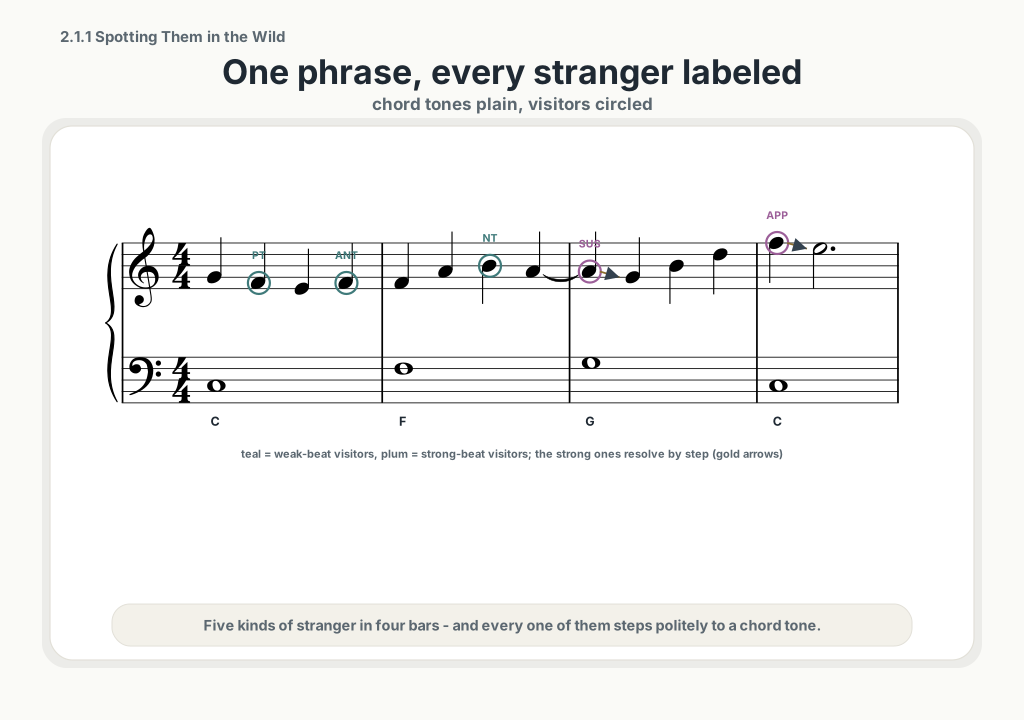
The passing tone (or passing note) is the most common type of non-chord tone. A passing tone literally passes between 2 different chord tones. A passing tone can pass between 2 chord tones of the same chord or between 2 chord tones of different chords. Passing tones fall on weak or relatively weak beats. The passing tone itself moves by step (a 2nd), filling in the interval of a 3rd between the two chord tones.
Sometimes there will be two passing tones in a row; this is very common when moving between the 5th of the chord up to the root above: sol-la-ti-do.
Neighbour Tone
A neighbour-tone (or auxiliary-tone) is a non-chord tone that falls between two chord-tones that are the same note. A neighbour-tone can pass between two chord tones of the same chord or between 2 chord tones of 2 different chords. The neighbour can be above or below the chord-tones. Ultimate distance moved - none.
Anticipation
An anticipation arrives early on a pitch belonging to the next chord, then repeats or continues as that chord begins. It may be approached by step or leap; its defining ‘resolution’ is the repeated pitch.
Incomplete Neighbour
An incomplete neighbour is approached by a leap and then resolved by step to the chord tone (or vice versa - approached by step and resolved by leap).
Escape Tones
An escape tone (or échappée) is approached by step and left by leap in the opposite direction. The inverse contour - leap in, step out - belongs to the incomplete-neighbour family. Historical uses of cambiata vary, so we will reserve that term for a later counterpoint context.
Changing Tone Pattern
A changing tone pattern is a pair of non-chord tones appearing between the same start/end note. Start on a chord note and then move to a neighbour tone and then leap to the other neighbour tone before returning to the original note.
Strong Beat Non-chord Tones
Strong beat non-chord tones are very different from their weak beat relatives. Strong beat NCTs are usually quite obvious to the listener because they can produce somewhat unusual chords, and are expressive notes, dissonant by definition, which often have some harmonic significance. Of course, they will also be more audible simply by virtue of appearing on a strong beat.
Strong beat NCTs typically produce chords that are not (initially) standard chords, but become chords once the NCT has resolved to a chord tone. Strong beat NCTs are usually replacing a missing chord tone. This is particularly so when the 3rd of a triad is replaced with a 4th above the root.
Suspensions
Appoggiaturas
Accented Passing Tones
Accented Neighbour Tones
Suspensions
Suspensions are accented dissonances that must be prepared and then resolved.
There are three parts to a suspension:
preparation
suspension
resolution
Suspensions are numbered according to the interval above the bass. Suspensions typically resolve down by step except the leading tone, which rises to the tonic, especially in an outer voice - a figure the strict nomenclature calls a retardation, though we will treat it as part of the suspension family.
Appoggiaturas
An appoggiatura is an accented non-chord tone; approached by leap; resolves by step to the note of resolution. Appoggiaturas fall on strong or relatively strong beats and resolve by step onto a weaker beat.3
Accented Passing Tones
An accented passing-tone is an accented non-chord tone that acts exactly like a passing-tone except for its placement on a (relatively) strong beat.
Accented Neighbour Tones
An accented neighbour-tone acts exactly like a neighbour-tone except for its placement on a (relatively) strong beat.
Notes
- The distinction between strong-beat and weak-beat non-chord tones corresponds to what classical theory calls "accented" versus "unaccented" dissonances. This distinction is foundational in common-practice voice-leading pedagogy; see Stefan Kostka and Dorothy Payne, Tonal Harmony: With an Introduction to Twentieth-Century Music, 7th ed. (New York: McGraw-Hill, 2013), chs. 5–6, for a standard textbook treatment.
- In common modern pedagogy, an échappée (escape tone) is approached by step and left by leap in the opposite direction. Cambiata has varied historical meanings, including a multi-note contrapuntal figure, so this book does not use it as a simple inverse synonym for escape tone.
- The Italian appoggiatura (from appoggiare, "to lean" or "to support") is the term for an accented non-chord tone that leans - emotionally as well as melodically - against its resolution. C.P.E. Bach described the appoggiatura as one of the most expressive ornaments available to a melodist in his Essay on the True Art of Playing Keyboard Instruments (1753).