4.3.1Introduction
In 1784, a customs official in Salzburg confiscated a piece of music by Mozart on the grounds that it contained a chord so dissonant it could only be intended to corrupt public morals. The chord in question was an augmented sixth. Two centuries later, Charlie Parker played its enharmonic twin - a dominant seventh whose root lay a tritone from the dominant it replaced - and called it hip.
Same four notes. Related voice leading. Two entirely different musical civilizations. This chapter is about the bridge between them.
In Chapter 3, we explored secondary dominants and diminished seventh chords as tools for chromatic movement and harmonic surprise. This chapter extends that conversation in two directions: first, backward to the classical era’s most elegant predominant sonorities, and second, forward into the jazz language where those classical chords transform into something entirely new. Augmented sixth chords represent one of the most sophisticated predominant harmonies in the classical and Romantic vocabularies. They create a distinctive sound through the expansion of a dissonant interval - the augmented sixth - that resolves outward to the octave, driving the harmonic motion toward the dominant. Yet these same chords, viewed through an enharmonic lens, become the gateway to tritone substitution, a technique that jazz musicians adopted and transformed into a fundamental tool of modern harmonic vocabulary.
We are building on foundations laid across Unit III. In Chapter 3.1, we saw how secondary dominants multiply the V→I pull across the key. In Chapter 3.2, we discovered how diminished seventh chords concentrate that pull into a single, coiled sonority. In Chapter 4.2, we explored how chromatic alterations intensify the dominant’s tension to its breaking point. Now we encounter two techniques that approach the dominant from an entirely different angle - not by strengthening V, but by replacing it with chords that achieve the same closural effect through different voice-leading pathways.
This chapter traces the bridge between classical voice-leading disciplines and jazz harmonic flexibility. We begin with the augmented sixth chord in its traditional context, examining the three principal types and their resolution patterns. We then reframe these chords enharmonically - particularly the German sixth, which reveals itself as a dominant seventh in disguise - and from that reframing emerges tritone substitution, a technique that has shaped popular music, jazz, and contemporary songwriting for nearly a century.
4.3.2The Augmented Sixth Interval
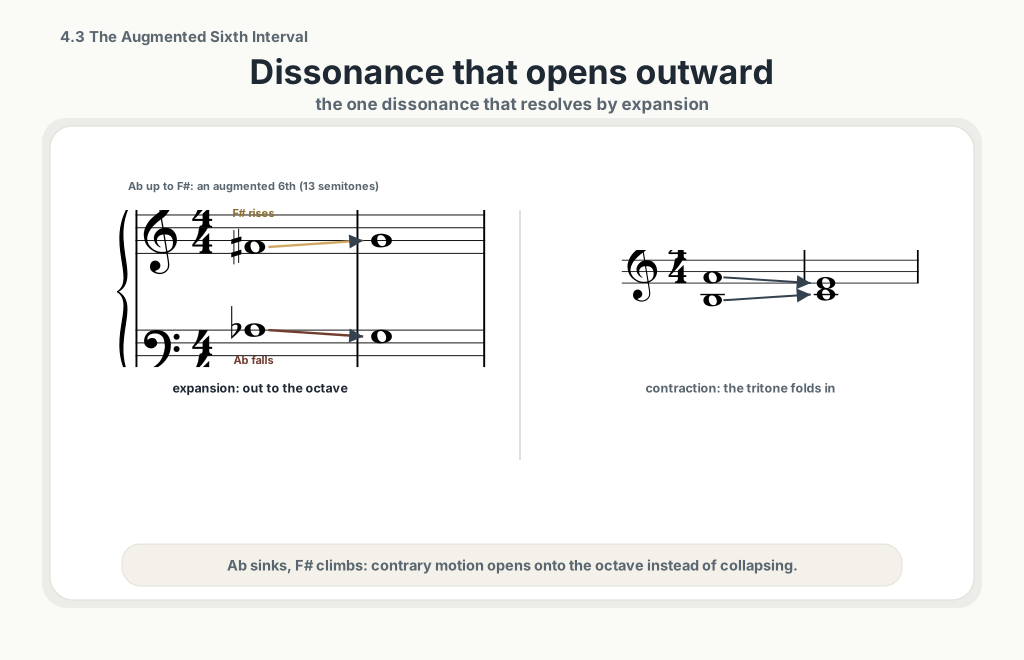
The augmented sixth interval forms the harmonic nucleus of augmented sixth chords. Unlike the diminished intervals we studied in Chapter 3, the augmented sixth exists primarily as a linear phenomenon: two voices expand outward from a starting point, pulling apart under harmonic tension, and resolve to the octave. This expansion creates a characteristic sound that is both restless and focused. The interval measures ten semitones (compared to the major sixth’s nine semitones), and this extra semitone creates the dissonance that demands resolution.
In traditional voice leading, the augmented sixth interval typically appears between the bass (the root of the augmented sixth chord) and a soprano voice. As the chord resolves, the lower voice moves down a semitone while the upper voice moves up a semitone, creating a smooth two-semitone expansion. This outward expansion - rather than the inward compression we hear with diminished intervals - gives augmented sixth chords a distinctive urgency. Where a diminished seventh chord might surprise us with enharmonic reinterpretation, an augmented sixth chord compels us forward through sheer voice-leading logic.
The Sage
“The augmented sixth is one of the rare common dissonances whose defining resolution expands rather than contracts. Where many familiar dissonances compress - the seventh falls, the tritone contracts - the augmented sixth opens outward, like a door swinging on its hinges. It is dissonance as aperture: the wider it opens, the more light comes through.”
Some augmented sixth sonorities also contain a tritone. In C major, the French sixth A-flat–C–D–F-sharp contains both the defining augmented sixth (A-flat to F-sharp) and a tritone (A-flat to D). The German sixth A-flat–C–E-flat–F-sharp contains a different tritone (C to F-sharp). These embedded tritones link the fuller augmented sixth chords to the secondary dominants we studied earlier and foreshadow their relationship to tritone substitution later in this chapter.
4.3.3The Three Types: Italian, German, and French Sixth Chords
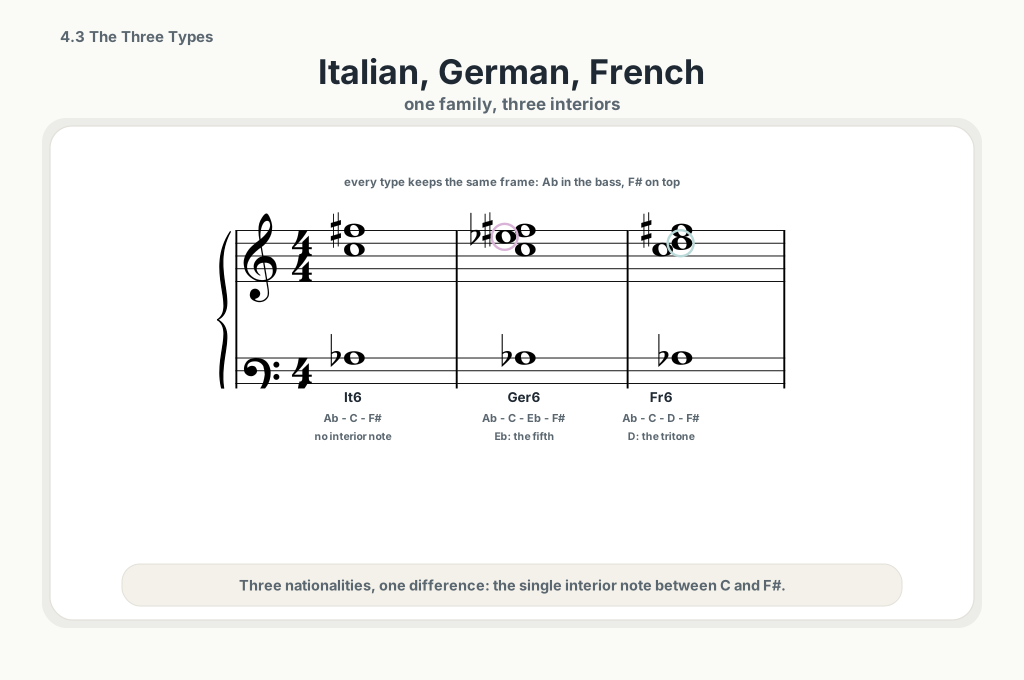
Augmented sixth chords appear in three principal forms, each defined by the intervals built above the bass note. These types carry geographical names - Italian, German, and French - a legacy of nineteenth-century music theory pedagogy. While the terminology may seem arbitrary, each type has distinct voice-leading properties and characteristic functions.
The Italian sixth (It6) is the simplest form: it consists of the root, the major third above that root, and the augmented sixth. In the key of C, an Italian sixth chord built on A-flat contains A-flat, C, and F-sharp. In four-part writing, this creates a spare, direct harmony with just three pitches (often the root is doubled). The Italian sixth has an almost skeletal clarity, and its voice leading is the most straightforward: the augmented sixth expands to the octave while the remaining C voices typically move by step to B and D within the dominant harmony.
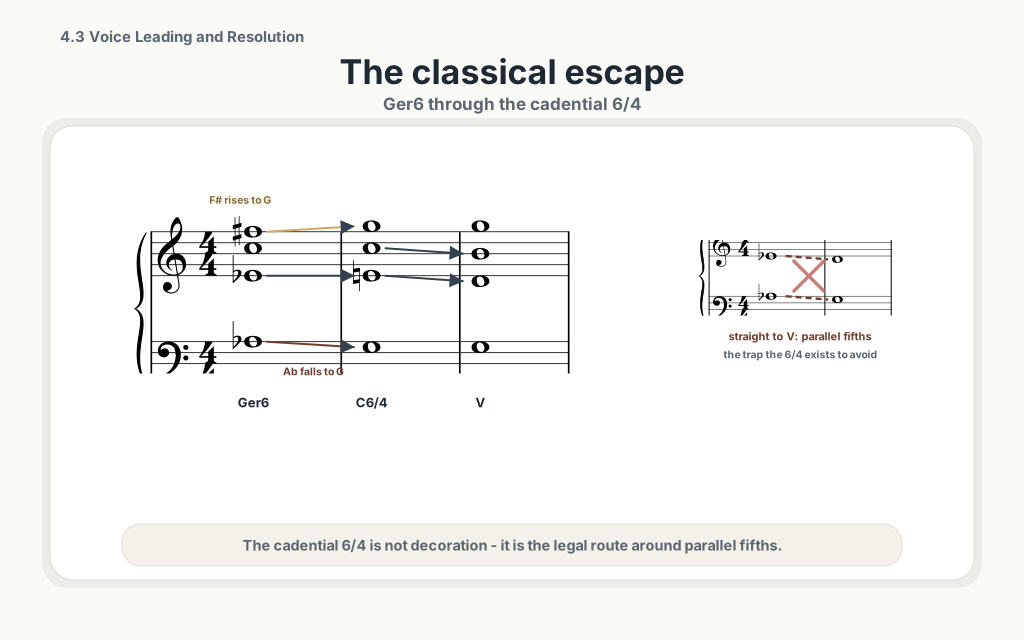
The German sixth (Ger6) adds a perfect fifth above the root, creating four distinct pitches: root, major third, perfect fifth, and augmented sixth. Our A-flat German sixth would contain A-flat, C, E-flat, and F-sharp. The German sixth is the most familiar type in common-practice music, and it creates a richer, more sonorous sound than the Italian sixth. However, the German sixth presents a voice-leading challenge: when resolved directly to the dominant chord, the perfect fifth A-flat–E-flat can move in parallel to the perfect fifth G–D. To avoid this problem, composers typically insert a cadential six-four chord between the German sixth and the dominant, creating a smoother voice-leading path and a more refined harmonic rhythm.
The French sixth (Fr6) replaces the perfect fifth with an augmented fourth above the root, giving it a unique character. An A-flat French sixth contains A-flat, C, D, and F-sharp. The augmented fourth adds a lightness to the sonority, and the French sixth often appears in contexts where a more delicate touch is desired. The French sixth’s voice leading is also the most flexible of the three: both the augmented fourth and the augmented sixth expand outward during resolution, and the chord resolves smoothly without the parallel-fifth problem that plagues the German sixth.
Prof. Krankenhorn
“I have long maintained that the geographical labels for these chords are an embarrassment to pedagogy. The ‘Italian’ sixth has nothing to do with Italy. The ‘French’ sixth was not invented in France. And the ‘German’ sixth - I say this with some national pride - is by far the most harmonically sophisticated of the three, which suggests the nomenclature is at least partially correct.”
The Jester
“Professor, are you claiming the German sixth chord for Germany?”
Prof. Krankenhorn
“I am claiming it for rigour.”
4.3.4Voice Leading and Resolution
The resolution of augmented sixth chords follows principles that connect them to dominant function, even though they technically contain no V chord. As predominant chords built on the lowered sixth degree, augmented sixth chords function as functional equivalents to the subdominant chords we encountered in earlier chapters. They pull forward toward the dominant with an intensity that makes the V-I motion feel inevitable.
In classical voice leading, the resolution process proceeds as follows: the augmented sixth interval expands outward to the octave (typically A-flat descending to G while F-sharp rises to G in the key of C major), while the remaining chord tones move smoothly into the dominant harmony. The chord tone that creates difficulty is the perfect fifth (in the German sixth), which must be handled carefully to avoid parallel fifths. The standard solution, as mentioned above, is to resolve through a cadential I⁶₄ over the dominant bass, which allows the E-flat of the German sixth to rise by semitone to E and creates two separate harmonic moments instead of one direct leap.
The characteristic voice-leading pattern looks like this in C major: Ger6 (A-flat, C, E-flat, F-sharp) resolves to a cadential I⁶₄ over G (G, C, E), which then resolves to V (G, B, D). A-flat falls to G, F-sharp rises to G, E-flat rises to E, and C remains common; as the cadential six-four resolves, C falls to B and E falls to D. This creates a smooth, efficient voice-leading path that respects all classical constraints while moving toward dominant harmony.
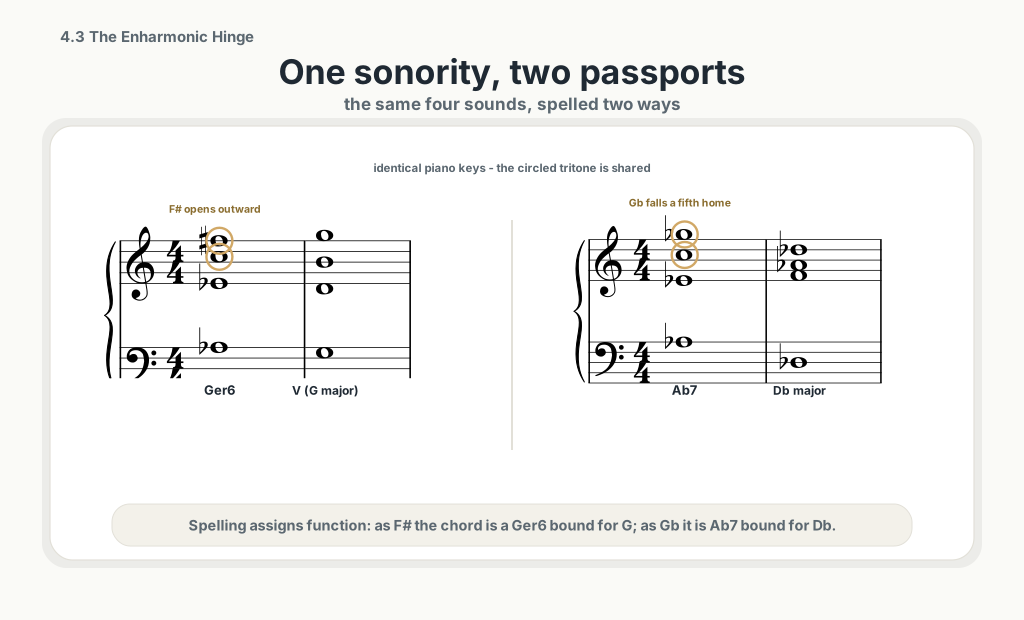
A useful pedagogical shortcut exists for understanding the German sixth: imagine it as an enharmonic rewriting of a dominant seventh chord. If we respell the F-sharp as G-flat and read the German sixth chord vertically, we get A-flat, C, E-flat, and G-flat. Spelled this way, the sonority is simply a dominant seventh chord built on A-flat (A-flat, C, E-flat, G-flat) - the V7 of D-flat. This observation - that the German sixth is enharmonically identical to a V7 chord - becomes the conceptual bridge to tritone substitution, a technique we will explore in depth in Section 4.3.5.
4.3.5The Bridge to Jazz: Tritone Substitution
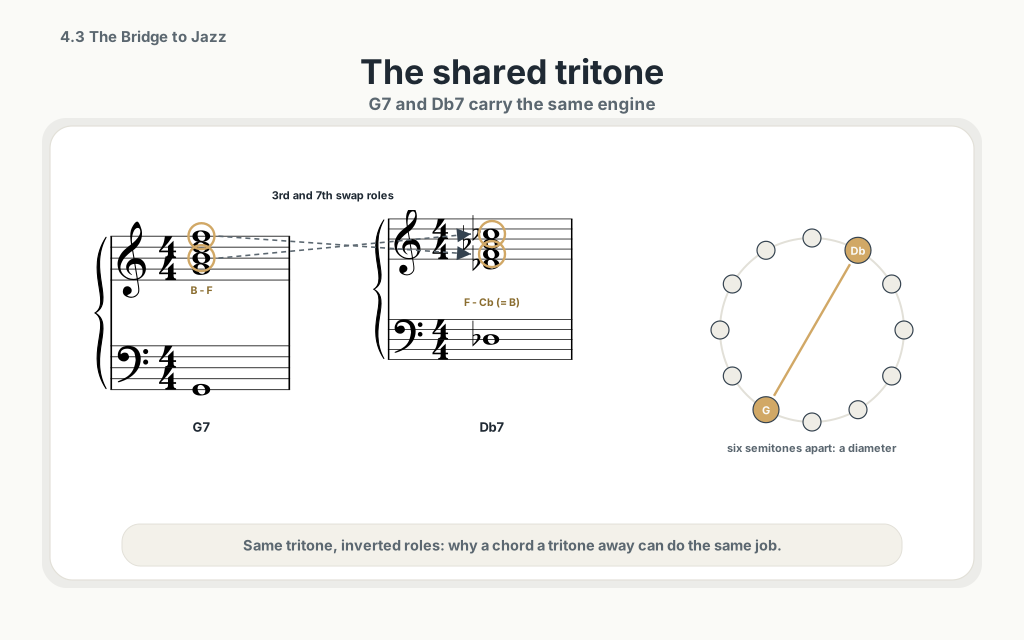
Tritone substitution emerges from a single observation: two dominant seventh chords whose roots are a tritone apart (six semitones) contain the same tritone pitch classes between their thirds and sevenths. This shared tritone means that for purposes of harmonic function, one chord can replace the other with minimal disruption to voice leading and with a dramatic change to bass movement.
This is substitutive closure in its purest chemical form - the same concept we encountered with the backdoor dominant in Chapter 3.4, but operating through a different mechanism. Where ♭VII→I achieves closure through plagal-adjacent motion, the tritone substitution achieves closure through chromatic bass descent while preserving the dominant’s most characteristic sound: the tritone itself.
In a ii-V-I progression in the key of C major, the dominant chord is G7, which contains the pitches G, B, D, and F. The tritone in this chord spans from B (the third) to F (the seventh). Now, if we build a dominant seventh chord on D-flat (the tritone-related root), we get D-flat, F, A-flat, and C-flat (enharmonically B). This D-flat7 chord contains the identical tritone (F and C-flat, enharmonically B), with the chord-tone roles reversed: F is now the third and C-flat is the seventh. When we substitute D-flat7 for G7 in our ii-V-I progression, we get ii-bII7-I, where D-flat7 (the tritone substitution) resolves down by half-step from D-flat to C, creating smooth chromatic bass motion.
The Craftsman
“Here is the practical rule: any dominant seventh chord can be replaced by another dominant seventh chord whose root is a tritone away. G7 becomes D♭7. E7 becomes B♭7. The voice leading takes care of itself - the third and seventh simply swap roles. Once you internalize this single substitution, you have unlocked half of jazz harmony. The other half is knowing when not to use it.”
This technique offers profound advantages over traditional dominant function. First, the chromatic bass line is more compelling: instead of a G to C bass motion (a generic fifth), we get a D-flat to C motion (a graceful semitone descent). Second, the tritone substitution side-steps the traditional dominant entirely, creating a sense of functional displacement while maintaining harmonic coherence. Third, because the tritone substitution shares the third-to-seventh tritone with the original dominant, the dominant’s most characteristic sound remains intact - the dissonant tritone that demands resolution.
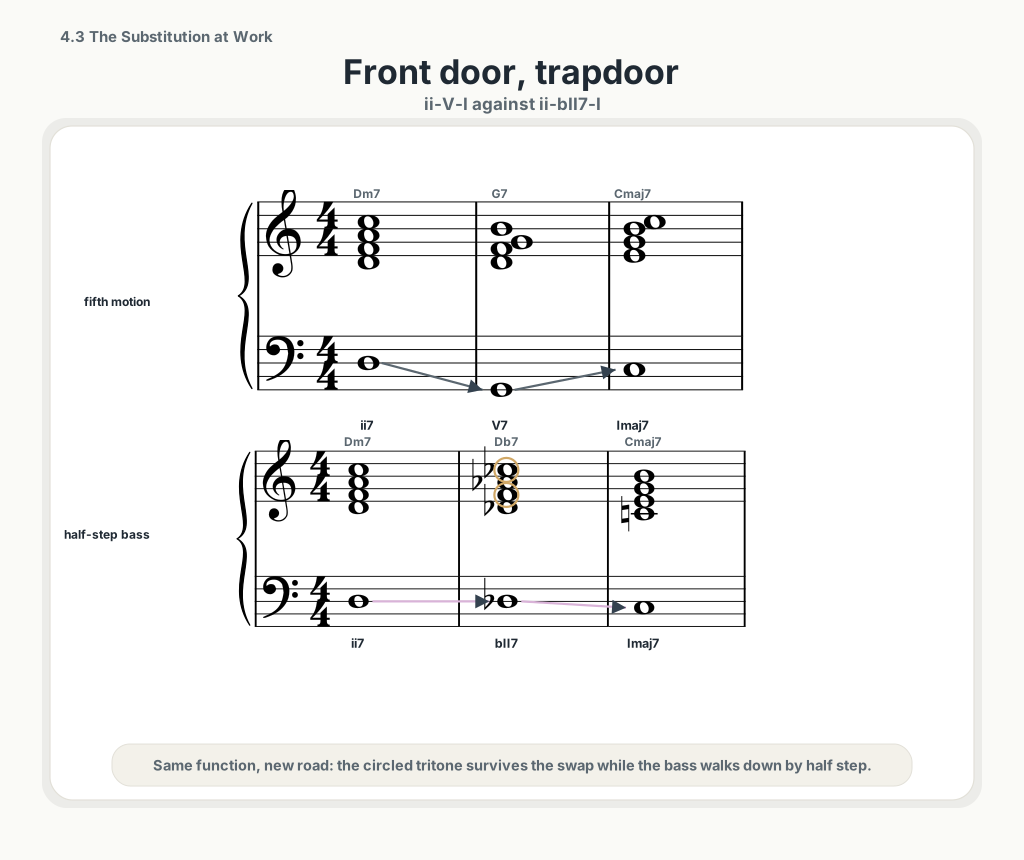
The bridge between augmented sixth chords and tritone substitution now becomes clear: the German sixth chord is itself a tritone substitution in classical clothing. When we enharmonically rewrite the German sixth built on A-flat as an A-flat dominant seventh chord (by respelling F-sharp as G-flat), we reveal the same dominant-seventh sonority that jazz musicians use as a tritone substitute. The difference lies in context and voice-leading convention: the classical composer avoids the parallel fifths and inserts a cadential six-four, while the jazz musician embraces the chromatic bass motion directly.
4.3.6Tritone Substitution in Practice
Tritone substitution has become so thoroughly absorbed into the jazz language and contemporary popular music that it functions as an unquestioned tool of harmonic expression. It appears across virtually every jazz standard, in the chord progressions of rhythm and blues, in the sophisticated harmonies of contemporary pop production, and in the language of modern singer-songwriters who have absorbed jazz influence.
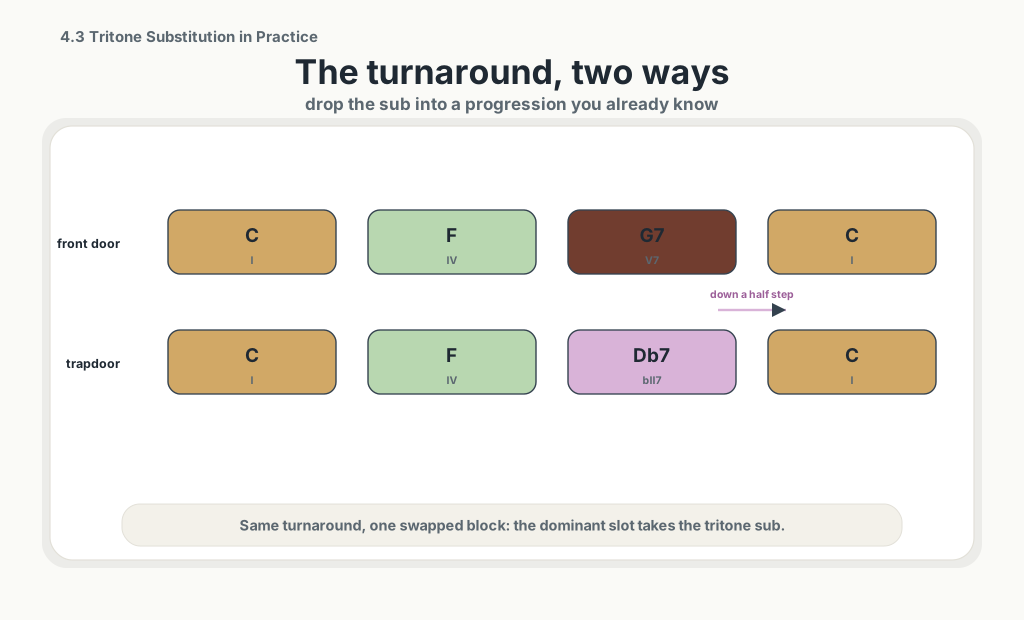
The technique’s application is straightforward: whenever a V7 (or any dominant seventh) chord appears in a progression, it can be replaced with bII7 (the tritone-substituted dominant). In practice, this substitution often appears in two contexts. First, it may replace the dominant in a standard ii-V-I progression, creating a smooth chromatic bass line that traditional voice leading would not produce. Second, it may substitute for a V7 chord that resolves to a chord other than the tonic - for instance, a vi7 or a IV chord - creating unexpected harmonic colour while maintaining functional integrity.
Consider a simple example: in a blues progression in C, a traditional turnaround might use C-F-G7-C. If we substitute the tritone equivalent of G7 (which is D-flat7) for the G7 chord, we get C-F-D-flat7-C. The D-flat7 resolves down by half-step to C, and though the F-D-flat motion in the bass is unconventional, it creates a sophisticated chromatic pathway that feels both smooth and surprising. This is exactly the kind of substitution that Amy Winehouse employed in songs like Back to Black, where jazz-influenced harmonic language sits comfortably alongside R&B and soul idioms.
The Traveller
“The first time I heard a tritone substitution consciously, I was transcribing a Thelonious Monk solo in a practice room at two in the morning. He played a D♭7 where I expected a G7, and I spent twenty minutes convinced I had the wrong key. Then I played it on the piano, and the bass note slid down by half-step into C, and I understood. Monk wasn’t wrong. He was just arriving by a different route - the scenic route, the chromatic route, the route that makes you lean forward in your chair.”
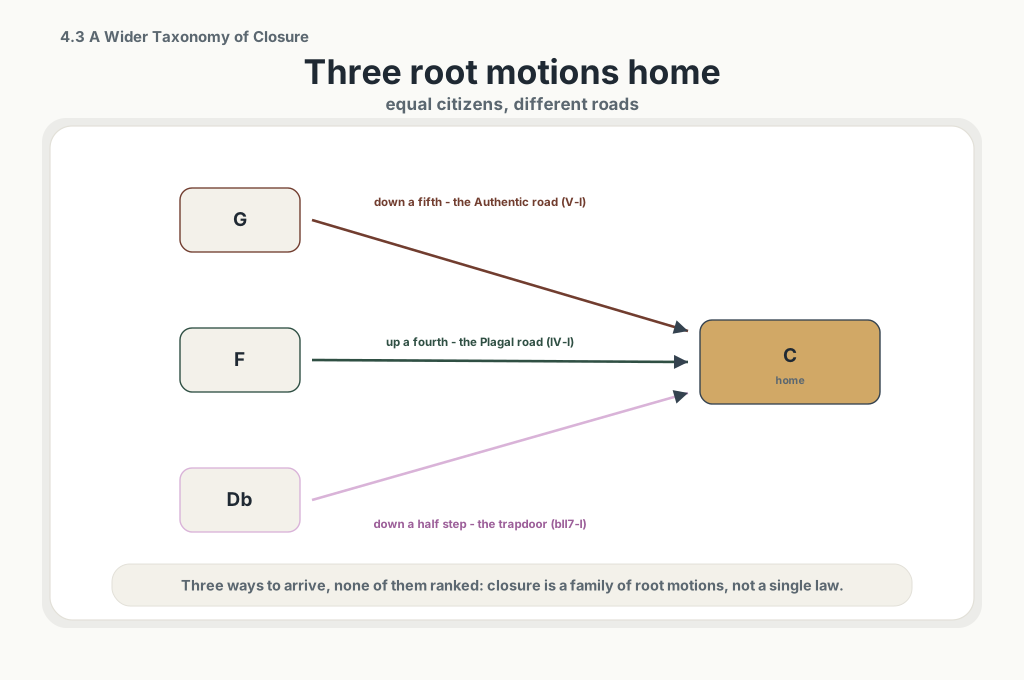
Tritone substitution thus adds another entry to our taxonomy of graded closure (Chapter 2.3). Where the Authentic Paradigm achieves closure through root motion by fifth (V→I), and the Plagal Paradigm achieves it through root motion by fourth (IV→I), the tritone substitution achieves closure through root motion by half-step (♭II→I). Three different root motions, three different colours of arrival - but all three achieve the rhetorical effect of homecoming. The hierarchy between them is not one of strength but of style.
In more complex jazz contexts, tritone substitution becomes a tool for extended harmonic exploration. Composers and improvising musicians use tritone substitution not merely as a simple chord swap, but as a harmonic lens through which to view progressions. A ii-V progression built on tritone substitution (ii-bII7) creates a sense of functional drift, where the traditional dominant function is displaced by chromatic bass motion. Steely Dan, throughout their catalogue (particularly in a song like Josie), employed this kind of sophisticated tritone substitution within more complex harmonic environments, layering tritone subs alongside other jazz techniques to create the distinctive harmonic language that defined their sound.
4.3.7Summary
Augmented sixth chords and tritone substitution represent two different historical approaches to the same harmonic phenomenon: the exploitation of the tritone’s inherent instability and its capacity to resolve smoothly through chromatic motion. In the classical era, the augmented sixth chord achieved this through strict voice-leading disciplines, carefully managed resolutions, and hierarchical harmonic function. In the jazz tradition, the same harmonic potential was liberated from those classical constraints, transformed into a flexible, endlessly applicable substitution technique.
The enharmonic equivalence between the German sixth chord and the dominant seventh - both containing the same tritone in different inversions - serves as the conceptual hinge upon which these two traditions meet. Understanding this connection deepens our grasp of harmonic function itself: functions are not absolute properties of individual chords, but relationships forged between chords within a harmonic context. A German sixth chord and a dominant seventh chord may contain identical pitches, yet serve radically different formal functions depending on the voice-leading context and harmonic language in which they appear.
As we move forward to Chapter 4.4 on enharmonic diminished seventh chords, we will see again how enharmonic reinterpretation can unlock new harmonic possibilities. The techniques we have explored here - classical voice-leading discipline and jazz harmonic flexibility - will reappear in new forms, demonstrating that many of the most powerful harmonic resources available to composers and improvising musicians emerge from the creative reinterpretation of classical foundations.
The Quantum Function - the idea that chords in jazz and modern pop exist in multiple functional states simultaneously - lurks just beneath the surface of this chapter. A German sixth chord is simultaneously a predominant and an enharmonic dominant seventh. A tritone substitution is simultaneously a ♭II7 and a disguised V7. These chords do not ‘choose’ their identity until the voice leading resolves them. In Chapter 4.6, when we encounter symmetrical scales and Neo-Riemannian transformations, this functional ambiguity will deepen into a governing principle.
Closing Reflection
The German sixth and the tritone-substituted dominant are, in the end, enharmonic versions of the same sonority wearing different clothes for different centuries. The classical composer calls it an augmented sixth and resolves it through a cadential 6/4, obeying the voice-leading etiquette of the salon. The jazz musician calls it a tritone sub and lets the bass slide down by half-step, obeying the voice-leading instinct of the bandstand. Both are right. Both are hearing the same tritone, the same pull, the same need to arrive. The only difference is the route - and the century. This is perhaps the deepest lesson of chromatic harmony: the same sounds, the same tensions, the same resolutions keep being rediscovered, generation after generation, in new contexts and under new names. The harmony does not change. Only the language we use to describe it.