In 711 AD, an army crossed the Strait of Gibraltar and brought with them a musical tradition that would outlast every empire that followed. Eight centuries later, when Ferdinand and Isabella expelled the last Moors from Granada, the music stayed. It seeped into the flamenco of the Roma, into the liturgical chant of the Spanish church, into the guitar traditions that would eventually cross the Atlantic and electrify. When Dick Dale played ‘Misirlou’ on a Fender Stratocaster in 1962, he was channelling a melodic tradition older than Western harmony itself.
This chapter is about what survived - and what it means for the way we understand closure, cadence, and the pull of home.
The musical heritage of southern Spain, particularly Andalusia (Al-Andalus), has profoundly influenced popular music through its distinctive modal qualities, harmonic progressions, and rhythmic patterns. This chapter explores the Phrygian dominant scale and related harmonic devices that create the characteristic “Spanish tinge” heard across genres from flamenco to rock, metal, and film scores. More fundamentally, we will examine how the Andalusian cadence functions as a distinct closural system with its own internal logic - not a deviation from common-practice grammar, but a complete alternative approach to harmonic closure rooted in centuries of Spanish and Mediterranean tradition.
The Phrygian Dominant Scale
The Phrygian dominant scale, also called the Spanish gypsy scale or Freygish scale, is the fifth mode of harmonic minor. As introduced in Chapter 1.4 when we encountered the harmonic minor scale and its modes, the Phrygian dominant emerges from that same parent scale with a distinctive pattern of intervals that immediately signals the Spanish tinge to listeners’ ears.
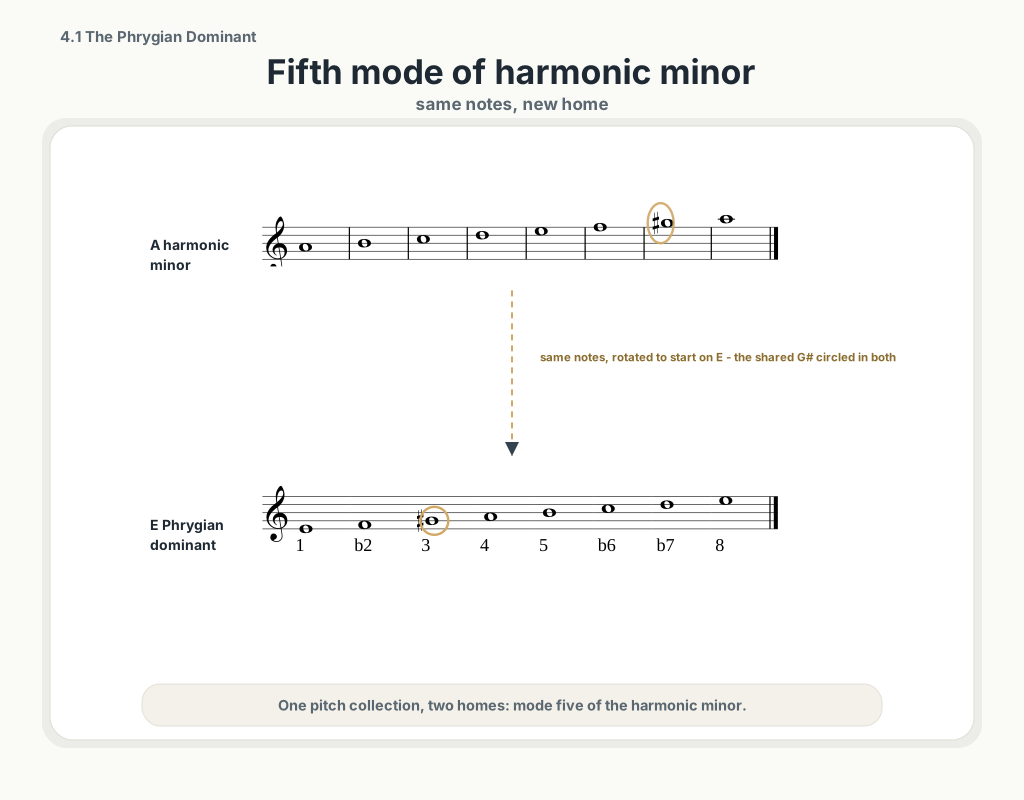
The scale features a root, followed by a minor second (b2), a major third (3), a perfect fourth (4), a perfect fifth (5), a minor sixth (b6), and a minor seventh (b7). Take E Phrygian dominant as an example: the notes are E, F, G#, A, B, C, D. This scale is neither purely major nor purely minor - it occupies a fascinating middle ground that Chapter 2.6 explored as part of our survey of modes. The Phrygian mode itself, with its characteristic minor second, here gains a major third from harmonic minor’s chromatic alteration, creating a scale that sounds both exotic and driving.
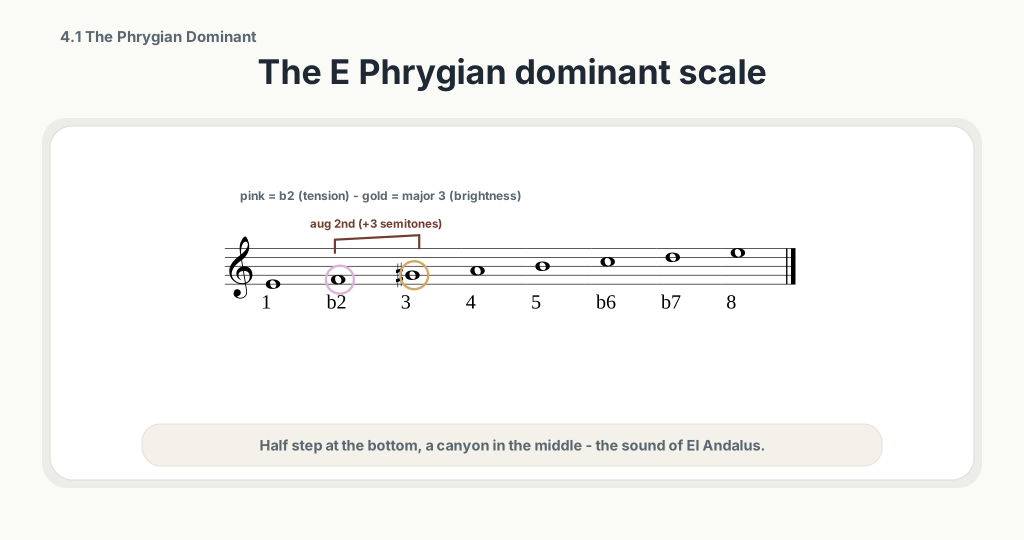
The scale’s most arresting characteristic elements deserve close attention. The minor second (b2) creates immediate tension with the tonic pitch, giving the scale a sense of unease and exotic colouring. Simultaneously, the major third (3) provides brightness and forward energy that would otherwise be muted by the minor second and minor sixth. Together, these elements create what is perhaps the scale’s most iconic feature: the augmented second interval between the b2 and the 3. In E Phrygian dominant, this leap from F to G# is unmistakable - not quite a minor second, not quite a major second, but a whole step plus a half step. This interval, rooted in flamenco and Spanish guitar tradition, has become synonymous with the “Spanish sound” in popular music globally.
The Traveller
“I once sat in a courtyard in Granada at midnight, listening to a flamenco guitarist play a single chord - E major with an F in the bass - for what felt like ten minutes. Nothing resolved. Nothing needed to. The ♭2 hung in the air like incense, and the music simply… was. I understood then that closure is not always a destination. Sometimes it is a state you inhabit.”
The Andalusian Cadence: A Distinct Closural System
The most recognizable progression derived from this Andalusian tradition is the Andalusian cadence, a descending minor tetrachord progression typically represented in Roman numerals as i–bVII–bVI–V. Played out in A minor, this yields Am–G–F–E. The progression has circulated through popular music for centuries, appearing in countless songs across genres, but it deserves reconsideration in light of how we understand closure itself.
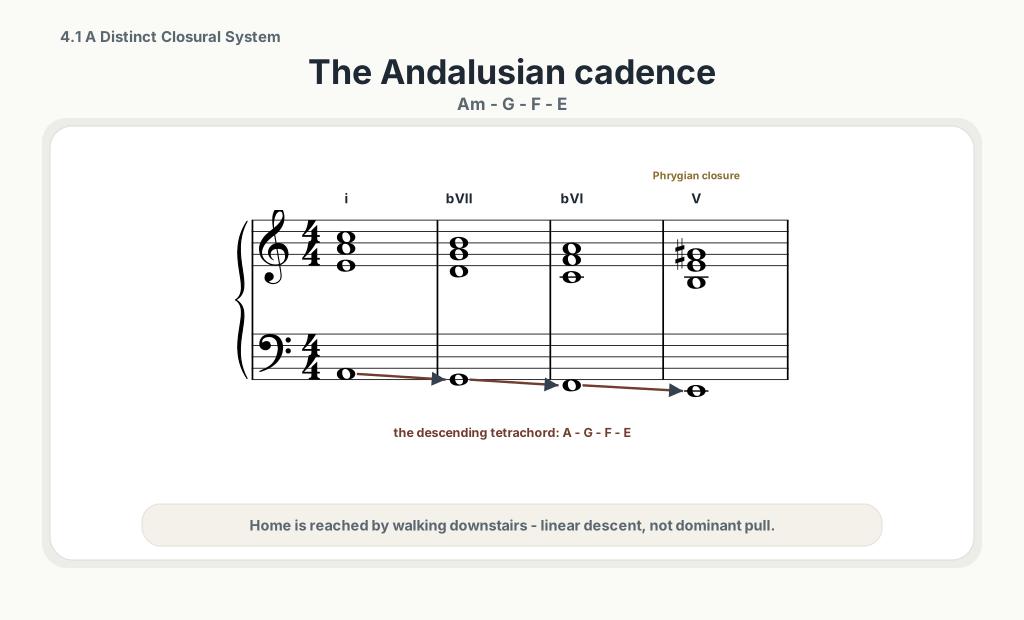
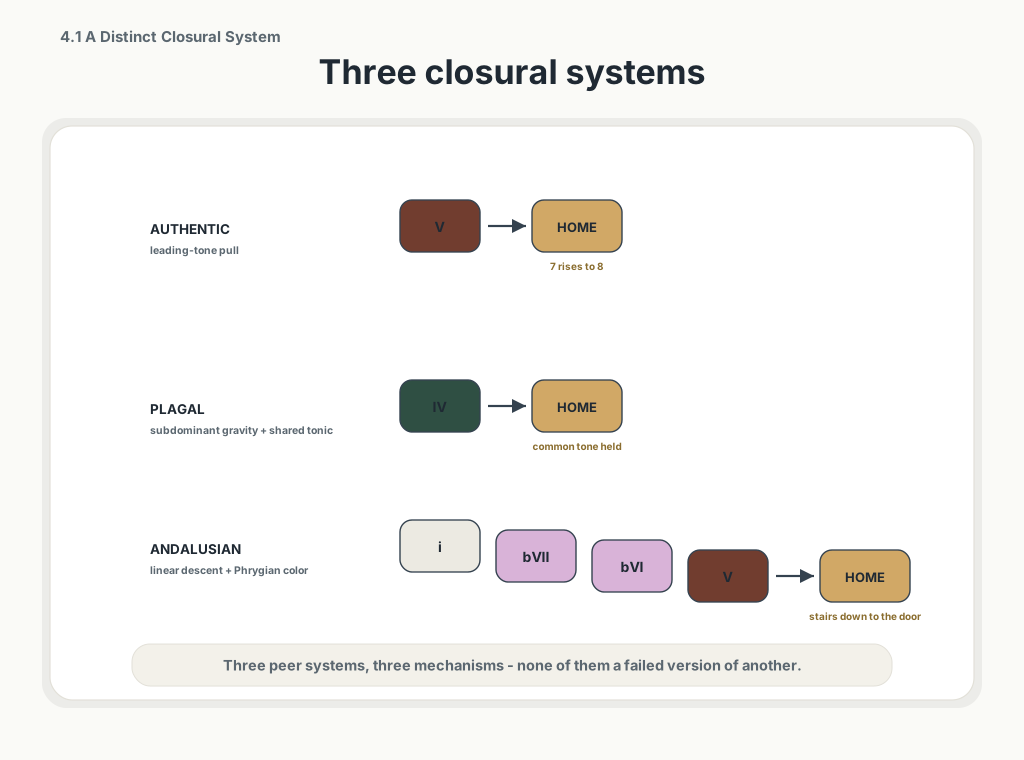
When we first encountered the Andalusian cadence in Chapter 2.5, we identified it as a chord schema - a recurring harmonic shape that carries cultural and stylistic meaning. Then, in Chapter 3.4, when we explored modal mixture and borrowed chords, we learned that the bVII and bVI chords are diatonic to the natural minor scale rather than borrowed chromatic intrusions. Here, in Chapter 4.1, those observations converge into a deeper truth: the Andalusian cadence is not a “failed” authentic cadence (V–I), nor is it a diminished plagal progression. Instead, it is a complete closural system with its own internal logic and cultural gravity.
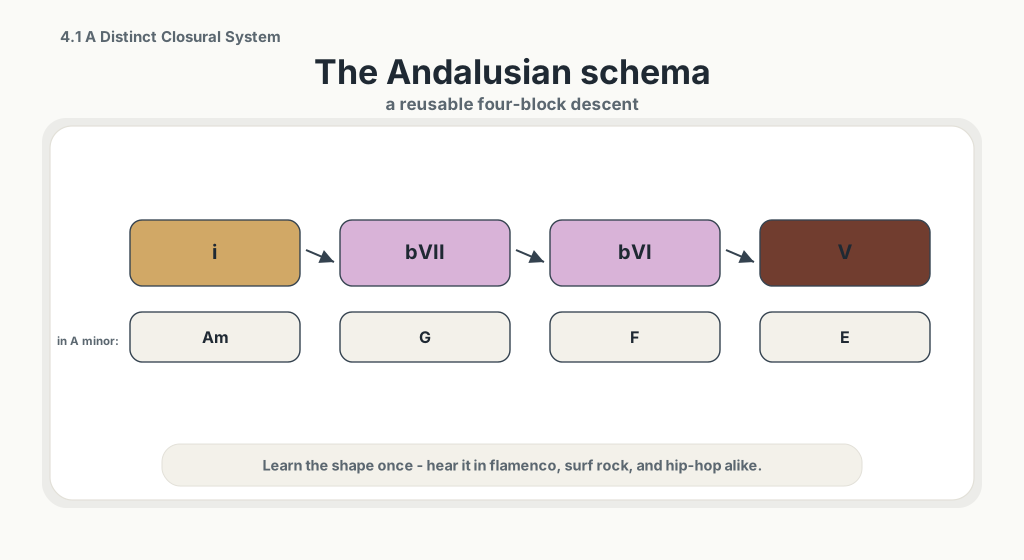
The Andalusian cadence achieves closure through the interaction of two forces. First, the linear momentum of the descending tetrachord itself - E, D, C, B in the bass (or A, G, F, E in root position) - creates the sensation of arrival through sheer downward motion. This is not the functional closure of V–I (dominant to tonic), but it is genuine closure nonetheless. Second, the final V chord (in this case, E major) functions not as a dominant seeking resolution to a tonic, but as what we might term a “Phrygian closure” or “Andalusian closure” - an arrival point that derives its strength from the Phrygian dominant scale that has coloured everything that came before. The E major chord, read through the lens of E Phrygian dominant (with its characteristic b2, the F just below), sounds like home even though it sits on the fifth scale degree. In flamenco and Andalusian-influenced music, this is exactly how closure works: not through dominant-to-tonic resolution, but through the weight of scalar and rhythmic context.
To frame this more explicitly: the Andalusian cadence is a cadential archetype parallel to the Plagal Paradigm (IV–I, also explored in Chapter 2.5). Both operate by different harmonic grammar than the V–I authentic cadence. Both achieve closure through alternative means. The Plagal Paradigm uses subdominant gravity and a shared tonic pitch; the Andalusian cadence uses linear descent and Phrygian scalar context. Neither is a substitute or variation on V–I. Each is a self-contained system.
The progression appears in countless songs that span stylistic boundaries. Hit the Road Jack (Ray Charles) places the Andalusian cadence at the song’s core, using the descending tetrachord to propel the narrative. Stairway to Heaven (Led Zeppelin) deploys it in the introductory section, where the acoustic guitar fingerpicking outlines the Am–G–F–E shape, establishing the song’s modal undercurrent. Sultans of Swing (Dire Straits) employs a variant of the cadence within its signature riff, filtered through a rock-oriented instrumental texture. Smooth (Santana) adapts the Andalusian cadence into a jazz-rock context, where the underlying modal language remains recognizable even as Latin rhythms and sophisticated harmonies are layered atop it. Each of these examples demonstrates how the same closural system - the Andalusian cadence as Phrygian closure - manifests across radically different musical contexts.
The Sage
“The Andalusian cadence descends. It does not rise toward resolution - it falls toward it. In a culture where the word ‘occident’ means ‘where the sun falls,’ there is something profoundly fitting about a cadence that finds home by descending through the scale. Every sunset is an Andalusian cadence.”
Harmonic Devices from the Spanish Tradition
Beyond the complete Andalusian cadence, the Spanish tradition offers several harmonic devices that create the distinctive tensions and colours of the Spanish tinge. These tools operate within the framework of modal mixture (Chapter 3.4) but gain their expressive power from their rootedness in Andalusian and flamenco practice.
The Phrygian II (bII Major Chord)
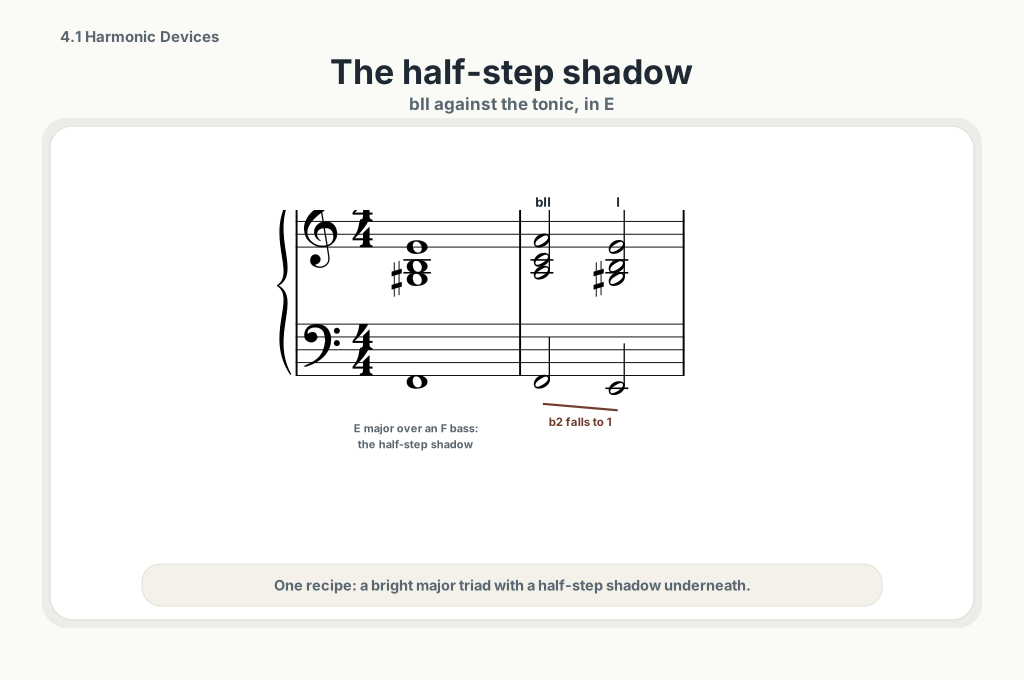
The bII major chord - a major chord built on the lowered second scale degree - is one of the most immediately recognizable tools in Spanish-influenced harmony. In E Phrygian dominant, this would be an F major chord. This harmony creates immediate tension with the tonic, mirroring the tension that the b2 interval creates within the scale itself. The bII major chord does not function as a chromatic passing chord or a borrowed harmony in the modal mixture sense; rather, it sits at the foundation of the Spanish harmonic aesthetic, stating the Phrygian character in concentrated form. In flamenco-inspired progressions, the bII often appears as a moment of maximum tension before resolution, or as an accent that punctuates a melodic phrase. It is a defining sound of the tradition.
The Spanish Dominant (V7#9 and Variants)
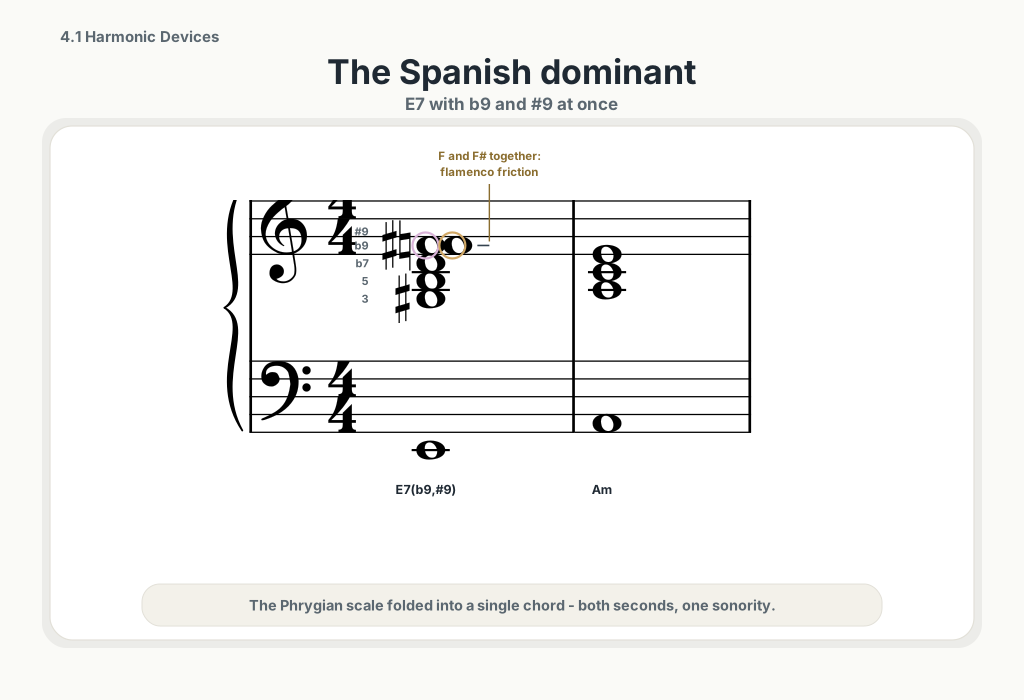
The Spanish dominant, typically notated as a V7 with both a b9 (flat-ninth) and #9 (sharp-ninth), combines the Phrygian-dominant flat ninth with a blues-inflected sharp ninth in a dominant seventh chord. An E7(b9,#9) chord in the context of A minor includes the root E, the major third G#, the perfect fifth B, the minor seventh D, and both the flat-ninth F and the sharp-ninth F𝄪 (enharmonically G). This voicing creates the characteristic flamenco tension - the simultaneous presence of F, G, and G# creates a tightly clustered colour in Western equal temperament, combining Phrygian and blues-inflected tensions. The Spanish dominant is used extensively in jazz and fusion contexts, where its harmonic richness and exotic colour make it an ideal tool for creating sophisticated, tradition-aware arrangements. The device also appears in film scores and contemporary fusion music, wherever a moment of maximum Spanish flavour is desired.
Secondary Phrygian
Secondary Phrygian involves applying the Phrygian dominant scale to secondary chords and their dominants, creating multiple layers of Spanish tinge within a single progression. Rather than confining Phrygian dominant to a single tonic (as in i–bVII–bVI–V in A minor), secondary Phrygian allows a composer to establish A Phrygian dominant leading to a D minor chord, for instance, or E Phrygian dominant functioning as a secondary colour within a different harmonic context. This technique adds harmonic complexity and creates the sensation of shifting modal planes, as discussed in the forward-looking context of Chapter 4.5 on Advanced Modulation, where Phrygian dominant motion can facilitate modulation between distantly related keys by establishing new tonal centres through scalar colour rather than functional progression.
Spanish Rhythms and Their Adaptations
The Spanish tinge extends far beyond harmony into the rhythmic domain. The flamenco tradition, in particular, has contributed rhythmic patterns and feels that have been adapted and reinterpreted across popular music genres.
Hemiola Patterns
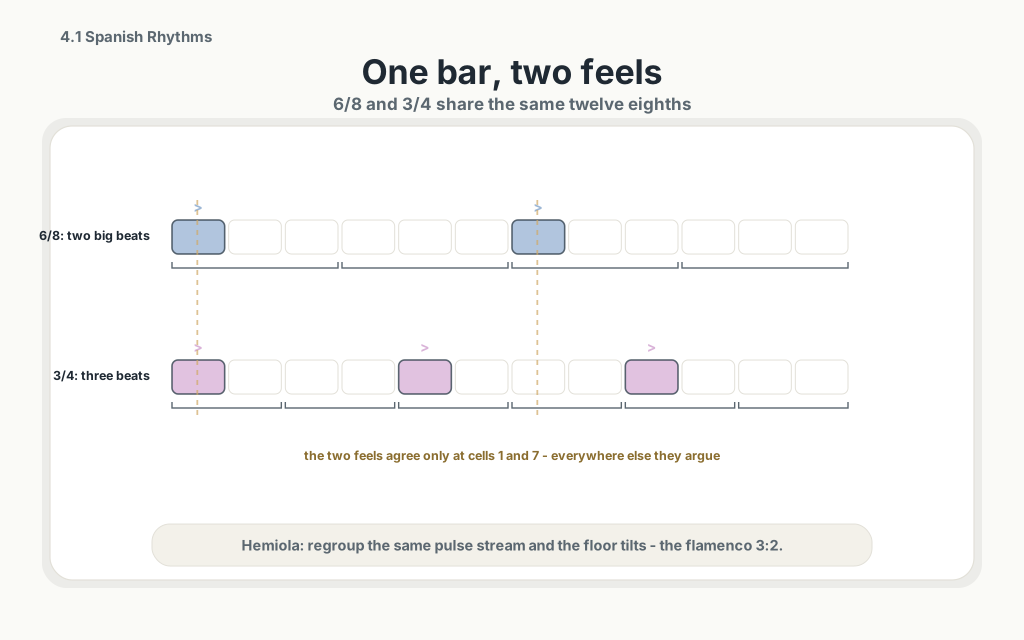
Hemiola refers to the use of 3:2 rhythmic relationships - the layering of three beats against two, or vice versa. In the flamenco context, performers regularly alternate between feels that suggest 6/8 meter and those that suggest 3/4, creating a dynamic interplay of rhythmic perspective. Rather than a metrically stable time signature, the music oscillates between these groupings, with accented patterns that reinforce now the triple, now the duple division. This cross-rhythmic sophistication has migrated into jazz, progressive rock, and contemporary classical music, where it creates the impression of polyrhythmic tension and forward motion without the metric instability that would characterize true polymeter.
Bulería Influences
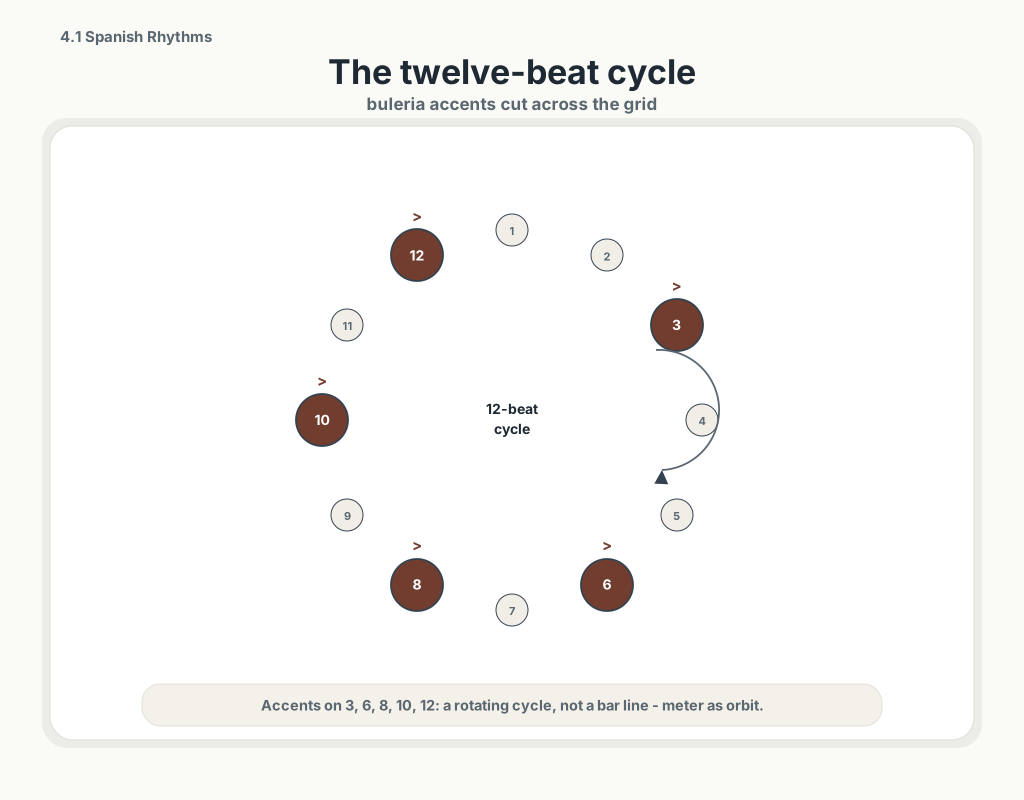
The bulería, a form of flamenco music, is built on a complex 12-beat cycle. Within this cycle, accented patterns create rhythmic peaks and valleys that drive the music forward. When adapted to rock and pop contexts - particularly in progressive rock and metal - these bulería-influenced patterns add harmonic and rhythmic sophistication. The cycles may be simplified or compressed to fit four-bar or eight-bar structures, but the essential idea remains: rhythmic accents that cut across the metric grid, creating tension and release through timing rather than through harmonic function alone.
Applications in Popular Music
The Phrygian dominant scale, the Andalusian cadence, and the various harmonic devices of the Spanish tradition have been absorbed into contemporary popular music across multiple genres. Each genre has adapted these tools in ways that reflect its own harmonic language and aesthetic priorities.
Metal and Hard Rock
Power metal and neoclassical metal have embraced the Phrygian dominant scale with particular enthusiasm. Yngwie Malmsteen’s early work, particularly his neoclassical guitar solos, draws heavily on the Phrygian dominant scale and related Phrygian modes, using high-speed alternate picking to outline scalar passages that would feel at home in a flamenco context. Marty Friedman, particularly in his work with Megadeth and his solo releases, has integrated Spanish-influenced scalar concepts with metal’s aggressive harmonic environment. The combination of harmonic minor’s natural darkness and the Phrygian dominant’s exotic colouring creates an ideal foundation for metal’s aesthetic of intensity and otherness. The Spanish tinge, filtered through electric amplification and heavy effects, becomes a marker of sophistication and instrumental mastery in the metal idiom.
Prof. Krankenhorn
“The Phrygian dominant in a heavy metal guitar solo. I suppose next you will tell me that Palestrina would have approved of power chords. The descent of Western civilization continues - fittingly, in a Phrygian direction.”
The Jester
“Palestrina never had a wah pedal, Professor. He might have liked it.”
Film Scores
Ennio Morricone’s work for spaghetti western films stands as perhaps the most iconic deployment of Spanish harmonic elements in film scoring. In these soundtracks, Spanish-influenced themes signal dramatic tension, desert landscapes, and the moral ambiguity of the genre’s protagonists. The Phrygian dominant scale and the Andalusian cadence function as shorthand for setting and atmosphere, evoking the southern Spanish and Mediterranean contexts that the westerns, through their aesthetic lineage, invoke. Contemporary film composers continue this tradition whenever a moment calls for Spanish colour - in Mediterranean-set dramas, in scenes of passion or danger, in moments where exoticism and otherness must be signalled without explicit cultural specificity.
Jazz Fusion
Chick Corea has written numerous compositions that integrate Spanish harmonic and rhythmic elements into the jazz fusion idiom. His work demonstrates how the Andalusian cadence and Phrygian dominant scales can coexist with jazz harmony’s sophisticated tertian structures, creating a hybrid language. Al Di Meola’s flamenco-influenced technique - combining classical guitar technique with jazz harmonic language - represents another approach to the same integration. The collaboration between Paco de Lucía (a flamenco master) and fusion musicians like Al Di Meola and John McLaughlin produced some of the most sophisticated treatments of the Spanish tradition in a contemporary context, demonstrating that flamenco’s harmonic concepts are not merely exotic colour but full compositional systems capable of the highest level of harmonic discourse.
The Craftsman
“Here is the practical takeaway: if you want the ‘Spanish sound’ in any key, build a major chord on any note and put a bass note one semitone below the root. That interval - root to ♭2 - is the entire flavour. Everything else is decoration. E major with F in the bass. A major with B♭ in the bass. The recipe is always the same: a major triad with a half-step shadow underneath.”
Contemporary Pop
In modern dance music, reggaeton production has incorporated Andalusian harmonic elements, particularly the use of bVII as a chord colour within loop-based structures. Contemporary pop ballads often invoke the “Spanish” sound through the deployment of Phrygian dominant scales in melodic or harmonic passages, using the tradition’s association with passion and drama to intensify emotional moments. Rodrigo y Gabriela, a modern flamenco-rock fusion duo, has brought the Andalusian cadence and Phrygian dominant scales directly into contemporary acoustic rock, demonstrating the tradition’s continuing vitality. Dick Dale’s Misirlou, often cited as a surf rock classic, layers Phrygian dominant harmonic language over a frenetic surf-rock rhythm, creating a fusion that inspired generations of guitarists to explore Spanish scalar colours. Shakira’s work incorporates Latin pop elements with Andalusian harmonic undercurrents, bringing the Spanish tradition into the global pop idiom and demonstrating the tradition’s universal adaptability.
Conclusion: The Andalusian Legacy
The Phrygian dominant scale and the harmonic devices of the Andalusian tradition represent a complete alternative approach to tonal harmony - not a deviation from the common practice, but a self-contained system with its own internal logic, historical depth, and aesthetic power. The Andalusian cadence, in particular, merits recognition as a closural archetype equal in status to the authentic cadence and the plagal cadence. By understanding the Andalusian cadence as a Phrygian closure, we move beyond seeing it as a mere stylistic ornament and recognize it as a fundamental principle of how music can signal arrival and finality. The tradition continues to evolve in contemporary music, adapted by guitarists, composers, and popular music makers who find in the Spanish tinge a source of endless creative possibility.
The Andalusian cadence is, in the end, a reminder that Western harmony did not begin with Bach. Long before the Authentic Paradigm was codified, long before V–I was crowned king of the cadences, there was a descending tetrachord in a courtyard in Córdoba, and it sounded like home. The Phrygian tradition does not ask permission from the dominant. It finds its own way down, and when it arrives, the arrival is unmistakable. Eight centuries after Al-Andalus fell, that sound is still here - in surf rock, in metal, in flamenco, in film scores, in the muscle memory of every guitarist who has ever let their hand fall from the fifth fret to the first. Some closures do not need a leading tone. They only need gravity.