2.6.1Introduction to Modality
If you've spent any time studying traditional music theory, you might have been led to believe that the entire universe of Western music is divided into two strict camps: major keys and minor keys. This binary system - often called the major/minor tonal system - has dominated classical music theory for centuries.
But if you listen closely to a lot of pop, rock, folk, and jazz, you'll quickly realize that the major/minor binary doesn't quite explain everything you're hearing. Why does the harmony in Lynyrd Skynyrd's Sweet Home Alabama (1974) sound major but feature a prominent ♭VII chord? Why does the minor groove in Santana's Oye Como Va feel brighter and more open than a traditional minor key?
The answer lies in modes.
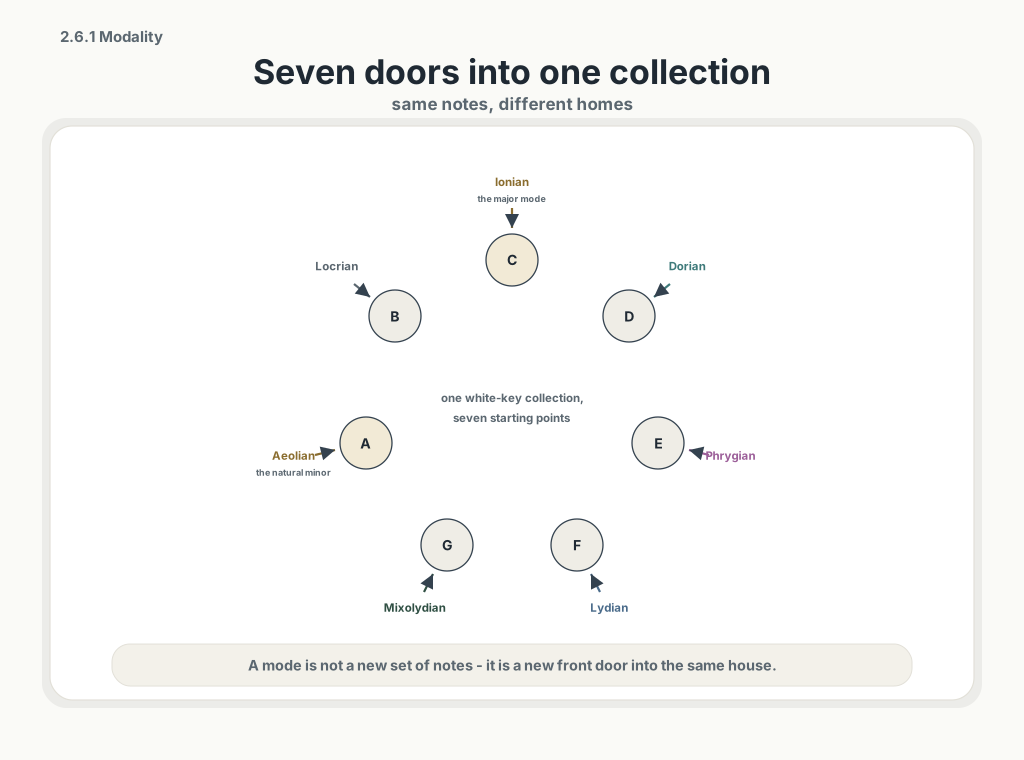
Practically speaking, a mode is just a scale. But in the context of popular music, a mode is an entire harmonic ecosystem. Long before the major/minor system was codified in European classical music, folk traditions across Europe - particularly English and Celtic - relied on a broader palette of diatonic modes.1 Today, these modes form the harmonic backbone of much of our modern popular music.
There are seven diatonic modes, but they generally fall into three categories:
Major Modes: Ionian, Lydian, Mixolydian
Minor Modes: Aeolian, Dorian, Phrygian
Diminished Mode: Locrian
Let's explore how these modes function not just as scales for soloing, but as the foundational harmonic environments for entire songs.
2.6.2Ionian (The Major Mode)
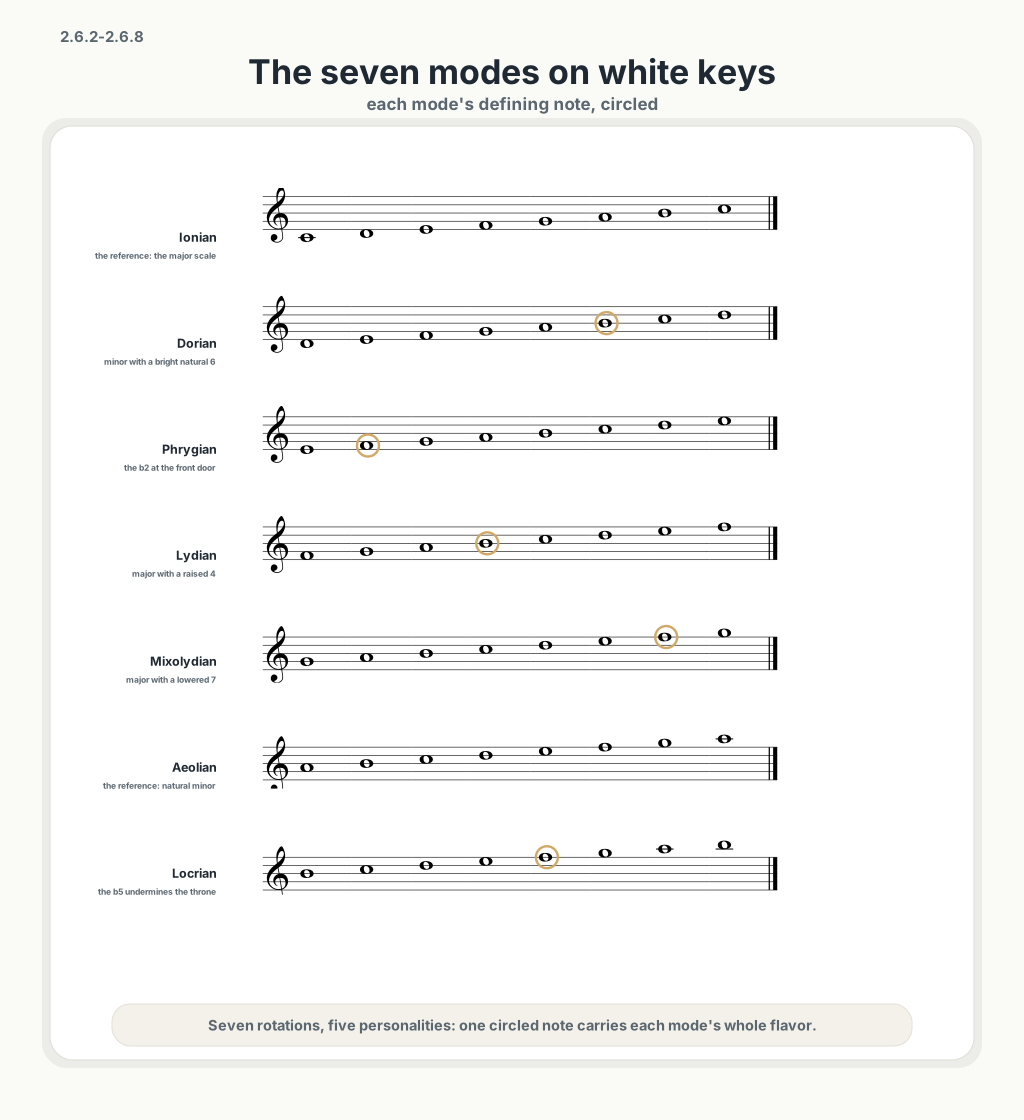
The Ionian mode is simply another name for the major scale. If a song is entirely diatonic to a major key - using only the chords naturally built from the major scale - it is functioning in the Ionian mode.
Because Ionian is the bedrock of the traditional major key system, we have already spent considerable time with it (particularly in Chapter 1.4, Scaling the Heights, and Chapter 2.4, Primary Chords). Its defining characteristic is the strong gravitational pull of the leading tone (scale degree 7̂) resolving upward by a half step to the tonic (scale degree 1̂). This creates the powerful V–I dominant-to-tonic resolution that drives so much of Western harmony - what we called the Authentic Paradigm in Chapter 2.4.
Songs like The Beatles' Let It Be (1970) and Van Morrison's Brown Eyed Girl (1967) are classic examples of Ionian harmony in action.
2.6.3Aeolian (The Natural Minor Mode)
Just as Ionian is the basis for the major key, the Aeolian mode is the basis for the natural minor key. It is a minor mode characterized by a minor third, a minor sixth (♭6̂), and a minor seventh (♭7̂).
The defining harmonic characteristic of Aeolian in pop and rock is the heavy use of the ♭VII and ♭VI chords. Because Aeolian lacks the raised leading tone of the harmonic minor scale, it does not naturally produce a major V chord. Instead, the harmony often moves through progressions like i–♭VII–♭VI (e.g., Am–G–F), creating a darker, more brooding sound without the sharp, classical V–i resolution.
You can hear pure Aeolian harmony driving the dark, propulsive progressions of U2's Sunday Bloody Sunday (1983), Jimi Hendrix's All Along the Watchtower (1968), and R.E.M.'s Losing My Religion (1991).
2.6.4Mixolydian
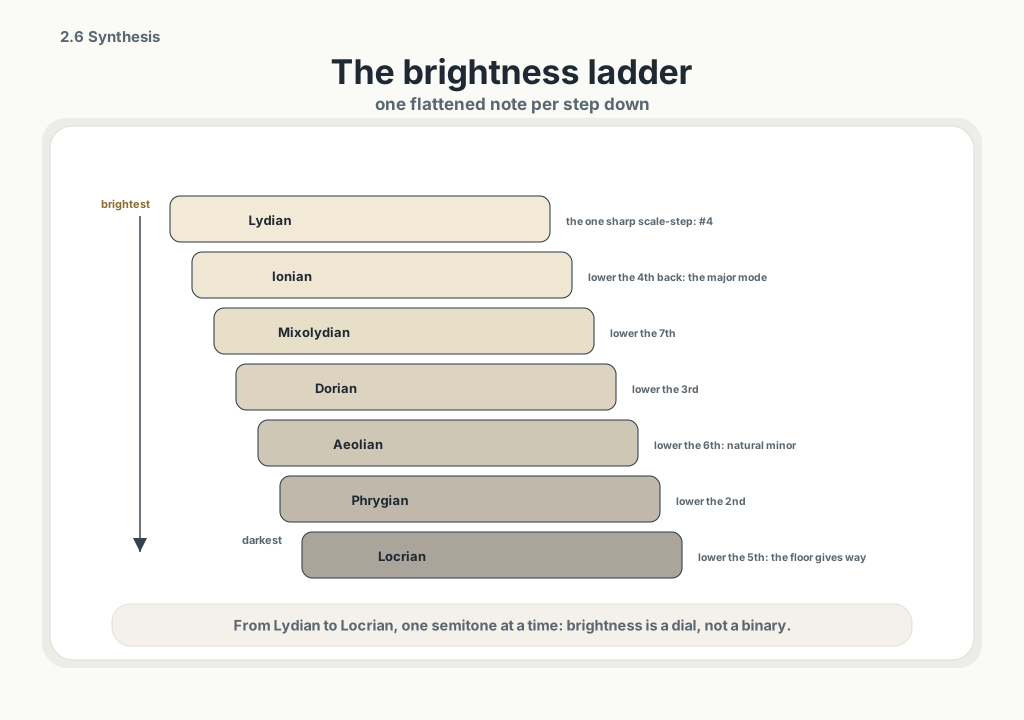
The Mixolydian mode is arguably the most important mode in rock and roll. It is a major mode, identical to the Ionian (major) scale, but with one crucial difference: it features a flat seventh (♭7̂) scale degree.
This single lowered note completely changes the harmonic landscape. Because the seventh scale degree is flattened, the leading tone is gone. The V chord becomes minor (v), and a new, powerful major chord emerges on the flattened seventh degree: the ♭VII chord.
In Mixolydian rock, the ♭VII chord often takes over the role of the dominant, pulling the harmony back to the tonic in a bluesy, less rigid way than a traditional V–I cadence. The classic Mixolydian progression is I–♭VII–IV–I, sometimes called the "double plagal" progression (which acts as a modal counterweight to the diatonic circle progressions we studied in Chapter 2.4 - Primary Chords).
Mixolydian is the sound of the 1960s and 1970s classic rock revolution. You hear it in the driving riffs of The Rolling Stones' Satisfaction (1965), the acoustic strumming of The Beatles' Norwegian Wood (1965), and the anthemic choruses of Boston's More Than a Feeling (1976). More recently, the spare, groove-oriented texture of Lorde's Royals (2013) has frequently been analyzed in terms of Mixolydian's leading-tone-free environment, though analysts have also proposed Aeolian readings - illustrating how modal ambiguity is a genuine feature of minimalist pop harmony, not merely a theoretical puzzle.
2.6.5Dorian
If Mixolydian is the king of rock, the Dorian mode is the king of groove. Dorian is a minor mode, identical to the Aeolian (natural minor) scale, but with a raised sixth (♮6̂) scale degree.
This raised sixth is the characteristic note of Dorian, and it has a profound effect on the harmony. It changes the minor iv chord found in natural minor into a major IV chord. The oscillation between the minor tonic (i) and the major subdominant (IV) is the quintessential sound of Dorian.
This i–IV vamp creates a bittersweet, floating groove that feels minor but never fully resolves into darkness. It has roots in Celtic and English folk music - “Scarborough Fair,” documented in nineteenth-century English collections, is a classic example of Dorian melody. The related ballad text is older, but the present evidence does not establish the age of the familiar Dorian tune. The Dorian i–IV sound later became foundational in funk, jazz-rock, and disco.2
You can hear the classic Dorian i–IV groove in Carlos Santana's Oye Como Va (1970), Herbie Hancock's Chameleon (1973), and Daft Punk's Get Lucky (2013). Pink Floyd's "Another Brick in the Wall, Pt. 2" (1979) also relies heavily on the Dorian sound to create its hypnotic, driving minor feel. The Dorian mode also frequently appears in minor blues, which we will explore in Chapter 3.7 (Advanced Blues).
2.6.6Phrygian
The Phrygian mode is a dark, exotic-sounding minor mode characterized by a flat second (♭2̂) scale degree.
This lowered second degree creates a half-step interval right at the bottom of the scale, giving Phrygian a tense, distinctly Spanish or Middle Eastern flavour. Harmonically, the flat second produces a major ♭II chord right next door to the minor tonic (i). The tight, grinding movement between the i and ♭II chords is the hallmark of Phrygian harmony.
Phrygian has deep roots in flamenco music, where the modo frigio shapes characteristic progressions such as the cadencia andaluza - the harmonic fingerprint of the Andalusian tradition we explored in Chapter 2.5.3 While it is rare to find an entire pop song written strictly in Phrygian, the mode is frequently used for modal colouring to inject tension or an exotic flair. It is a staple of heavy metal, where the half-step motion suits aggressive, distorted guitar riffs, as heard in Metallica’s Wherever I May Roam (1991). Outside metal, its distinct flavour appears in the iconic riff of Jefferson Airplane’s White Rabbit (1967). Its deeper cultural history will be examined in Chapter 4.1.
2.6.7Lydian
The Lydian mode is a major mode, identical to the Ionian scale but with a raised fourth (♯4̂) scale degree.
This augmented fourth (or tritone) above the root gives Lydian a bright, floating colour. Heard through an Ionian lens, ♯4̂ may pull toward 5̂; in a stable Lydian context it can instead act as a characteristic degree. Lydian often sustains that colour over a bass pedal or ostinato, though I–II motion and other progressions can also establish the mode.
Lydian is incredibly popular in film scoring, where its floating, other-worldly quality suits scenes of wonder and magic - a function exploited masterfully by John Williams in his score to E.T. the Extra-Terrestrial (1982) and countless other films. It also appears in pop and rock when a composer wants to evoke a sense of wonder or spaciousness. Joe Satriani's Flying in a Blue Dream (1989) is a famous guitar instrumental built almost entirely on Lydian harmony. The quirky opening riff of The Simpsons theme (Danny Elfman, 1989) is also famously Lydian.
2.6.8Locrian
Finally, we have the Locrian mode, the black sheep of the modal family. Locrian is a diminished mode, characterized by both a minor third and a flat fifth (♭5̂) scale degree.
Because its tonic triad is a diminished chord - which is inherently unstable and dissonant - it is almost impossible to establish Locrian as a resting tonal centre. The ear constantly wants to resolve the dissonance to a more stable major or minor key.
As a result, Locrian is almost never used for full chord progressions in popular music. It occasionally appears as a melodic colour in extremely dark or dissonant contexts - in the heavy metal of Slipknot, or in the industrial drone of Björk's Army of Me (1995), where the tritone-heavy riff evokes Locrian's characteristic dissonance without fully committing to it as a tonal centre - but it remains a rare and specialized tool.4
Suggested Exercises
The Modal Shift: Take a simple chord progression in C Ionian (C–F–G–C). Now, alter the chords to play the progression in C Mixolydian (C–B♭–F–C). How does the mood change when the leading tone is removed?
The Dorian Vamp: Set up a loop playing a minor i chord and a major IV chord (e.g., Am to D major). Improvise with A Dorian (A–B–C–D–E–F♯–G), perhaps beginning from A minor pentatonic and deliberately adding F♯ over the D chord.
Modal Listening: Listen to The Beatles' Norwegian Wood (1965). The verses are in E Mixolydian, but the bridge shifts to a different mode. Can you identify the mode used in the bridge based on the characteristic chords?
Notes
- The diatonic modes - Dorian, Phrygian, Lydian, Mixolydian, and Aeolian - predate the consolidation of major/minor tonality in the seventeenth and eighteenth centuries. They were systematized in medieval and Renaissance music theory (following the ancient Greek modal nomenclature, though the ancient and medieval nomenclatures do not map onto each other exactly) and remained the harmonic basis of chant, folk song, and polyphony until the gradual consolidation of major/minor tonality in the seventeenth and eighteenth centuries. For a thorough history, see Harold Powers et al., "Mode," in Grove Music Online, ed. Laura Macy (Oxford: Oxford University Press, 2001).
- “Scarborough Fair” appears in nineteenth-century English collections; the related ballad text is older, but the present evidence does not establish the age of the familiar Dorian tune.
- The modo frigio names the flamenco Phrygian mode; the cadencia andaluza names a related descending harmonic schema. From a minor-key starting point it may be labelled i–♭VII–♭VI–V; when the final Phrygian tonic is treated as I, the same roots may be labelled iv–III–II–I.
- Walter Everett's framework for "making sense of rock's tonal systems" classifies modal rock along a spectrum from common-practice tonal behaviour to blues-inflected pentatonic systems. Dorian, Mixolydian, and Aeolian fall under his "System 2" (diatonic modal systems with common-practice voice leading but sometimes without functional harmonic progressions), while Locrian rarely appears as a stable system at any level. See Walter Everett, "Making Sense of Rock's Tonal Systems," Music Theory Online 10, no. 4 (2004), §§3–5.
Further Reading
Everett, Walter. "Making Sense of Rock's Tonal Systems." Music Theory Online 10, no. 4 (2004). The essential taxonomic framework for understanding how rock music uses tonality and modality; Everett's six-system model (particularly Systems 1–4) provides rigorous analytical vocabulary for the mode-based harmonic environments discussed in this chapter.
Everett, Walter. The Foundations of Rock: From Blue Suede Shoes to Suite: Judy Blue Eyes. New York: Oxford University Press, 2009. The most comprehensive analytical reference for rock harmony and voice leading; contains detailed case studies of Mixolydian, Dorian, and Aeolian usage across the rock canon.
Powers, Harold, et al. "Mode." In Grove Music Online, ed. Laura Macy. Oxford: Oxford University Press, 2001. The standard reference article tracing the history of modal theory from ancient Greece through the Renaissance to its twentieth-century revival; essential context for understanding why the seven modes have the names they do.